A stored peptide fails in two ways: it loses potency, or it becomes a different molecule that still tests clean. The second is the one nobody checks for, because HPLC purity does not see it.
Which failure your vial is exposed to depends on the sequence in it, not on general handling advice. MOTS-c has two oxidation-prone methionines, oxytocin has a disulfide bridge that can open, glutathione oxidises into a dimer that is a different compound, and NAD+ is not a peptide at all. The identity questions behind all of that sit in what HPLC testing can and cannot tell you and mass spectrometry for peptides. Storage after mixing begins where reconstituting peptides step by step ends, and the volume arithmetic belongs to the reconstitution calculator.
How should a peptide be stored before and after reconstitution?
A lyophilised peptide and a reconstituted one are two different storage problems, and only the second has any labelled instruction behind it in this fact base. Tesamorelin's approved label is the single sourced in-use period available: an 11.6 mg multi-dose vial reconstituted with 1.3 mL of bacteriostatic water to 8 mg/mL, giving seven doses, with the vial discarded after seven days. Dry powder has no equivalent figure here for any compound, and the platform publishes none.
Lyophilised (dry) | Reconstituted (in solution) | |
|---|---|---|
Water present | Removed by freeze-drying | The solvent, by definition |
Hydrolysis | Not the operative route | NAD+ hydrolyses readily in solution |
Oxidation | Possible where oxidation-labile residues exist | Possible, and glutathione oxidises readily in air and in solution |
Sourced in-use period | None in this fact base, for any compound | 7 days — tesamorelin, EGRIFTA WR, BLA 022505 |
Sourced temperature figure | None | 8 °C for EPO, which degrades above it |
What the state changes | Fewer degradation routes are available | Every route that needs water becomes available |
The asymmetry in that table is the practical point. Reconstitution does not start a clock that somebody has measured; it opens chemistry that dry powder had closed. The one number with a regulator behind it belongs to one product's presentation, and borrowing it for an unlabelled compound is borrowing an in-use period that was never tested on that molecule. The preservative question that sits alongside it is separate again and handled in bacteriostatic versus sterile water.
Which storage failures pass an HPLC purity test?
Most of them, and this is the article's central finding. HPLC separates by hydrophobicity and reports peak area, so it measures homogeneity rather than identity — a vial in which every molecule has degraded the same way still returns one clean peak and an excellent purity percentage. Four compounds in this fact base carry a named, structure-specific degradation route that behaves exactly like this: MOTS-c, VIP, oxytocin and glutathione. Mass spectrometry sees all four. A purity certificate sees none.
Compound | Storage failure | Mass consequence | Caught by HPLC purity? | What catches it |
|---|---|---|---|---|
MOTS-c | Oxidation at Met1 and Met6 | +16 Da per oxidation | No — oxidised MOTS-c can still show high HPLC purity | MS showing no +16 Da adducts |
VIP / aviptadil | Oxidation at Met21 | +16 Da | No | MS showing no +16 adduct |
Oxytocin | Cys1–Cys6 disulfide reduced or scrambled | +2 Da, two hydrogen atoms | No — returns a high purity figure while pharmacologically inert | MS confirming the cyclic mass, not the linear +2 Da form |
Glutathione | Oxidation of GSH to the GSSG dimer | A different compound, not a variant | No — an excellent number against the wrong analyte | MS confirming the 307.33 Da monomer mass |
NAD+ | Hydrolysis in solution | Not peptide degradation chemistry at all | Different impurity profile entirely | Recent test date, documented cold chain |
BPC-157 | Unknown | No published stability study exists | — | Nothing; every shelf-life figure is vendor-derived |
Read that table as a statement about the test rather than about the vendors. A certificate reporting 99.4% is telling you that one species dominates the sample, which is true of a well-made vial and equally true of a vial in which that species is the oxidised form. See how to read peptide lab test results and red flags in peptide certificates of analysis for what a document can and cannot be asked to prove.
What does methionine oxidation do to MOTS-c and VIP?
Methionine oxidises readily, and each oxidation adds 16 daltons to the molecule. MOTS-c carries methionine at positions 1 and 6 of its 16-residue sequence MRWQEMGYIFYPRKLR, which gives it two oxidation-prone residues rather than one, and oxidised MOTS-c can still show high HPLC purity while being a different molecule from the one in the mouse studies. VIP has the same problem at a single site: Met21 is oxidation-prone, and the check is MS showing no +16 adducts.
Worked example — what a +16 Da shift looks like on MOTS-c
Input | Value |
|---|---|
MOTS-c free base molecular weight | 2,174.6 |
One methionine oxidised | 2,174.6 + 16 = 2,190.6 |
Both methionines oxidised | 2,174.6 + 32 = 2,206.6 |
Shift as a proportion of the molecule | 32 ÷ 2,174.6 = 1.47% |
That is an example of the arithmetic, not a specification. It also shows why the shift is easy to miss on paper: 1.47% of the mass is a rounding error next to the salt-form spread on the same compound, where free base, acetate and TFA forms run 2,174.6, 2,234.64 and 2,288.6 — a range of 114 daltons. Two different questions are being confused whenever a single "molecular weight" is quoted without saying which form was weighed, and TFA versus acetate salt forms separates them.
The consequence for storage is specific rather than general. MOTS-c is the compound in this fact base where handling most plausibly changes what is in the vial, because the sequence gives oxidation two places to happen and the routine test gives it nowhere to show. Compound background sits in MOTS-c science, per-injection volume in the MOTS-c calculator, and vendor detail on the MOTS-c compound page.
What happens when oxytocin's disulfide bridge opens or scrambles?
Oxytocin is closed by a Cys1–Cys6 disulfide bridge that forms a six-residue ring with a three-residue tail, and that bridge is the part storage can break. A reduced oxytocin — bridge broken, chain linear — differs from the intact peptide by two hydrogen atoms and will happily return a high HPLC purity figure while being pharmacologically inert. Mass spectrometry sees it; purity testing does not. Disulfide scrambling and deamidation are the other routes this structure is prone to.
Worked example — the mass gap a purity test is being asked to notice
Input | Value |
|---|---|
Intact cyclic oxytocin | 1,007.19 g/mol |
Reduced linear form | 1,007.19 + 2 = 1,009.19 |
Difference as a proportion | 2 ÷ 1,007.19 = 0.20% |
Two tenths of one per cent is the entire structural difference between an active nonapeptide and an inert one, and no chromatographic purity figure is being asked to resolve it. The platform's own data is consistent with the mechanism without proving it: the Purity Index records oxytocin at 98.96 across 53 recency-weighted tests from 14 laboratories (verified August 2026), against a platform composite of 99.50 — the lowest score of any well-tested compound tracked here, on one of the smallest test counts.
What that composite most plausibly represents, for a disulfide-bridged peptide, is oxidation products, disulfide scrambling or deamidation. That is an inference from structure rather than a measurement of cause, and it is stated as one. Oxytocin science carries the full identity picture, including the separate risk of substitution by vasopressin, which is the same backbone differing at only two positions.
Why does stored glutathione stop being glutathione?
Glutathione has the cleanest version of this problem, because its degradation product is not a damaged form of the molecule but a second molecule with its own PubChem record. Glutathione oxidises readily in air and in solution, and GSSG — two GSH molecules joined by a disulfide bond — is pharmacologically not the same thing, so a vial that has oxidised in storage can still return an excellent HPLC number against the wrong analyte. The reduced form is 307.33 g/mol; the oxidised dimer is a different compound.
That distinction changes what a buyer should be worried about on this compound. Adulteration is an unlikely failure mode for glutathione, because there is little economic reason to substitute anything for it, and handling is a likely one. The risk here is not that somebody swapped in a cheaper powder; it is that the product oxidised, or was filled inaccurately, or was never tested for endotoxin on a formulation intended for injection.
The check that resolves it is mass spectrometry confirming the 307.33 Da monomer mass rather than a purity percentage alone. Glutathione science sets out the identity data and the oral-versus-injected evidence question, which is a separate argument from this one.
Why does NAD+ behave differently from a peptide in solution?
NAD+ is not a peptide and does not degrade like one. NAD+ hydrolyses readily in solution, and the identity and purity testing conventions this platform applies to peptides do not transfer cleanly to it: HPLC still works, but the degradation chemistry is different and the relevant impurities are different. A certificate of analysis for NAD+ written in "peptide purity" language suggests the vendor has copied a template rather than tested the product in front of them.
The two handling flags that follow are a recent test date and a documented cold chain, with an old certificate and room-temperature shipping as the red flags. That is the whole of the sourced storage guidance available for this compound, and it is a document check rather than a temperature.
One market observation belongs alongside it. The NAD+ price page shows zero shops with product in stock at verification (August 2026) while the Purity Index records NAD+ at 99.07 across 306 recency-weighted tests, against the platform composite of 99.50. A compound with 306 tests on file and no current inventory anywhere is one vendors were selling, testing and have stopped listing, and the data cannot tell us why. Background sits in NAD+ and cellular energy.
Does BPC-157 have a shelf life?
Not one that anybody has measured, and this is the most-sold compound on the platform. No peer-reviewed stability or storage study of BPC-157 has been published, so every shelf-life figure in circulation is vendor-derived and nobody can cite a degradation curve for this compound. The phrase "stable gastric pentadecapeptide" that runs through the literature refers to the molecule's resistance to degradation in stomach acid, which is a biological property of the sequence. Shelf stability in a reconstituted vial is a separate question nobody has published on.
The storage advice most often attached to this compound is also wrong on its own terms. A large amount of BPC-157 handling guidance rests on the claim that the peptide is vulnerable to methionine oxidation, and the sequence contains no methionine — and no cysteine, no tryptophan and no tyrosine, none of the classically oxidation-labile residues. A vendor page building a handling protocol on methionine oxidation is describing a residue this molecule does not contain.
What follows is narrower than either the reassurance or the alarm. General handling practice applies to BPC-157 as it does to any lyophilised peptide, and a specific expiry presented as measured is presented on evidence that does not exist. BPC-157 science and where to buy BPC-157 both treat that absence as the finding rather than a footnote.
How long does a reconstituted vial last, and what sets the limit?
Three different things are routinely confused here, and only one of them is a measured shelf life. An in-use period is set by an approved label, a preservative addresses microbial growth between entries, and a degradation curve describes what the molecule does over time — tesamorelin's label supplies the first, bacteriostatic water supplies the second, and no compound in this fact base supplies the third. The sourced figure is seven days, and it belongs to EGRIFTA WR rather than to peptides in general.
What sets it | The mechanism | Sourced figure available |
|---|---|---|
Approved in-use period | A regulator wrote it into the label | Yes — 7 days, tesamorelin, EGRIFTA WR |
Preservative | Benzyl alcohol inhibits growth between entries | Named in the label at 1.3 mL into an 11.6 mg vial |
Degradation curve | The molecule changing chemically over time | None, for any compound here |
Cold-chain threshold | Loss of activity above a temperature | 8 °C for EPO, which degrades above it |
Vendor expiry date | A number on a document | Not a measurement where no stability study exists |
Borrowing tesamorelin's seven days for an unlabelled compound is the specific error, because that figure describes one presentation of one molecule reconstituted with one diluent volume. For a compound like BPC-157 there is nothing to replace it with. Material that has already travelled through a shipping route carries a further unknown, covered in peptide shipping, cold chain and customs, and material that is about to travel again in travelling with research peptides.
Does freezing, thawing or light exposure damage a peptide?
This platform holds no sourced answer, and says so rather than filling the gap. No freeze-thaw study, photostability study or storage-temperature range for any peptide appears in this fact base, so every specific figure in circulation — cycles tolerated, degrees, hours of light exposure — is convention rather than measurement, and Peptigrity publishes none of them. The one temperature with a source attached is EPO's, which degrades above 8 °C, and EPO is a recombinant protein rather than a synthetic peptide.
Storage parameter | What it is claimed to control | Where the figure comes from |
|---|---|---|
Lyophilised storage temperature | Rate of degradation in dry powder | Not sourced — convention only |
Reconstituted storage temperature | Rate of degradation in solution | Not sourced — refrigeration after mixing is handling practice |
Number of freeze-thaw cycles | Physical stress on the molecule | Not sourced — no study located |
Light exposure | Photodegradation of light-labile residues | Not sourced — no photostability data located |
Agitation and shaking | Denaturation or aggregation | Not sourced here — see our dedicated article |
In-use period after mixing | Microbial and chemical limits | Approved label — tesamorelin, 7 days |
Cold-chain threshold | Loss of biological activity | Sourced — EPO degrades above 8 °C |
Oxidation of a named residue | Change of molecular identity | Sourced — MOTS-c Met1/Met6, VIP Met21, +16 Da each |
Two honest points follow from that column. Marking something unsourced is not the same as saying it does not matter, and a mechanism can be real while its numbers are invented — a reader should treat "not sourced" as an instruction to stop trusting the decimal places, not as permission to ignore the parameter. The shaking question has its own treatment in does shaking damage peptides, and the mechanical handling steps that come before storage in reconstituting peptides step by step.
Which storage errors actually change the molecule?
The errors worth naming are the ones with a chemical consequence rather than a tidiness consequence, and they cluster on a small number of compounds. Oxidation-labile sequences, disulfide-bridged sequences and NAD+ are where handling plausibly changes the contents of the vial; everything else on this list is a documentation failure that makes a good vial unusable rather than a bad one. Both categories end the same way, with material you cannot make a dose from.
Treating a purity certificate as evidence of intact structure. A single clean peak is consistent with a fully oxidised sample. Purity measures homogeneity, not identity.
Applying general storage advice to a specific sequence. MOTS-c has two methionines and BPC-157 has none. The same protocol is doing different work in each vial.
Building a handling protocol on methionine oxidation for BPC-157. The sequence contains no methionine, cysteine, tryptophan or tyrosine.
Quoting a shelf life for a compound with no stability study. For BPC-157 there is no published study, so any specific expiry is vendor-derived.
Borrowing tesamorelin's seven-day in-use period for an unlabelled compound. That figure belongs to EGRIFTA WR, not to peptides.
Leaving a reconstituted vial without a written date and concentration. Neither can be reconstructed afterwards, and both are needed before a dose can be calculated.
Reading "stable gastric pentadecapeptide" as a shelf-life claim. It describes acid resistance in the gut, a property of the sequence rather than of your vial.
Assuming a peptide certificate covers NAD+. NAD+ hydrolyses in solution and has a different impurity profile; peptide purity language on its certificate suggests a copied template.
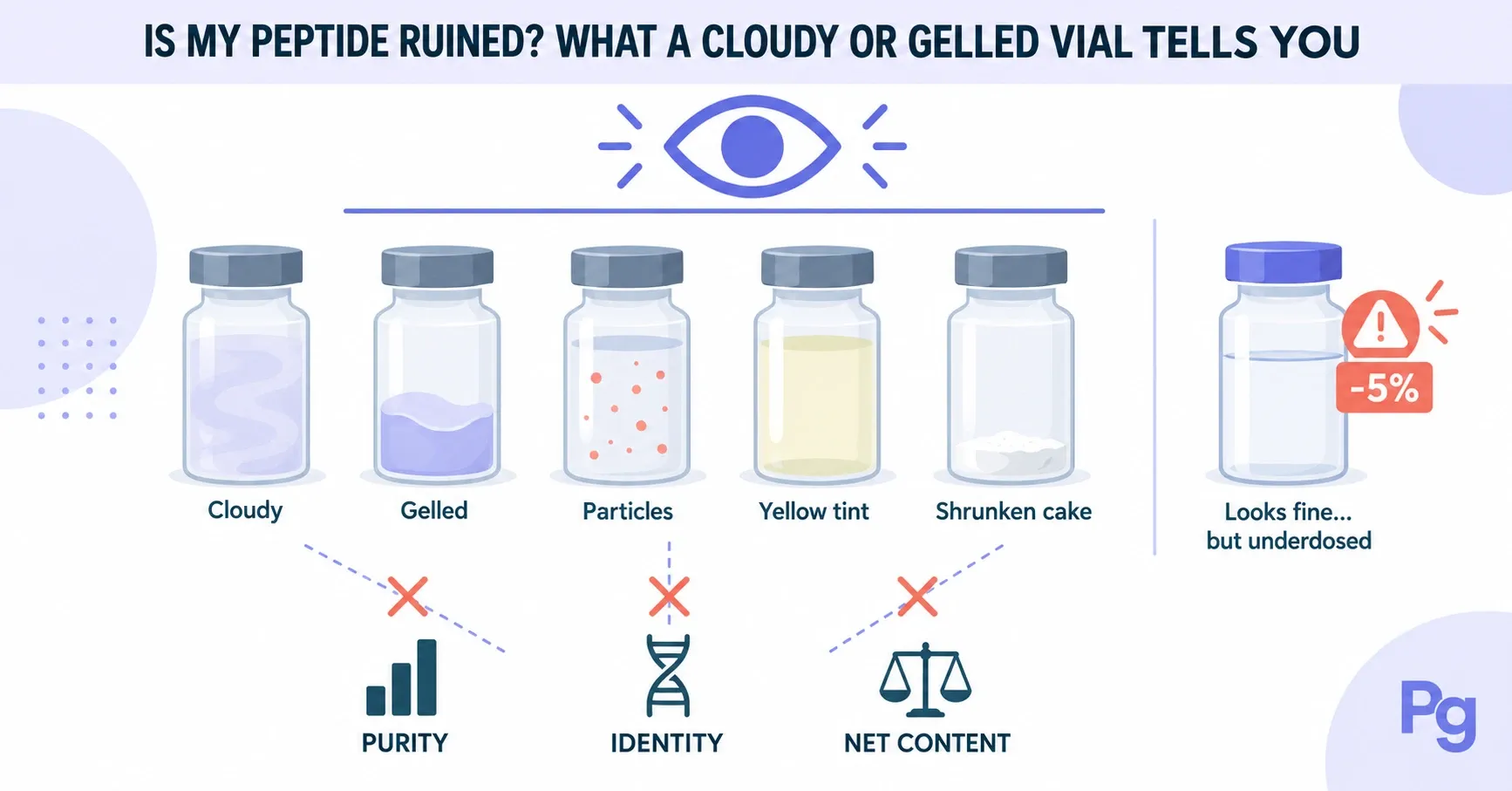
Injecting a cloudy or particulate solution. Inspect before drawing. This is the only degradation signal visible without instruments, and most of the ones on this page are invisible.
Assuming labelled milligrams are peptide milligrams. Fill variance and salt form are fixed before you open the vial, and no storage protocol corrects them. See why 10 mg isn't 10 mg.
How do you check a vial before you draw from it?
Eight checks separate a vial you can dose from one you cannot, and only two of them are visual. Clarity and a written concentration are the ones you perform at the bench; the other six are read off a certificate, because the degradation routes on this page produce no visible change and no movement in a purity percentage. Each resolves to a yes or a no, and each catches a failure the next check cannot.
Check | What it confirms | How | Red flag |
|---|---|---|---|
Concentration and date on the vial | An in-use period is knowable at all | Read it before drawing | An open vial with neither written on it |
Solution clarity | Nothing has precipitated or come out of solution | Hold it to the light before drawing | Particles, cloudiness or discolouration |
Mass spectrometry on the certificate | The molecule is the intact form, not a variant | Read the MS mass, not the purity percentage | Purity quoted alone on an oxidation-prone sequence |
No +16 Da adduct | Methionine has not oxidised | MS on MOTS-c (Met1, Met6) or VIP (Met21) | A certificate reporting only area percent |
Cyclic mass, not the linear +2 Da form | Oxytocin's Cys1–Cys6 bridge is intact | MS confirming 1,007.19 rather than 1,009.19 | A high HPLC figure presented as proof of activity |
Monomer mass at 307.33 Da | Glutathione has not oxidised to GSSG | MS confirming the monomer | An excellent purity number against the wrong analyte |
Certificate date and shipping route | The material was tested recently and handled cold | Read the date; ask how it travelled | Old CoA and room-temperature shipping — the NAD+ flags |
Any stated shelf life | Whether a measurement exists behind it | Ask which study produced it | No published stability study exists for BPC-157 |
Six of those eight rows are questions for a document rather than for a vial, which is the practical shape of this subject. A reader holding a reconstituted vial can confirm that it is clear and that they wrote a date on it, and nothing further without an instrument. Everything else had to be established before purchase, which is what how to verify peptide quality before you buy is for.
Which storage claims survive the evidence?
Three of these ten claims are supported by a source, and all three are structural chemistry rather than storage protocol. Methionine oxidation at named positions, disulfide reduction on oxytocin and glutathione's oxidation to GSSG are documented in this fact base; the temperature, freeze-thaw and light figures in general circulation are not. The distinction the table draws is between false and untested, which are different verdicts with different consequences.
Claim | Evidence | Verdict |
|---|---|---|
Oxidation can change a peptide without changing its purity figure | MOTS-c Met1/Met6, +16 Da each; VIP Met21 | Correct — structurally documented |
A broken disulfide bridge passes HPLC | Reduced oxytocin differs by two hydrogen atoms, +2 Da | Correct — MS required |
Oxidised glutathione is still glutathione | GSSG is a different compound from GSH at 307.33 Da | False |
NAD+ can be handled like a peptide | NAD+ hydrolyses readily in solution; different impurity profile | False |
BPC-157 needs special handling against methionine oxidation | The sequence contains no methionine | False |
BPC-157 has a known shelf life | No published stability study exists | Unsourced — every figure is vendor-derived |
A reconstituted vial has a general in-use period | The one labelled period is 7 days, tesamorelin only | Applies to one product, not to peptides |
A specific storage temperature is required | No temperature range sourced for any peptide here | Convention only |
A specific number of freeze-thaw cycles is tolerable | No study located | Not sourced |
Cold chain matters for a recombinant protein | EPO degrades above 8 °C | Correct — measured threshold |
What do 11,852 independent lab tests say about degradation?
Less than a reader would hope, and the limitation is worth publishing. Peptigrity tracks 530 shops and 11,852 independent lab tests across 118 peptides, with 1,283 community reviews (verified August 2026), and trust scores weight community reviews and independently verified HPLC purity equally at 50% each — but an index built from HPLC purity is structurally blind to the oxidation, reduction and dimerisation failures this page describes. Our largest dataset cannot measure its own subject.
Compound | Purity Index | Test depth | What the number can and cannot show |
|---|---|---|---|
MOTS-c | 99.43 | 494 recency-weighted tests, 23 laboratories | Cannot distinguish oxidised from unoxidised MOTS-c |
Oxytocin | 98.96 | 53 recency-weighted tests, 14 laboratories | Lowest of any well-tested compound here; composite consistent with oxidation, scrambling or deamidation |
Glutathione | 99.56% average | 105 independent tests across 224 shops, range 99.19% to 100.00% (verified May 2026) | Cannot distinguish GSH from GSSG |
BPC-157 | 99.37 | 588 recency-weighted tests, 23 laboratories | Nothing about shelf life — no stability study exists |
NAD+ | 99.07 | 306 recency-weighted tests | Peptide-purity conventions do not transfer cleanly |
Platform composite | 99.50 | Across 118 peptides | A homogeneity benchmark, not a stability benchmark |
Price context sits alongside those figures rather than inside them. MOTS-c price data shows 72 shops in stock at a median of $4.50/mg (verified August 2026), oxytocin price data shows 32 shops in stock at a median of $6.00/mg with no lowest tracked price published because we do not have one, and glutathione price data shows 38 shops in stock, median $0.054/mg, lowest $0.017/mg on a 1,500 mg vial at $25.00 (verified 8 August 2026). Those figures exclude shipping, taxes and customs, coupon codes, bulk tiers, multi-vial kits and account-gated pricing.
Those certificates are ones vendors chose to publish, which is a selection-biased sample rather than a random survey, and it remains the largest analytical dataset available on this market. Individual results with the testing laboratory named sit in the lab test database, and per-compound averages in the Purity Index.
The trial that would settle this
No stability study exists for any compound on this page, and the design that would produce one is ordinary rather than ambitious. The study that would settle peptide storage places identical vials at defined temperatures in both states, dry and reconstituted, and assays them over time by mass spectrometry rather than HPLC — because the failures at issue are mass shifts of 16 and 2 daltons that a purity percentage cannot resolve. Nothing about that is difficult. It has simply never been run on this market's compounds.
Element | Requirement | Why it is the gap |
|---|---|---|
Design | Prospective stability study, defined conditions, timed sampling | No published stability study exists for BPC-157 or the others here |
Arms | Lyophilised versus reconstituted, at each temperature tested | Only the reconstituted state has any labelled figure |
Primary assay | Mass spectrometry, not HPLC purity | The failures are +16 Da and +2 Da shifts |
Compounds | MOTS-c, oxytocin, glutathione, BPC-157 | Two methionines, one disulfide, one dimerising tripeptide, one blank |
Secondary arms | Freeze-thaw cycles, light exposure, agitation | Not sourced anywhere — pure convention |
Duration | At least the 7 days tesamorelin's label allows, and beyond it | The only in-use period here with a regulator behind it |
Closest existing evidence | The EGRIFTA WR reconstitution instruction | An instruction, not a degradation curve |
Frequently Asked Questions
Does a high purity result mean my vial has not degraded?
No. HPLC separates by hydrophobicity and reports peak area, so it measures how homogeneous a sample is rather than what the sample is. A vial in which every molecule has oxidised the same way still produces one clean peak. Mass spectrometry is the test that resolves a +16 Da or +2 Da shift.
Which peptides are most vulnerable to oxidation in storage?
The ones carrying oxidation-labile residues. MOTS-c has methionine at positions 1 and 6, and VIP has methionine at position 21, each oxidation adding 16 daltons. Oxytocin's vulnerability is different in kind, a Cys1–Cys6 disulfide bridge that can reduce or scramble, and glutathione oxidises into GSSG, a separate compound.
How long does a reconstituted vial last?
Only one compound here has an answer with a regulator behind it. Tesamorelin's approved label gives seven doses from an 11.6 mg vial reconstituted with 1.3 mL of bacteriostatic water and instructs discarding it after seven days. That figure belongs to that product, and no equivalent labelled period exists for the research-market compounds on this page.
What temperature should peptides be stored at?
Peptigrity does not publish one, because no storage temperature range for any peptide appears in this fact base. The single sourced temperature is EPO's, a recombinant protein that degrades above 8 °C. Any specific figure you are quoted for a synthetic peptide is convention rather than measurement, and should be treated as such.
Does BPC-157 need special storage handling against oxidation?
Not for the reason usually given, because the sequence contains no methionine, no cysteine, no tryptophan and no tyrosine. Handle it as you would any lyophilised peptide, and be aware that no published stability study for this compound exists, so any specific shelf-life figure you are quoted comes from the seller rather than from measurement.
Can I tell by looking whether a vial has gone bad?
Rarely. Cloudiness, visible particles or discolouration are worth acting on and worth inspecting for before every draw, but the degradation routes described on this page produce no visual change at all. An oxidised MOTS-c solution and an intact one look identical, which is why the check that matters is a mass spectrum rather than an inspection.
Where storage ends and the certificate begins
Storage decides one thing: whether the molecule you received is still the molecule when you draw it. It does not decide whether the vial contained the right compound, the right amount, or anything resembling the label — those were settled before it arrived, and no handling protocol reaches backwards to fix them. What this page can state with a source is narrow: two methionines on MOTS-c, one disulfide on oxytocin, a dimer for glutathione, hydrolysis for NAD+, and for BPC-157 a blank where a stability study should be.
Browse the immune support and longevity peptides category, or our complete peptide guide with 118 compounds (verified August 2026). For per-injection volume, use the MOTS-c calculator alongside the reconstitution calculator, and settle the mixing step in reconstituting peptides step by step. Hardware sits in peptide injection equipment and technique in how to inject peptides. Compare shops through independent lab tests and community-verified shop reviews.
This article is for educational and informational purposes only and does not constitute medical advice. Peptides discussed may be investigational compounds not approved by the FDA (or equivalent regulators in your jurisdiction) for human use. Always consult a qualified healthcare provider before using any peptide or research compound. Peptigrity is an independent review platform and does not sell, endorse, or recommend specific products or vendors.