Reconstitution is a five-minute procedure with three points of failure: contamination, a diluent volume that makes the dose unmeasurable, and a vial nobody dated. All three are avoidable, and none of them announce themselves.
This page is the procedure, not a reason to use anything. Peptigrity is an independent review platform and does not sell peptides. Work out the diluent volume first with the reconstitution calculator, the bacteriostatic water calculator and the peptide dosing calculator, and see how to calculate peptide doses for the arithmetic behind that choice.
What do you need before you reconstitute a peptide vial?
You need four things on the surface before the first stopper is swabbed: the lyophilised vial, the diluent, a sterile syringe and needle for the transfer, and alcohol swabs. You also need two numbers decided in advance — the diluent volume you intend to add, and the concentration that will produce. Deciding the volume after the powder is wet is not possible, because the water is already in and the concentration is already fixed.
Item | Purpose | Decided in advance? |
|---|---|---|
Lyophilised peptide vial | The mass in the calculation | Label mass, salt form and any assayed quantity |
Diluent | Dissolves the powder and sets the volume | Bacteriostatic or sterile water, per the section below |
Transfer syringe and needle | Moves diluent into the vial | Sized to hold the full volume in one draw where possible |
Alcohol swabs | Decontaminates both stoppers | At least two |
Sharps container | Disposal at the end | In place before you start |
Label or marker | Records concentration and date | The concentration you calculated |
Two of those rows carry more weight than their length suggests. The sharps container belongs on the surface before the first needle comes out of its wrapper, because the moment you need it is not the moment to go looking for it — see how to dispose of peptide syringes and sharps safely. And the marker matters as much as the syringe: an open vial with no concentration written on it is a vial whose doses cannot be calculated, no matter how carefully it was mixed.
Read the certificate before you read the protocol. The salt form and any net peptide content figure change the mass you are actually dissolving, which changes the concentration, which changes every dose drawn afterwards — the mechanism is set out in why 10 mg isn't 10 mg. Equipment choices are covered in peptide injection equipment.
How do you reconstitute a peptide vial step by step?
The procedure is eleven steps, and the order matters at three of them. Swab both stoppers and let them dry, draw the calculated diluent volume, angle the needle so the stream runs down the inside glass wall, then leave the vial still until the powder dissolves. Swirl gently only if it needs help. Label the vial with concentration and date before it goes anywhere, and put the transfer needle in the sharps container rather than back in its cap.
Wash and dry your hands, and clear a flat working surface with nothing else on it.
Bring the peptide vial to room temperature if it has been refrigerated, and leave the flip cap in place while it does.
Remove both flip caps and swab both rubber stoppers with alcohol — the diluent vial and the peptide vial. Let them air dry rather than wiping them.
Attach a sterile needle to the transfer syringe and draw your calculated volume of diluent. Do not touch the needle or the swabbed stoppers with anything.
Check the volume in the barrel against your calculation before the needle goes anywhere near the peptide vial. This is the last point at which an arithmetic error is free to fix.
Insert the needle through the peptide vial's stopper at an angle, so the tip points at the inside glass wall rather than straight down at the powder.
Depress the plunger slowly and let the diluent run down the wall. If the vial is under vacuum it will pull the liquid in on its own — keep a thumb on the plunger so the stream stays slow and controlled rather than jetting in.
Withdraw the needle and dispose of it in the sharps container. Do not recap it, and do not reuse it for the injection.
Leave the vial standing still and let the powder dissolve. Most lyophilised material goes into solution without help.
Swirl gently, in the vial's own plane, only if undissolved material remains. Do not shake, and do not invert repeatedly.
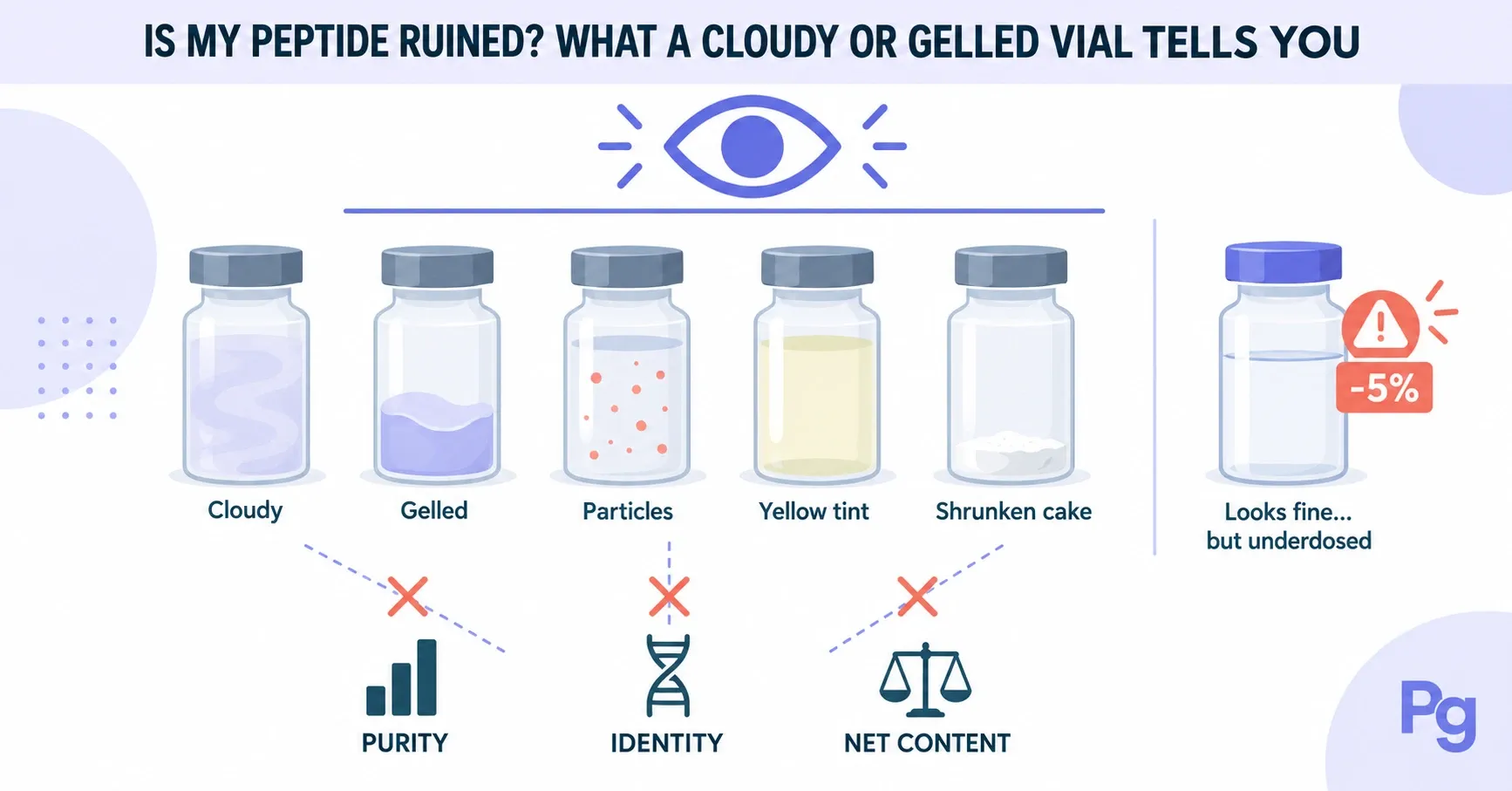
Inspect, then label. The solution should be clear with no visible particles. Write the concentration and the date of reconstitution on the vial, then refrigerate.
Step 5 is the one people skip and the one that cannot be undone. Once the diluent is in, the concentration is fixed for the life of the vial: adding more later invalidates every dose calculated before it, and there is no way to remove it. Run the figure through the reconstitution calculator before the needle is loaded, not after.
Step 11 is the one people skip and then regret quietly. A vial with no concentration written on it forces you to reconstruct the arithmetic from memory each time, and a vial with no date makes the in-use period unknowable. The peptide log sheet is a place to keep both.
Why does the diluent run down the vial wall instead of onto the powder?
Running the diluent down the glass is about how the liquid enters, not about where it lands. A stream jetted directly onto the powder drives liquid through the air-liquid interface under pressure and generates foam, and foam is the visible sign of a peptide solution being agitated at its surface. Directing the stream at the inside wall lets it arrive as a film that runs down and pools under the powder instead. The technique costs nothing and removes a variable.
The practical consequences are immediate regardless of any chemistry. Foam takes time to settle, and until it does you cannot inspect the solution for clarity or particles, which is step 11. Foam also sits at the top of the vial where a needle enters, so a vial drawn from too early can pull air rather than solution. And a forceful stream can spray powder up the walls above the liquid line, where it stays dry and undissolved and quietly reduces the amount actually in solution.
There is one honest limit on this section. Whether surface agitation degrades a given peptide, and by how much, is a separate empirical question from whether the technique is worth using — and it is examined on its own terms in does shaking damage peptides. This page gives the procedure. That page gives the argument, and it is not restated here.
Should you swirl the vial or shake it?
Swirl, and only if the powder needs help. Most lyophilised peptide dissolves without any agitation at all if the vial is left standing, which makes swirling a fallback rather than a step. A swirl keeps the liquid moving within its own plane and does not repeatedly drive it through the air-liquid interface; shaking and repeated inversion do exactly that, and produce the foam described above. The difference is a handling choice with no cost attached.
Two things follow for the procedure itself. Patience substitutes for agitation — a vial left alone for a few minutes usually resolves what a shake would have been reaching for. And undissolved material after a gentle swirl is information, not a prompt to swirl harder. Particles that will not go into solution are a reason to stop and inspect rather than to escalate the force, and the inspection step exists for that.
Whether shaking measurably damages any specific peptide is the question Peptigrity examined in does shaking damage peptides, and that analysis is not duplicated here. The procedural recommendation on this page stands on its own footing: swirling achieves the same dissolution, produces no foam, and leaves you able to inspect the vial immediately.
How much diluent should you add?
There is no standard volume, and where an approved label states one, that is the number. Tesamorelin's current label specifies 1.3 mL of bacteriostatic water into an 11.6 mg vial to give 8 mg/mL, from which a 1.28 mg daily dose is 0.16 mL, or 16 units. For a research vial with no label, the diluent volume is your choice, and the useful criterion is that it puts your intended dose at a readable number of graduations on the syringe you own.
Compound | Route | Amount | Frequency | Duration | Evidence level |
|---|---|---|---|---|---|
Tesamorelin | Subcutaneous | 1.28 mg from an 11.6 mg vial at 8 mg/mL | Once daily | Indefinite; discard vial after 7 days | Approved label (BLA 022505) |
Semaglutide | Subcutaneous | 0.25 mg escalating to 2.4 mg | Once weekly | Chronic | Approved label |
PT-141 | Subcutaneous | 1.75 mg in 0.3 mL, fixed-dose autoinjector — no reconstitution | Max 1 per 24 hours | "More than 8 doses per month is not recommended" | Approved label |
Research-market vial | Chosen by the buyer | Chosen by the buyer | Chosen by the buyer | Chosen by the buyer | Varies — often no human dose-ranging study |
The tesamorelin row is worth reading twice, because it contains a change most guidance has not caught up with. The 11.6 mg multi-dose presentation arrived through supplement SUPPL-20 in March 2025 and lowered the daily dose from 1.4 mg to 1.28 mg. Instructions written for the older 2 mg single-dose vial specify the wrong diluent volume and the wrong concentration, and the error survives every subsequent step. The tesamorelin calculator works from the current figures.
For an unlabelled vial the arithmetic is short. Concentration is mass divided by volume, so a 10 mg vial in 2 mL gives 5 mg/mL and a 250 microgram dose is 0.05 mL — 5 units on a U-100 syringe. The same 10 mg in 1 mL gives 10 mg/mL and puts the same dose at 2.5 units, which is harder to read accurately. Full worked examples are in how to calculate peptide doses, and compound-specific tools include the BPC-157 calculator.
Is bacteriostatic water or sterile water the right diluent?
The difference is one property: bacteriostatic water contains a preservative that inhibits bacterial growth, and sterile water does not. That property is what makes repeated entry into the same vial over days a different proposition from a single entry. The one approved reconstitution instruction quoted on this page — tesamorelin's — specifies bacteriostatic water, with the reconstituted vial giving seven doses and discarded after seven days.
Bacteriostatic water | Sterile water | |
|---|---|---|
Preservative | Present — inhibits bacterial growth | None |
Repeated entry over days | The property it exists for | Not what it is for |
Named in the tesamorelin label | Yes — 1.3 mL | No |
Effect on concentration arithmetic | Identical — volume is volume | Identical |
Decides the in-use period on its own | No — the label or the compound does | No |
Two clarifications belong with that table. Neither diluent changes the arithmetic, because concentration is mass over volume and the volume is the volume regardless of what is dissolved in it. And the preservative does not set an in-use period by itself — tesamorelin's seven-day discard comes from its label, not from the water. The comparison in full, including which situations call for which, is in the bacteriostatic water guide, and the bacteriostatic water calculator converts a target concentration into a volume.
What goes wrong most often, and what happens when it does?
The failures cluster into three groups. Contamination failures come from unswabbed stoppers, recapped needles and reused syringes, and an injectable preparation has no step downstream that catches them. Arithmetic failures come from a diluent volume chosen after the fact or never written down, and they produce a wrong dose every time the vial is used. Handling failures — jetting, shaking, powder sprayed above the liquid line — mostly cost you clarity, time and some of the material.
Both stoppers not swabbed, or wiped dry instead of air-dried. The peptide vial's stopper is the one people remember and the diluent vial's is the one they forget. Wiping removes the alcohol before it has done anything.
A needle recapped or reused. Recapping is where needlestick injuries happen, and a needle that has been through a stopper is no longer sterile. Use a fresh one for the injection and put the transfer needle straight into the sharps container.
Diluent volume decided after the powder is wet. It cannot be undone. Topping up an open vial later changes the concentration and invalidates every dose calculated before it.
The vial never labelled. Concentration and date, written at reconstitution. Without the concentration no dose can be calculated; without the date the in-use period is unknowable.
The stream jetted onto the powder. Produces foam, delays inspection, and can spray dry material above the liquid line where it never dissolves.
Shaking or repeated inversion instead of a gentle swirl. Produces the same foam for no dissolution benefit, since standing still usually achieves it anyway.
Injecting a cloudy or particulate solution. Undissolved material after a gentle swirl is a reason to stop and inspect, not to agitate harder.
The label mass assumed to be peptide mass. A 10 mg TFA-salt vial holds roughly 9.5 mg of peptide, a 114 dalton spread across salt forms, and fill variance on this platform runs as wide as +72% on IGF-1 LR3. Mixing does not correct any of that.
Reconstituted vials left at room temperature. Refrigerate after mixing, and treat any in-use period stated on a label as the limit rather than a suggestion.
How do you check the vial before and after mixing?
Six checks bracket the procedure, three before and three after. Before: the certificate's salt form, the net peptide content figure and the state of the seal. After: solution clarity, the concentration and date written on the vial, and agreement between the volume you added and the volume you calculated. None of these requires equipment, and each resolves to a yes or a no rather than a judgement.
Check | What it confirms | How | Red flag |
|---|---|---|---|
Salt form on the CoA | Which mass you are dissolving | Named on the certificate, matching the mass spec result | Not stated — a silent >5% offset |
Net peptide content | Peptide mass versus salts and water | Net content or amino acid analysis on the batch | Purity quoted as though it were quantity |
Seal and stopper intact | The vial has not been entered | Flip cap in place, stopper unmarked | Any prior puncture mark |
Solution clarity after mixing | The powder is fully in solution | Visual inspection once foam has settled | Persistent particles or cloudiness |
Concentration and date on the vial | Every later dose can be calculated | Written at reconstitution | An open vial with neither |
Volume added matches volume calculated | The concentration is what you think | Compare barrel reading to your figure | Any discrepancy — recalculate before use |
Two of those rows are about the certificate rather than the vial, and they belong before mixing because they cannot be checked afterwards. Sterility and pyrogen questions sit in the same place: see peptide sterility testing under USP 71 and endotoxin testing and the LAL assay for what a certificate can and cannot tell you about injectable material.
How do you store a reconstituted vial?
Refrigerate it, date it, and treat any label-stated in-use period as a limit. Tesamorelin's approved label gives seven doses from the reconstituted 11.6 mg vial and instructs discarding it after seven days — the only in-use period on this page with a regulator behind it. Research-market compounds mostly have no equivalent figure, and for at least one heavily sold compound the reason is direct: no published stability study exists for BPC-157, so there is nothing to state.
Handling before reconstitution is the other half of this, and it is the half that happens out of your control. Material that has already been through a shipping route, a customs hold or an uncontrolled warehouse has a history no certificate records — peptide shipping, cold chain and customs covers what that history does. Temperature, shelf life and degradation across both states are handled in how to store peptides.
One widely repeated storage claim is worth correcting where it applies. BPC-157 is often handled as oxidation-sensitive, but it contains no methionine, cysteine, tryptophan or tyrosine — the residues that rationale depends on. Handle it as you would any lyophilised peptide, and note that the absence of an oxidation mechanism is not the same as the presence of a stability study. There isn't one.
Which reconstitution claims survive the evidence?
Three of these nine claims hold cleanly. An approved label's diluent volume and in-use period are authoritative, more diluent lowers concentration without changing the peptide present, and bacteriostatic water differs from sterile water by the preservative alone. The rest fail or need rewording — a reconstituted vial does not keep indefinitely, topping up an open vial is not harmless, and mixing corrects nothing about what the vial contained to begin with.
Claim | Evidence | Verdict |
|---|---|---|
A label's stated diluent volume and in-use period are authoritative | Tesamorelin: 1.3 mL, 8 mg/mL, 7 doses, discard after 7 days | Correct — use the label |
More diluent means a weaker peptide | It lowers concentration; the peptide mass is unchanged | Wrong wording, right arithmetic |
Bacteriostatic and sterile water differ by the preservative | That is the distinguishing property | Correct |
Shaking damages peptides | Examined separately and not restated here | |
2 mL is the standard reconstitution volume | No standard exists; the volume is a choice | Convention only |
A reconstituted vial keeps indefinitely refrigerated | The one approved in-use period on this page is 7 days | Contradicted where a label exists |
You can top up an open vial with more diluent | Invalidates every dose calculated before it | False |
BPC-157 needs oxidation-protective handling | No methionine, cysteine, tryptophan or tyrosine | Right caution, wrong reason |
Careful mixing corrects a mislabelled vial | Salt form and fill variance are set before you open it | False |
What do 11,852 lab tests show about what you are mixing?
Peptigrity tracks 530 shops and 11,852 independent lab tests across 118 peptides, with 1,283 community reviews (verified August 2026), with trust scores weighting community reviews and independently verified HPLC purity equally at 50% each. On the two compounds used above, the Purity Index records BPC-157 at 99.37 across 588 recency-weighted tests from 23 laboratories (verified August 2026), against a platform composite of 99.50, and tesamorelin carries a +23.6% fill overage on record.
Compound | Purity Index | Tests · laboratories | Quantity finding |
|---|---|---|---|
BPC-157 | 99.37 recency-weighted | 588 tests, 23 laboratories; 99.35% across 805 tests | Net content frequently absent from certificates |
Tesamorelin | — | Fill accuracy tested quantitatively | +23.6% overage on record |
IGF-1 LR3 | 98.51% | 125 tests, 220 verified shops | +1% to +72% |
BPC-157 price data sits alongside live figures showing 66 shops in stock, a median of $5.90/mg and a lowest tracked price of $1.50/mg on a 10 mg vial (verified August 2026), while tesamorelin price data shows 60 shops in stock, median $7.00/mg, lowest $3.50/mg on a 20 mg vial across 73 comparable offers ranging to $22.00/mg (verified 8 August 2026). Those figures exclude shipping, taxes and customs, coupon codes, bulk tiers, multi-vial kits and account-gated pricing.
Those certificates are ones vendors chose to publish, which is a selection-biased sample rather than a random market survey, and it remains the largest analytical dataset available. Results are searchable in the lab test database, and vendor-level detail sits on the BPC-157 compound page in the tissue repair and healing peptides category.
The trial that would settle this
Reconstitution technique has never been tested head-to-head, and it could be. The study that would settle this page is a controlled comparison on a single batch: diluent run down the wall against diluent jetted onto the powder, and standing-and-swirling against shaking, assayed by HPLC and mass spectrometry at fixed intervals across the in-use period. Nothing about that design is difficult. It has simply never been run on the compounds this market sells.
Element | Requirement | Why it is the gap |
|---|---|---|
Design | Single batch, split into arms, blinded assay | Technique guidance is convention, not measurement |
Arms | Wall-run versus jetted; standing and swirled versus shaken | The two procedural choices this page makes |
Primary measure | HPLC purity and mass spectrometry identity over time | Detects degradation rather than inferring it |
Duration | Across a stated in-use period, refrigerated | No published stability study exists for BPC-157 |
Diluent arm | Bacteriostatic versus sterile water, same concentration | The preservative's effect over repeated entries |
Closest existing evidence | Peptigrity's analysis in does shaking damage peptides | Argument and literature, not a controlled experiment |
Frequently Asked Questions
How long does a peptide take to dissolve after adding the diluent?
Most lyophilised material goes into solution while the vial stands still, without agitation. If some remains after a few minutes, a gentle swirl in the vial's own plane is the next step rather than a shake. Material that still will not dissolve is a reason to stop and inspect the solution, not to increase the force.
Can I use tap water, saline or sterile water instead of bacteriostatic water?
The distinguishing property of bacteriostatic water is a preservative that inhibits bacterial growth, which matters for a vial entered repeatedly over days. Tesamorelin's approved label names bacteriostatic water specifically, at 1.3 mL. The comparison in full is in our bacteriostatic water guide, and anything medical belongs with a clinician rather than an article.
What do I write on the vial?
The concentration and the date of reconstitution, at minimum. Without the concentration, no dose can be calculated from that vial afterwards, since a unit on a syringe is a volume and not an amount of peptide. Without the date, any in-use period is unknowable — tesamorelin's label, for example, instructs discarding the reconstituted vial after seven days.
Does shaking actually damage the peptide?
That question is examined on its own terms in our dedicated article on shaking, and it is not restated here. What this page can say is procedural: standing and swirling dissolves the powder just as effectively, produces no foam, and lets you inspect the solution for clarity immediately rather than waiting for bubbles to settle.
Can I add more diluent later if the dose comes out too small?
No, and this is the one step that cannot be undone. Adding diluent to an open vial changes the concentration and invalidates every dose calculated before it. Decide the volume before the needle is loaded — a 30 mg vial in 6 mL rather than 2 mL moves a 250 microgram dose from 1.7 units to 5 units on a U-100 syringe.
How long does a reconstituted vial last in the fridge?
Where an approved label states an in-use period, that is the answer: tesamorelin's is seven doses and seven days. For research-market compounds there is usually no equivalent figure, and for BPC-157 the reason is direct — no published stability study for the compound exists, so no in-use period can be quoted honestly.
Where reconstitution ends and injection begins
Reconstitution decides two things and no others: what concentration is in the vial, and whether the contents are still clean. It does not correct a mislabelled salt form, a fill that ran 26.7% over, or a dose figure with no human study behind it — those are settled before the vial reaches you and after it leaves this procedure. What happens next is a separate technique with its own failure modes.
Browse the tissue repair and healing peptides category, or our complete peptide guide with 118 compounds (verified August 2026). For per-injection volume, use the peptide dosing calculator alongside the reconstitution calculator, then see how to inject peptides and subcutaneous versus intramuscular injection. Whether a compound has a dose worth measuring at all is sorted in the peptide dosage guide. Compare shops through independent lab tests and community-verified shop reviews.
This article is for educational and informational purposes only and does not constitute medical advice. Peptides discussed may be investigational compounds not approved by the FDA (or equivalent regulators in your jurisdiction) for human use. Always consult a qualified healthcare provider before using any peptide or research compound. Peptigrity is an independent review platform and does not sell, endorse, or recommend specific products or vendors.