Last Updated: October 2026
Telling real from fake Hospira bacteriostatic water comes down to one documented presentation: per the FDA-approved label, the product Hospira markets in the US is a 30 mL semi-rigid plastic vial with 0.9% benzyl alcohol, a prescription-only drug sold in trays of 25. Hospira, Inc. is the Pfizer company that makes it, and Pfizer's hospital catalogue lists the vial's flip-top cap as garnet. Bacteriostatic water is sterile water for injection with a preservative, benzyl alcohol, added to stop bacteria growing between uses, and What Benzyl Alcohol Permits in a Reconstituted Vial, and Where the Label Forbids It covers what that preservative allows and where it is ruled out. Whether a given vial is the Hospira product it claims to be is a separate question, and the label answers most of it.
Every check a buyer can run compares the vial with that label and that catalogue, and the checks work in one direction only: a mismatch exposes a fake, while a perfect match cannot prove a genuine vial, because cap colors and label text can be copied. We found no FDA or Pfizer notice of counterfeit Hospira bacteriostatic water as of October 2026; the fakes described in buyer communities are community-reported, and Peptigrity holds no record of them yet. Photos of real vials change that, so post the one you received in the grey market peptide forum and the next buyer has something real to compare against; the last section lists the photos that help.
The short version
Genuine Hospira bacteriostatic water in the US is a 30 mL multiple-dose plastic vial with 0.9% benzyl alcohol and a garnet flip-top cap.
The vial is meant to be plastic, so plastic alone proves nothing, while a soft squeeze bottle or a glass vial sold as the 30 mL product does not match the label.
The vial carries a printed lot number and expiry date, and Pfizer's line for suspected counterfeits (1-800-438-1985) is the route for a lot you doubt.
No look at the vial can confirm the preservative strength, the sterility or the absence of fever-causing contaminants, and only a lab test can.
The US label marks the product prescription-only, and in 2026 the FDA treated bacteriostatic water sold beside research peptides as an unapproved drug.
What does a genuine Hospira bacteriostatic water vial look like?
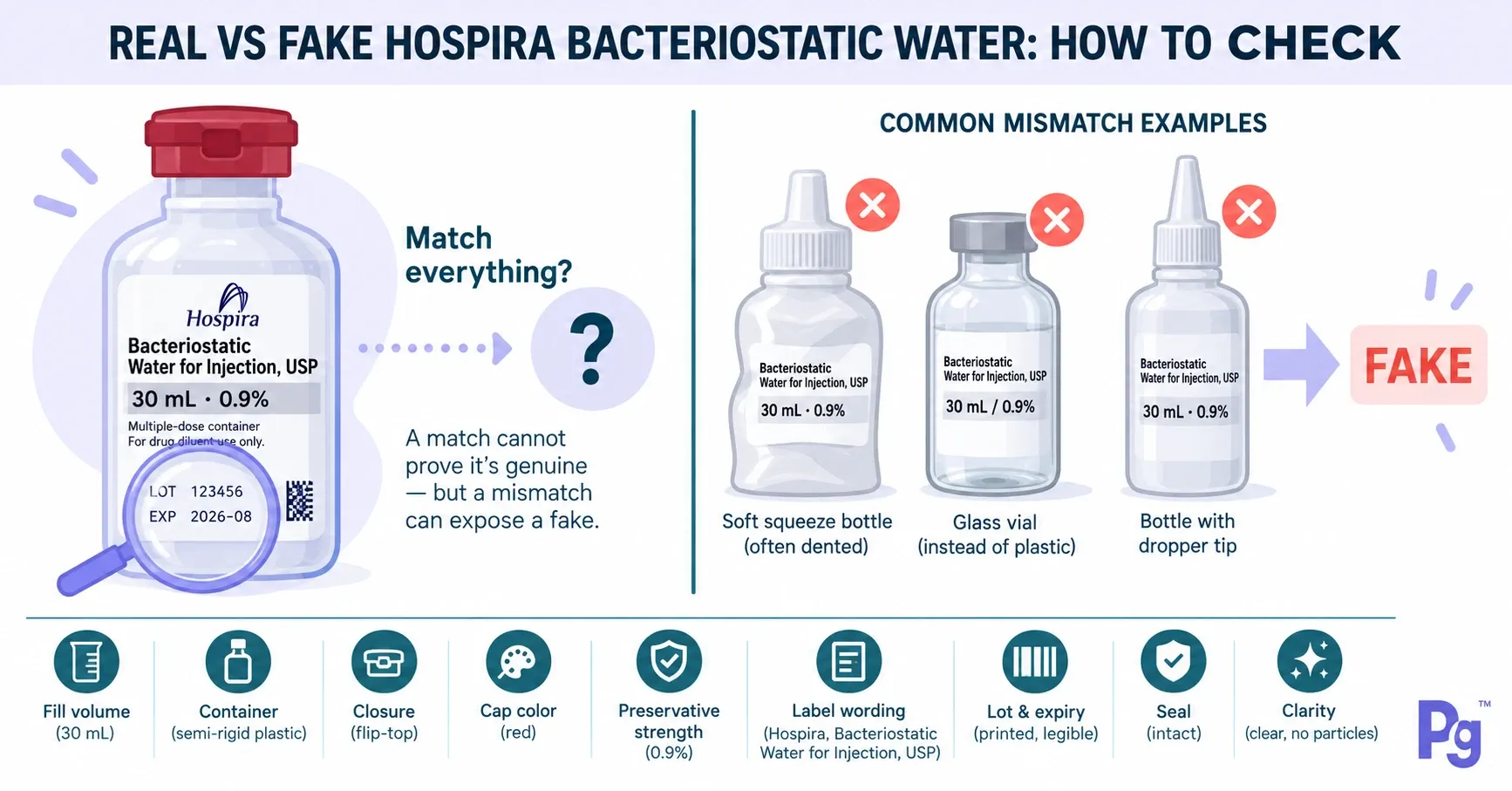
A genuine Hospira bacteriostatic water vial, as sold in the US, is a 30 mL multiple-dose Fliptop vial made of semi-rigid plastic, per the FDA-approved label. The plastic is a polyolefin made from ethylene and propylene, and the label says the container needs no vapor barrier to hold its volume. Pfizer's hospital catalogue lists the cap color as garnet, a deep red. Check those four points before anything else: 30 mL, plastic, flip-top, garnet cap.
The label on DailyMed, BACTERIOSTATIC WATER injection, solution, lists two presentations and describes the container in one paragraph. Pfizer's catalogue entry for the tray, Bacteriostatic Water for Injection, USP, adds the cap color and the pack size. The table sets out what the two sources say about the 30 mL vial.
Feature | Genuine 30 mL Hospira vial | Documented in | Does not match |
|---|---|---|---|
Fill | 30 mL, multiple-dose | FDA-approved label | Another volume, or a single-dose claim, on a vial sold as the 30 mL product |
Container | Semi-rigid plastic (polyolefin) | FDA-approved label | A soft squeeze bottle; glass on a 30 mL, 0.9% vial |
Closure | Fliptop vial | Label; Pfizer catalogue | Dropper tip, screw cap, or no flip-top |
Cap color | Garnet | Pfizer catalogue (verified October 2026) | Any other color |
Preservative | 0.9% benzyl alcohol (9 mg/mL) | FDA-approved label | 1.1% on a 30 mL plastic vial, or no strength stated |
Pack | Trays of 25, shipped four trays to a case | Label; Pfizer catalogue | A Hospira-branded box of any other count |
The label lists one other presentation, and it is the only glass one: a 20 mL fill in a 30 mL glass Fliptop vial, preserved at 1.1% (11 mg/mL) benzyl alcohol, NDC 0409-1093-04. An NDC is the National Drug Code, the federal number that identifies a drug and its package. DailyMed gives that glass tray a marketing end date, while the 30 mL plastic tray has none. A glass Hospira vial is therefore not a fake by default, but it has to say 20 mL and 1.1%. Other manufacturers sell bacteriostatic water in glass vials too; those are different products, and the authenticity question only arises when a vial claims to be Hospira's.
Compare a vial against the package photos on DailyMed and the product photo in Pfizer's catalogue, not against a seller's listing photos, which show what the seller chose to show.
[Visual: editor's photos of a pharmacy-sourced 30 mL vial — label front, cap from above, profile — beside the DailyMed package photo for comparison]
What does the genuine Hospira label say, field by field?
The 30 mL Hospira vial label carries five items, per the label panel filed with DailyMed: the fill and use (30 mL, multiple-dose), the product name Bacteriostatic Water for Injection, USP, the preservative strength (0.9% benzyl alcohol), a capitalized warning against use in newborns, and a printed lot and expiry. The tray of 25 adds the NDC 0409-3977-03, the Rx-only mark, a drug-diluent-only statement and the Hospira name. A 30 mL vial stating any other strength does not match the label.
The newborn warning reads "NOT FOR USE IN NEONATES" on both the vial and the tray, because the label links benzyl alcohol to toxicity in newborns and reserves preservative-free sterile water for them. The vial panel is short, and every line on it is checkable against the table.
Field | On the 30 mL vial | On the tray of 25 | Red flag |
|---|---|---|---|
Fill and use | 30 mL, multiple-dose | 30 mL, multiple-dose | Another volume, or a single-dose claim |
Product name | Bacteriostatic Water for Injection, USP | The same name | A shortened or invented product name |
Preservative | 0.9% benzyl alcohol added | 0.9% benzyl alcohol per mL, as a preservative | Another strength, or none stated |
Warning | Not for use in newborns, in capitals | The same, under a warning heading | Warning missing |
Codes and marks | Lot and expiry area | NDC 0409-3977-03, contents of 25 vials of NDC 0409-3977-01, Rx only, drug-diluent use only | Research-use or not-for-human-use wording on a Hospira-branded vial |
Company | Not in DailyMed's text transcription; compare the package photo | Hospira | Another company's name on a Hospira-branded vial or tray |
Three facts prevent false alarms. The first block of an NDC identifies the company, and on every Hospira code in this listing that block is 0409, so a Hospira NDC starting with anything else does not match. DailyMed names two establishments that manufacture, label and pack the product, Hospira, Inc. and Pfizer Healthcare India Private Limited, so an Indian manufacturing site is not a red flag by itself. And this is the US label: a vial labeled for another country carries that country's codes and is checked against that country's label.
How do you check the lot number and expiry date on a Hospira vial?
Check that the Hospira vial carries a printed lot and expiry, that the expiry has not passed, and that both match the tray if you have it. The label template on DailyMed prints the lot as two digits, three digits and two letters, and the expiry as day, three-letter month and four-digit year. Genuine lots also come in other formats: the lot Hospira recalled in 2019 was W20308. For a lot you doubt, Pfizer's phone line is the route; we found no online lot lookup.
Check | What a genuine vial shows | How to check | Red flag |
|---|---|---|---|
Lot present | A printed lot number | Read the lot area on the label | Missing, handwritten, or a sticker over the label |
Expiry current | A printed day, month and year that has not passed | Read the expiry line | Missing, or already passed |
Vial matches tray | The same lot and expiry on both | Compare them, if you have the tray | Two different lots |
Not recalled | A lot absent from FDA recall notices | Search the lot on FDA's recalls page | Lot W20308, or any other recalled lot |
The FDA notice Hospira, Inc., Issues A Voluntary Nationwide Recall for one lot of BACTERIOSTATIC WATER for Injection, USP, due to a Potential Lack of Sterility Assurance records that Hospira recalled lot W20308, expiry 01 DEC 2019, because sterilization could not be confirmed for some of its vials, which were distributed in March and April 2018. The notice teaches two things. A lot can be genuine and still unfit to use. And genuine lots do not all follow the label's two-three-two template, so an unfamiliar format is a question to ask, not proof of a fake.
For a lot that still looks wrong, Pfizer's counterfeit page, Combatting Fake Medicine, gives one number for suspected counterfeits: 1-800-438-1985. The same page warns that counterfeits can look like the genuine product, which is why the lot matters more than the look. Have the lot, the expiry and clear photos ready before you call.
Is a soft plastic vial a sign of fake Hospira?
Plastic alone is not a sign of fake Hospira, because the genuine 30 mL vial is plastic by design. The FDA-approved label describes it as semi-rigid, and a vial that collapses or squeezes like a soft wash bottle does not match that description. The other container mismatches are a dropper tip or screw cap instead of a flip-top, and a glass vial sold as the 30 mL, 0.9% product. Set any such vial aside unused.
The rule of thumb in buyer communities is that real Hospira is hard and fakes are soft. It is community-reported, and the label supports only half of it. The label calls the container semi-rigid but publishes no stiffness figure a buyer could measure, so "too soft" is a comparison, not a test. The fair comparison is a vial from a pharmacy held in the other hand; the second best is the photos on DailyMed and in Pfizer's catalogue, which show the shape but not the feel.
These are the container mismatches with the label's description:
A container that squeezes flat or stays dented after a press
A bottle with a dropper tip, a nozzle or a screw cap
A glass vial labeled 30 mL with 0.9% benzyl alcohol
A vial with no flip-top cap over the stopper
The opposite mistake costs money rather than safety: throwing out a genuine vial because it is plastic and the buyer expected glass. The label settles that one.
Which red flags separate a fake Hospira vial from a genuine one?
Nine checks separate a fake Hospira vial from a genuine one, and each compares the vial with the FDA-approved label or Pfizer's catalogue: fill volume, container, closure, cap color, preservative strength, label wording, lot and expiry, seal, and clarity. One mismatch is reason enough to set the vial aside. Passing all nine shows only that the container matches the genuine presentation, because none of the nine measures what is inside.
Check | What a genuine vial shows | How to verify | Red flag |
|---|---|---|---|
Fill volume | 30 mL, multiple-dose | Read the label | Another volume on a product sold as 30 mL |
Container | Semi-rigid plastic | Compare with a pharmacy vial or the reference photos | A soft squeeze bottle; glass sold as the 30 mL, 0.9% product |
Closure | Fliptop vial | Look at the top | Dropper tip, screw cap, no flip-top |
Cap color | Garnet | Compare with Pfizer's catalogue photo | Any other color |
Preservative strength | 0.9% benzyl alcohol | Read the strength line | 1.1% on a 30 mL plastic vial; no strength stated |
Label wording | USP name, newborn warning, Hospira name on the tray | Read every line against DailyMed | Misspellings, research-use wording, another company's name |
Lot and expiry | Printed lot, unexpired date, same as the tray | Read both; search FDA recalls | Missing, handwritten, expired, mismatched or recalled |
Seal | Flip-top in place, stopper never punctured | Inspect before the first use | Cap missing, loose or lifted; puncture marks |
Clarity | Clear solution | Hold it to the light | Cloudiness, particles, color |
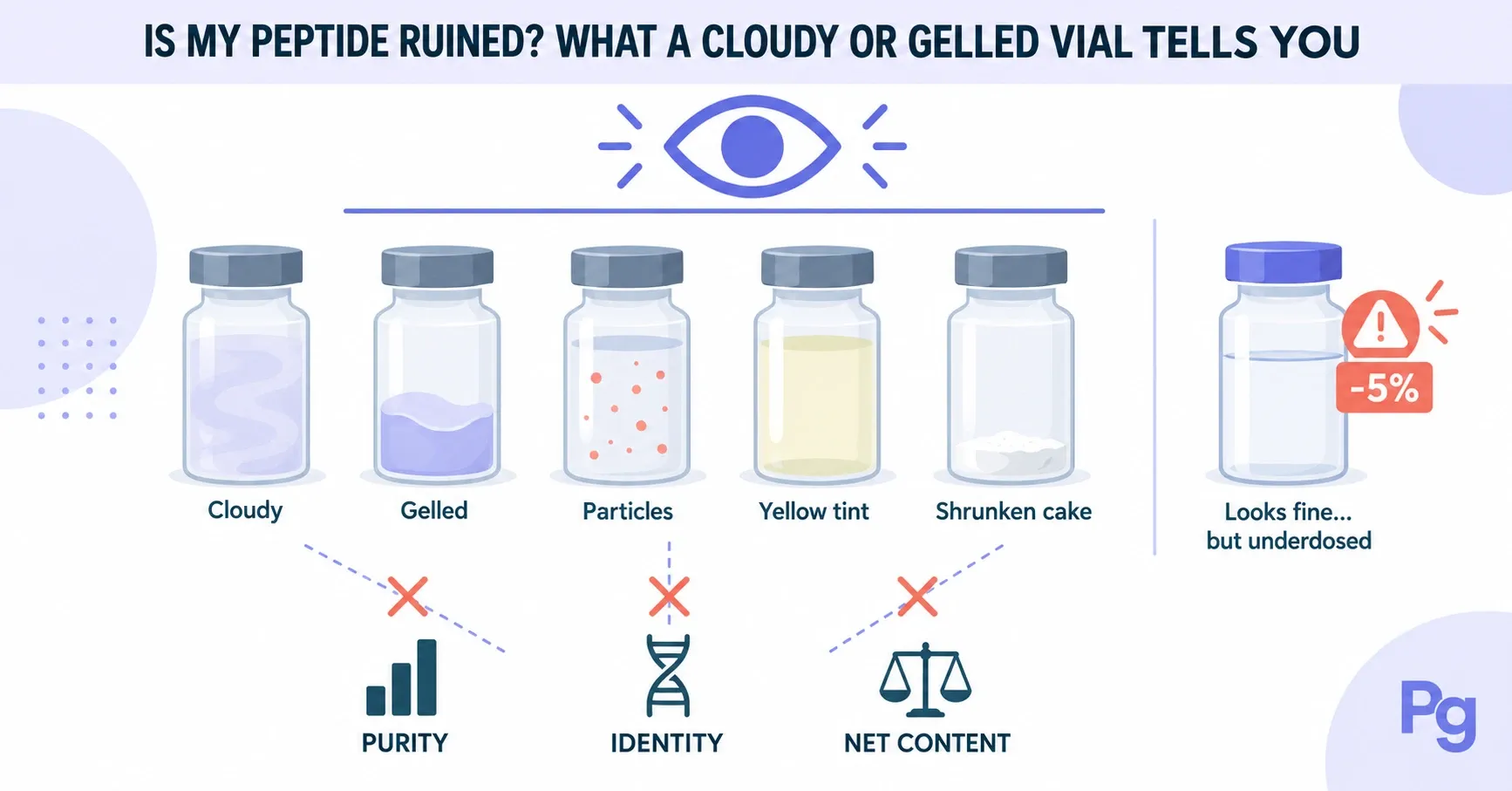
The label says not to use the product unless the solution is clear and the seal intact, so the last two rows are the manufacturer's own conditions rather than a buyer's extra caution. Cloudiness that appears only after the water meets a peptide is a question about the peptide, not the water, and Is My Peptide Ruined? What a Cloudy, Gelled or Discolored Vial Tells You, and What It Can't covers what that change can and cannot mean. A vial that passes all nine has a container that matches; whether its contents match is the next section's question. Once a vial has passed, the next question is usually volume, and the BAC Water Calculator works out how much water to add to a peptide vial for the strength you want.
What can a label check not tell you about a Hospira vial?
A label check cannot tell you what is inside a Hospira vial. The FDA-approved label promises water for injection that is sterile, free of fever-causing contaminants and preserved with 0.9% benzyl alcohol, and none of those three can be seen. A flawless-looking vial can hold water with no preservative, the wrong strength, or bacteria. Only a lab answers it: a benzyl alcohol assay for the preservative, a sterility test for microbes and an endotoxin test for fever-causing bacterial fragments.
A community-run market survey of bacteriostatic water brands, published in June 2026, reported products that measured almost no benzyl alcohol and others that failed sterility tests. Those are community-reported results, mostly from single vials, and not peer-reviewed. Genuine product is not exempt either, as the 2019 recall shows.
Each of the three tests answers a different question. A benzyl alcohol assay measures the preservative against the 0.9% on the label. A sterility test looks for living microbes, and Peptide Sterility Testing Explained covers what the USP <71> test checks. Endotoxins are fragments of bacterial cell walls that can cause fever when injected, even after the bacteria themselves are dead. The FDA guidance Pyrogen and Endotoxins Testing: Questions and Answers, revised in March 2026, sets out the agency's current thinking on the USP <85> bacterial endotoxins test and recommends that finished products be tested for endotoxins.
Send the vial sealed. Once a vial has been opened, a sterility or endotoxin result describes your handling as much as the product. The guide on how to test your peptides walks through preparing and shipping a sample, and Peptigrity's lab directory, Where peptides get verified, lists the methods each lab states it runs. Confirm in writing that a lab runs a benzyl alcohol assay before you ship, because it is a preservative test rather than a peptide test.
The stakes are the ones the label itself lists: among the reactions to the solution or the injection technique, it names fever, abscess and infection at the injection site. A diluent that is not sterile carries those risks into every peptide vial it is mixed into.
Stop and seek care: swelling of the face or throat, difficulty breathing or hives after an injection are signs of a serious allergic reaction; spreading redness, warmth or pus at an injection site with fever is an infection; severe or persistent abdominal pain with vomiting on a GLP-1 drug can be pancreatitis; confusion, sweating or shaking on an IGF-1 or insulin-adjacent compound can be hypoglycaemia. Call your local emergency number (911 in the US, 112 in the EU, 999 in the UK, 000 in Australia) or go to an emergency department, and bring the vial and its label. Research-use vials are not approved products in any jurisdiction, even where a prescription product of the same molecule exists; no article on this site replaces a clinician who knows your history.
Where do fake Hospira vials come from, and what does the law say?
As of October 2026, genuine Hospira bacteriostatic water is a prescription drug: the label marks it Rx only, the FDA approved it under a New Drug Application, number 018802, and Pfizer sells it in trays of 25 through wholesalers. A single vial from a peptide shop left that chain at some point, and nobody upstream answers for where it has been since. In 2026 the FDA told peptide sellers in warning letters that bacteriostatic water sold beside their peptides is itself an unapproved drug.
The federal Drug Supply Chain Security Act (DSCSA) system traces certain prescription drugs at the package level, and for this product the unit Pfizer sells is the tray of 25. A loose vial has left the unit that system follows, so its lot and expiry are the only trail a buyer has.
The FDA's position on bacteriostatic water sold outside that chain is on the record. In NuScience Peptides LLC - 733652 - 08/24/2026, one of several 2026 warning letters to peptide sellers, the agency treated a seller's bacteriostatic water, offered for reconstituting its peptides, as an unapproved new drug and rejected its research-use disclaimers; letters dated March 31, 2026 made the same point. That matches how the reference page on the grey market for peptides describes the wider market, where nobody upstream answers for a batch. A vial sold as Hospira by a peptide shop sits in the same position whether or not it is genuine.
Pfizer's counterfeit page says a counterfeit from a domestic, brick-and-mortar pharmacy is very unlikely in countries such as the US, which makes a pharmacy the most traceable source where your country's rules allow it. If a vial came from a peptide shop, that shop's page in the peptide shops directory holds its reviews, and a review there is how the next buyer hears about a bad vial.
How do you post your Hospira vial so others can compare it?
Post your Hospira vial in the Peptigrity forum with five photos and three facts: the label front, the lot and expiry close up, the cap from above, the vial in profile and the tray if you have it, plus the lot, the expiry and the seller's name without a link. Side-by-side photos are how mismatches get spotted, and each posted vial becomes a reference for the next buyer. Suspected fakes go in Scam Watch; lab results go in Lab Test Results.
The platform's peptide lab tests index holds 13,374 published certificates (verified October 2026), none of the 118 compounds in its library is a diluent, and there is no bacteriostatic water lab-test page. Photos and results posted by buyers are the first bacteriostatic water record the site will have.
These are the five photos that make a vial comparable:
The label front, flat and in focus
The lot and expiry, close up
The cap from above, in daylight
The vial in profile, beside a coin for scale
The tray or box, if you have it
Put the lot, the expiry and the seller's name in the post, without a link; the forum's rules keep store links and discount codes off threads. Cover your name and address on any shipping label in the frame. If you have had the water tested, add the brand, the lot, where it was bought (name only), the lab, what was tested and the result. A photo can expose a mismatch; it cannot confirm that a vial is genuine or safe to inject, and Peptigrity staff will not tell you otherwise.
Frequently Asked Questions
Is Hospira bacteriostatic water in a plastic or glass vial?
The 30 mL Hospira vial with 0.9% benzyl alcohol is plastic, a semi-rigid polyolefin, per the FDA-approved label. The only glass presentation on the label is a 20 mL fill in a 30 mL glass vial with 1.1% benzyl alcohol, which DailyMed lists with a marketing end date. A glass vial sold as the 30 mL, 0.9% product matches neither.
What color is the cap on genuine Hospira bacteriostatic water?
The cap is garnet, a deep red, according to Pfizer's hospital catalogue (verified October 2026). Cap color is easy to copy, so a wrong color rules a vial out, while a right color never rules it in.
Why does a Hospira vial say 1.1% benzyl alcohol?
The label covers a second presentation preserved at 1.1% (11 mg/mL) benzyl alcohol: a 20 mL fill in a 30 mL glass vial. A 1.1% strength printed on a 30 mL plastic vial matches neither presentation, so that combination is a mismatch.
Can you use Hospira bacteriostatic water after its expiry date?
Past the printed expiry, nothing from the manufacturer stands behind the vial's sterility or preservative strength. Community tests of long-expired vials circulate, but they cover a handful of vials and say nothing reliable about any other vial. Replace an expired vial rather than reason around the date.
Do you need a prescription for Hospira bacteriostatic water?
In the US, yes: the label marks the product Rx only, so pharmacies dispense it on a prescription. As of October 2026 the FDA has also treated bacteriostatic water sold beside research peptides as an unapproved drug in warning letters to the sellers. A pharmacist can say what applies where you live.
What should you do if you already used a vial you now think is fake?
Stop using it and keep the vial and its label. Talk to a clinician if any injection site turns red, warm or painful, or you develop a fever, because the label lists injection-site infection and abscess among the reactions to this kind of solution; fever with spreading redness or pus needs urgent care. Report the vial to Pfizer at 1-800-438-1985 and to the FDA's MedWatch program, then post it in the forum so others can check theirs.
This article is for educational and informational purposes only and does not constitute medical advice. Peptides discussed may be investigational compounds not approved by the FDA (or equivalent regulators in your jurisdiction) for human use; research peptides are sold for laboratory use and are not manufactured, tested or labelled to pharmaceutical standards. Peptigrity does not recommend doses: every dose figure above is an approved-label value, a published-trial value or a community report, and is labelled as such — a community report is not a recommendation. Self-injection carries risks of infection, allergic reaction and dosing error; signs of a serious allergic reaction, an injection-site infection with fever, severe abdominal pain, or confusion and sweating on an IGF-1 or insulin-adjacent compound are medical emergencies — call your local emergency number. Always consult a qualified healthcare provider before using any peptide or research compound. Peptigrity is an independent review platform and does not sell, endorse, or recommend specific products or vendors.