Two bottles of clear water differ by one ingredient: benzyl alcohol. That preservative is the entire reason a vial can be entered on seven consecutive days rather than once, and the entire reason a labelled caution exists against using it in newborns.
This page compares the materials, not the compounds, and anything medical belongs with a clinician. Peptigrity is an independent review platform and sells neither peptides nor diluents. Work out the volume first with the bacteriostatic water calculator and the reconstitution calculator, then follow the procedure in reconstituting peptides step by step.
What is the actual difference between bacteriostatic and sterile water?
One ingredient separates them, and everything else follows from it. Bacteriostatic water for injection is sterile water containing benzyl alcohol as an antimicrobial preservative, which inhibits bacterial growth; sterile water for injection contains no preservative at all. Both are sterile when the seal is intact. The difference only becomes operative once a container has been entered, because that is the moment a preservative has something to do and an unpreserved fluid has nothing.
Bacteriostatic water for injection | Sterile water for injection | |
|---|---|---|
Preservative | Benzyl alcohol — inhibits bacterial growth | None |
Sterile in an unopened container | Yes | Yes |
Repeated entry over days | The property it exists for | Not what it is for |
Named in the tesamorelin label | Yes — 1.3 mL into an 11.6 mg vial | No |
Contraindicated population | Neonates, per approved-label caution | No preservative-based caution |
Effect on concentration arithmetic | None — volume is volume | None — volume is volume |
Sets an in-use period on its own | No | No |
Two rows in that table are the ones people get wrong in opposite directions. The preservative does not sterilise anything — it inhibits growth in a fluid that was already sterile, which is a narrower claim than "keeps it clean." And the preservative does not set an in-use period by itself; where a period exists it comes from the product's label, not from the water. Both of those are corrected in detail below.
What does the preservative actually permit?
It permits a multi-dose vial, which is a specific and labelled thing rather than a general licence. Tesamorelin's approved label reconstitutes an 11.6 mg vial with 1.3 mL of bacteriostatic water to give 8 mg/mL, yielding seven doses from one vial, with the vial discarded after seven days. That is one puncture of the stopper per day for a week, into a fluid that a preservative is inhibiting growth in. Without a preservative, that repeated-entry pattern is not what the container is designed for.
Parameter | Figure | Where it comes from |
|---|---|---|
Vial | 11.6 mg, multi-dose | Approved label (EGRIFTA WR, BLA 022505) |
Diluent | 1.3 mL bacteriostatic water | Approved label |
Concentration after mixing | 8 mg/mL | Approved label |
Daily dose | 1.28 mg, subcutaneous | Approved label |
Doses per vial | 7 | Approved label |
In-use period | Discard after 7 days | Approved label — not the water |
Research-market vial | Chosen by the buyer | No label, no in-use period, no stability study |
The last row is the one that matters most to most readers, and it is deliberately empty. A research vial has no approved presentation, so the diluent volume, the concentration and the in-use period are all choices rather than instructions — and the preservative permits repeated entry without telling you for how long. The compound background sits in tesamorelin science.
Where is bacteriostatic water contraindicated?
There is one documented population, and it appears on approved labels rather than in folklore. Products preserved with benzyl alcohol carry a labelled caution against use in neonates, which is why sterile water rather than bacteriostatic water is specified where newborns are involved. This page does not quote a threshold figure, an exposure limit or a body-weight cutoff, because we hold no verified one — the caution itself is the sourced fact, and the numbers around it are a clinician's territory.
Two adjacent situations belong with a clinician rather than with an article. Known hypersensitivity to benzyl alcohol makes the preserved diluent the wrong choice by definition, and it is not something an article can assess. Pregnancy and neonatal exposure sit in the same category — tesamorelin's own label contraindicates pregnancy for reasons unrelated to the diluent, and stacking an article's judgement on top of a label's is not something Peptigrity does.
What this page will not do is convert a labelled caution into a general safety claim in either direction. The caution is specific, it is on the label, and its scope is the population it names. Anyone outside that population asking whether a preserved diluent is appropriate for them is asking a medical question, and the answer comes from a prescriber.
What is sterile water for injection, and when is it the right diluent?
Sterile water is the unpreserved option, and its case rests on the absence rather than on any added property. Sterile water for injection is sterile and contains no preservative, which makes it the diluent where a preservative is contraindicated or unwanted, and the one not designed for repeated entry. A single entry, a single dose and a container not kept open is the pattern it fits. The arithmetic it produces is identical to bacteriostatic water's, because water volume does not depend on what is dissolved in it.
Three situations point to it, and only the first is documented rather than inferred. The labelled neonatal caution is the sourced one. Known benzyl alcohol hypersensitivity follows directly from it. And a vial that will be fully used in one entry gets no benefit from a preservative, since the preservative's whole function concerns what happens between entries. None of those three is a reason to prefer sterile water in a repeated-entry multi-dose pattern, which is exactly the pattern tesamorelin's label describes and specifies bacteriostatic water for.
The failure mode to name here is the reverse one. Choosing sterile water and then treating the vial as a multi-dose container for a week uses the diluent that has no preservative in the pattern that a preservative exists for. That is a mismatch between the material and the usage, and no technique compensates for it.
Does the diluent change the concentration arithmetic?
It does not, and this is the most common misconception on the subject. Concentration is mass divided by volume, so 1.3 mL of bacteriostatic water and 1.3 mL of sterile water produce exactly the same concentration from the same vial — the preservative is present in trace quantity and the volume is the volume. Tesamorelin's labelled 8 mg/mL gives a 1.28 mg daily dose of 0.16 mL, which is 16 units on a U-100 syringe, regardless of which water went in.
The worked example, as an example and not a recommendation:
Labelled concentration after reconstitution: 8 mg/mL (from the EGRIFTA WR label)
Labelled daily dose: 1.28 mg
Volume per dose: 1.28 ÷ 8 = 0.16 mL
On a U-100 syringe: 0.16 mL × 100 = 16 units
Substituting sterile water at the same 1.3 mL: every figure above is unchanged
One honest observation belongs with that example. Dividing 11.6 mg by 1.3 mL gives 8.92 mg/mL, while the label states 8 mg/mL — the two are not the same number, and we are not asserting a reason for the difference. What follows practically is simple: use the label's stated concentration rather than a concentration you derived, because the label is the source of truth for an approved product and a derived figure is not. Run your own numbers through the bacteriostatic water calculator, the tesamorelin calculator and the reconstitution calculator, and see how to calculate peptide doses for the full arithmetic.
How does diluent choice change beyond-use dating?
Less directly than the folklore suggests, and the honest answer has two halves. Where an approved label exists, the label sets the in-use period — tesamorelin's is seven doses and seven days — and the diluent is a named input to that instruction rather than the thing that generates it. Where no label exists, no in-use period can be quoted honestly at all, and for at least one heavily sold compound the reason is direct: no published stability study exists for BPC-157.
Situation | What sets the dating | Diluent's role | Evidence level |
|---|---|---|---|
Approved product | The label — tesamorelin: 7 doses, discard after 7 days | A named input, not the source | Approved label |
Compounded preparation | USP <795> and <797>, with beyond-use dating and documented stability | An input to a documented process | Compendial standard |
503B outsourcing facility | USP plus CGMP, which 503A pharmacies are not subject to | Same, under a stricter regime | Regulatory |
Research-market vial | Nothing. No label, no documented stability | Permits repeated entry; dates nothing | No data |
The compounding rows are worth reading against the research row rather than on their own. A compounded preparation requires a prescription for a named patient, a licensed pharmacist in a state-licensed pharmacy, API from an FDA-registered establishment and a valid certificate of analysis on the bulk substance, all under USP <795> and <797> sterility and beyond-use dating rules — and FDA still states that "Compounded drugs are not FDA-approved. This means that FDA does not verify the safety, effectiveness or quality of compounded drugs before they are marketed." A grey-market vial has none of that apparatus, so it has no beyond-use date either. See compounding pharmacy versus research peptide.
What the preservative genuinely contributes is narrower than a date. It inhibits bacterial growth between entries, which addresses one failure mode across an in-use period that something else has to define. Temperature and degradation across both the dry and reconstituted states are a separate axis again, handled in how to store peptides and, for material that has already been through a shipping route, peptide shipping, cold chain and customs.
What does the one approved peptide reconstitution instruction actually say?
Exactly one approved peptide reconstitution instruction anchors this entire subject, and it changed recently enough that most guidance describes the wrong vial. EGRIFTA WR moved to an 11.6 mg multi-dose vial reconstituted with 1.3 mL of bacteriostatic water to 8 mg/mL, giving seven doses and discarded after seven days, and it lowered the daily dose from 1.4 mg to 1.28 mg. The change came through supplement SUPPL-20 in March 2025, not through a new approval.
EGRIFTA (original) | EGRIFTA SV | EGRIFTA WR (current) | |
|---|---|---|---|
Vial | 1 mg and 2 mg | 2 mg, single-dose | 11.6 mg, multi-dose |
Reconstitution | — | 0.5 mL diluent | 1.3 mL bacteriostatic water (8 mg/mL) |
Application | BLA 022505 | BLA 022505 | BLA 022505 |
Label reads | "Initial U.S. Approval: 2010" | "Initial U.S. Approval: 2010" | "Initial U.S. Approval: 2010" |
Route to the change | — | SUPPL-12, July 2019 | SUPPL-20, 25 March 2025 |
The single-dose-to-multi-dose move is precisely the distinction the preservative exists for, which is why this presentation is the one that names bacteriostatic water. A 2 mg single-dose vial is entered once; an 11.6 mg vial giving seven doses across seven days is entered seven times, and the diluent instruction changed with the presentation. That is the mechanism of this page stated in one product's history.
For anyone reading older guidance, the practical consequence is arithmetic. A protocol written for the 2 mg single-dose presentation specifies the wrong diluent volume and the wrong concentration, and the daily dose itself moved. Work from the current figures.
Which diluent errors actually cost you something?
The errors divide by what they damage. Sterility errors put a compromised fluid into a vial that will be injected, and nothing downstream catches them. Dating errors keep a vial in use past any period anyone can defend, usually because a number was borrowed from a compound that had a label. Arithmetic errors are the least serious here, because the diluent does not change the arithmetic — but assuming it does leads people to recalculate something that never moved.
Treating the preservative as a sterilising agent. It inhibits bacterial growth in an already-sterile fluid. It does not clean a contaminated one, and it does not replace swabbing the stopper.
Using sterile water in a repeated-entry, multi-dose pattern. The pattern the preservative exists for, run with the diluent that has none.
Borrowing tesamorelin's seven-day period for an unlabelled compound. That figure belongs to EGRIFTA WR's label, not to bacteriostatic water, and no published stability study exists for BPC-157 to replace it with.
Quoting an in-use figure for a research vial at all. There is no label and no documented stability, so any number is invented.
Not swabbing the diluent stopper. The peptide vial's stopper is the one people remember; the water's is the one they forget.
Topping up an open vial with more water. It changes the concentration and invalidates every dose calculated before it, whichever water is used.
Assuming the diluent changes the concentration. Volume is volume; the arithmetic is identical either way.
Deriving a concentration when the label states one. Dividing 11.6 by 1.3 gives 8.92, and the label says 8 mg/mL. Use the label.
Assuming a sterile diluent makes the peptide sterile. Sterility and pyrogens are properties of the material in the vial — see peptide sterility testing under USP 71 and endotoxin testing and the LAL assay.
How do you check a diluent before you use it?
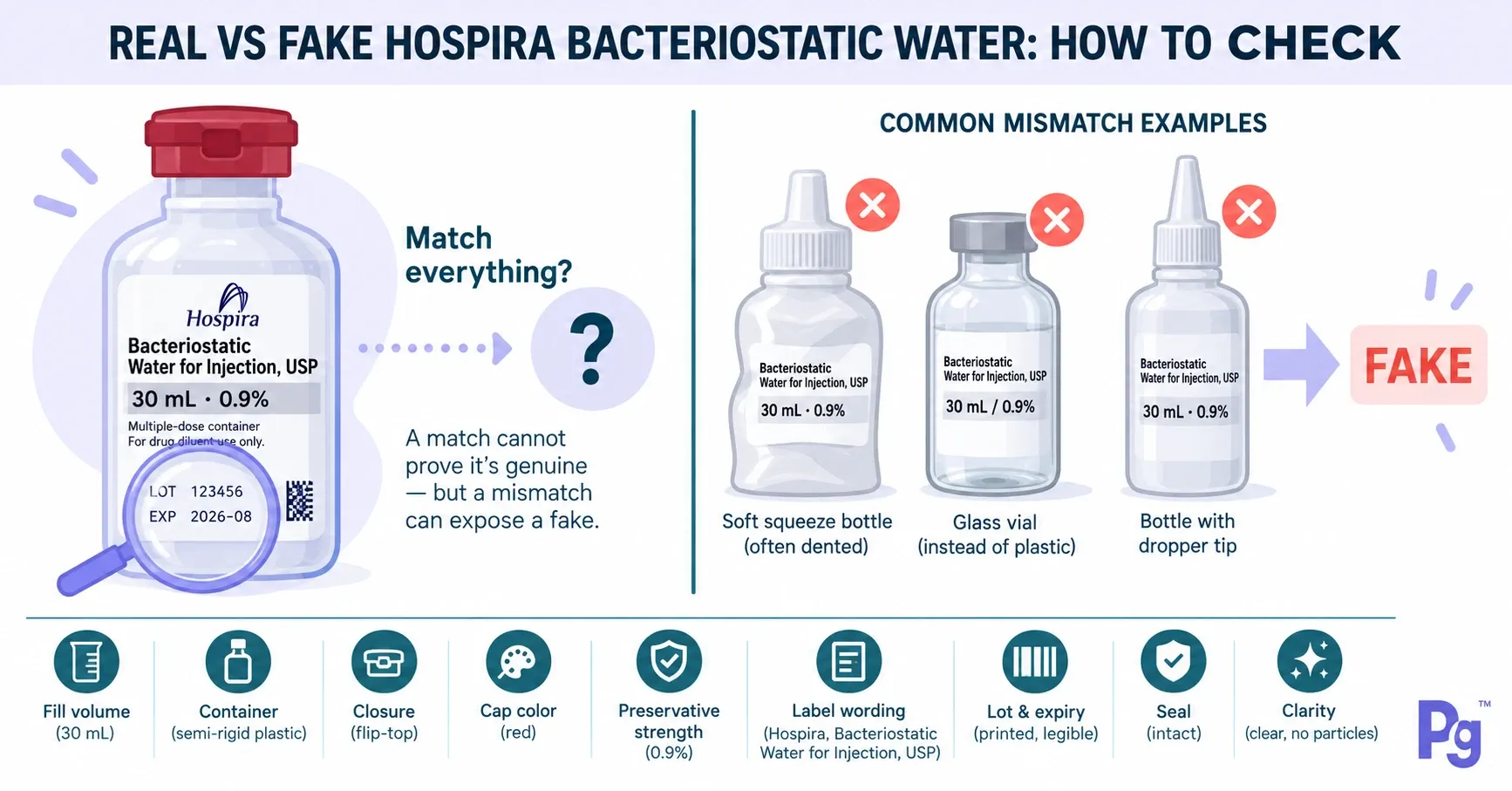
Six checks apply to the bottle rather than to the peptide, and all of them happen before anything is drawn. Read which water it is, confirm the seal is intact, confirm it is labelled for injection, check the expiry, inspect for clarity, and decide the entry pattern you are about to commit to. The last one is the check nobody performs and the one that decides whether the preservative was the right choice or an irrelevance.
Check | What it confirms | How | Red flag |
|---|---|---|---|
Which water it is | Preserved or unpreserved | The bottle names it explicitly | A bottle that names neither |
Seal intact | Not previously entered | Flip cap in place, stopper unmarked | Any prior puncture mark |
Labelled for injection | Intended use | Stated on the container | Anything else, including "lab grade" water |
Expiry date | Still within its own dating | Printed on the container | Undated, or past |
Clarity | Nothing visible in it | Hold it to the light before drawing | Particles, cloudiness, discolouration |
Your entry pattern | Whether a preservative is relevant at all | One entry, or repeated over days | Choosing the diluent after the pattern is set |
Two of those rows are about your intention rather than the bottle, and they belong here because the diluent choice is made before mixing and cannot be revisited afterwards. Once the water is in, the concentration is fixed and the container's history has begun. The procedure from that point is in reconstituting peptides step by step, and the injection itself in how to inject peptides.
Which bacteriostatic water claims survive the evidence?
Four of these nine claims hold cleanly. Benzyl alcohol is the distinguishing ingredient, it permits repeated entry into a multi-dose vial, tesamorelin's label specifies 1.3 mL of it, and the diluent does not change the concentration arithmetic. The failures cluster around dating: the preservative is repeatedly credited with setting in-use periods it does not set, and with a sterilising action it does not have.
Claim | Evidence | Verdict |
|---|---|---|
Benzyl alcohol is what distinguishes bacteriostatic water | It is the antimicrobial preservative; sterile water has none | Correct |
The preservative permits repeated entry over days | EGRIFTA WR: 7 doses, 7 days, 1.3 mL bacteriostatic water | Correct — labelled |
An approved label's diluent and in-use period are authoritative | Tesamorelin: 1.3 mL, 8 mg/mL, 7 doses, discard after 7 days | Correct — use the label |
The diluent changes the concentration | Volume is volume; the arithmetic is identical | False |
Bacteriostatic water sterilises the vial | It inhibits growth in an already-sterile fluid | Wrong mechanism |
The preservative sets the in-use period | The label sets it; the water is a named input | False |
Bacteriostatic water is contraindicated in neonates | Labelled caution on approved products | Correct — no figure held here |
A reconstituted research vial keeps for a set number of days | No label, and no published stability study for BPC-157 | No basis |
Sterile water is interchangeable with bacteriostatic water | Interchangeable on arithmetic, not on entry pattern | Half true — the half that matters fails |
What do 11,852 independent lab tests say about what the diluent goes into?
The diluent is the one component in this procedure nobody tests, and the vial it enters is the one component with a large dataset behind it. Peptigrity tracks 530 shops and 11,852 independent lab tests across 118 peptides, with 1,283 community reviews (verified August 2026), with trust scores weighting community reviews and independently verified HPLC purity equally at 50% each. Tesamorelin averages 99.41% purity across 497 independent tests, while one vendor's sample tested 23.6% above labelled quantity.
Compound | Purity Index | Tests · vendors | Quantity finding |
|---|---|---|---|
Tesamorelin | 99.41% average HPLC | 497 tests, 227 verified vendors | One sample +23.6% above label |
BPC-157 | 99.37 recency-weighted | 588 tests, 23 laboratories | No published stability study exists |
IGF-1 LR3 | 98.51% average HPLC | 125 tests, 220 verified shops | +1% to +72% |
Tesamorelin price data shows 60 shops in stock, a median of $7.00/mg and a lowest tracked price of $3.50/mg on a 20 mg vial, across 73 comparable offers ranging to $22.00/mg (verified 8 August 2026). Those figures exclude shipping, taxes and customs, coupon codes, bulk tiers, multi-vial kits and account-gated pricing.
That +23.6% overage is the reason the diluent question cannot settle a dose on its own. A perfect diluent choice, a correct 1.3 mL and an exact 16-unit draw still deliver whatever mass the vial actually contained, and the certificate is where that is settled rather than the bench. Individual results with the testing laboratory named sit in the lab test database, per-compound averages in the Purity Index, and vendor detail on the tesamorelin compound page.
The trial that would settle this
The diluent comparison has never been run on the compounds this market sells, and the design is unremarkable. The study that would settle this page splits one batch across bacteriostatic and sterile water at an identical concentration, then samples both at fixed intervals across a stated in-use period under repeated stopper entry, assaying purity, identity and microbial growth. It would produce the in-use numbers that currently do not exist for any research-market compound.
Element | Requirement | Why it is the gap |
|---|---|---|
Design | Single batch, split arms, blinded assay | Diluent guidance is convention outside one label |
Arms | Bacteriostatic versus sterile water, same concentration | The only variable that separates them |
Stress condition | Repeated stopper entry across the period | The exact pattern the preservative exists for |
Primary measures | HPLC purity, mass spectrometry identity, microbial growth | Tests the preservative's claim directly |
Duration | At least the 7 days tesamorelin's label allows | The only in-use period here with a regulator behind it |
Second compound | One with no label — BPC-157 | No published stability study exists for it |
Closest existing evidence | The EGRIFTA WR reconstitution instruction | An instruction, not a comparison |
Frequently Asked Questions
What is bacteriostatic water made of?
It is sterile water for injection containing benzyl alcohol as an antimicrobial preservative. That single ingredient is the whole difference from sterile water, and it is why one container tolerates being entered on consecutive days while the other is not designed for it. Both are sterile while their seals are intact.
Can I use sterile water instead of bacteriostatic water?
The arithmetic is identical, so the concentration will not change. The entry pattern is what differs: sterile water has no preservative, so using it in a vial you intend to enter repeatedly over days runs the pattern the preservative exists for without the preservative. Tesamorelin's label specifies bacteriostatic water for exactly that reason.
How long does a vial reconstituted with bacteriostatic water last?
Where an approved label states a period, that is the answer — tesamorelin's is seven doses and seven days. For research-market compounds there is usually no equivalent figure, and for BPC-157 the reason is direct: no published stability study for the compound exists, so no in-use period can be quoted honestly.
Is bacteriostatic water safe for everyone?
Approved labels for products preserved with benzyl alcohol carry a caution against use in neonates, and known hypersensitivity to benzyl alcohol is a separate reason it would be the wrong choice. This page holds no threshold figure and offers no assessment of any individual case, both of which are a clinician's territory rather than an article's.
Does bacteriostatic water sterilise a contaminated vial?
No, and this is the most consequential misunderstanding on the subject. The preservative inhibits bacterial growth in a fluid that was already sterile. It does not clean anything, it does not correct a missed swab, and it does not substitute for a fresh needle or an intact seal on either container.
Does using bacteriostatic water change how much peptide I get per unit?
No. Concentration is mass divided by volume, and the volume is the same whichever water is used, so a 16-unit draw from an 8 mg/mL vial delivers the same 1.28 mg either way. What changes the amount per unit is the diluent volume you chose, and our dose calculation article works through that.
Where the diluent question ends
The diluent decides two things: whether the container tolerates being entered repeatedly, and whether a labelled caution applies to you. It does not decide the concentration, which is arithmetic; it does not decide the in-use period, which comes from a label or from nowhere; and it does not decide what mass the vial held before you opened it, which a certificate settles and a +23.6% overage on record shows is worth checking.
Browse the growth hormone peptides category, or our complete peptide guide with 118 compounds (verified August 2026). For per-injection volume, use the bacteriostatic water calculator and the tesamorelin calculator alongside the reconstitution calculator, then follow reconstituting peptides step by step and how to inject peptides. Whether a compound has a dose worth measuring at all is sorted in the peptide dosage guide. Compare shops through independent lab tests and community-verified shop reviews.
This article is for educational and informational purposes only and does not constitute medical advice. Peptides discussed may be investigational compounds not approved by the FDA (or equivalent regulators in your jurisdiction) for human use. Always consult a qualified healthcare provider before using any peptide or research compound. Peptigrity is an independent review platform and does not sell, endorse, or recommend specific products or vendors.