A subcutaneous peptide injection is four decisions and about a minute: which site, which needle, what angle, and where the sharp goes afterwards. Injection site reactions occurred in 25% of patients on tesamorelin's approved label, which is why rotation is a step rather than a nicety.
This page is the procedure, not a reason to use anything. Peptigrity is an independent review platform and does not sell peptides, and anything medical belongs with a clinician rather than an article. The vial should already be mixed, labelled and dated before you reach step one — see reconstituting peptides step by step — and the volume should already be settled with the peptide dosing calculator and the reconstitution calculator. The route this page describes is subcutaneous, for the reasons set out in subcutaneous versus intramuscular injection.
What do you need in front of you before you inject?
Six things belong on the surface before the first wrapper opens: the reconstituted vial, a fresh sterile syringe and needle for the injection itself, alcohol swabs, a sharps container, and the concentration written on the vial in your own handwriting. Two numbers are already fixed by that point — the concentration set at reconstitution, and the volume that concentration makes your intended amount. Neither is decided at the point of injection, and neither can be changed afterwards.
Item | Purpose | Fixed in advance? |
|---|---|---|
Reconstituted, labelled vial | Holds a known concentration | Concentration and date, written at reconstitution |
Fresh syringe and needle | Draws and delivers the dose | Not the needle used for the diluent transfer |
Alcohol swabs | Decontaminates the stopper and the skin | At least two |
Sharps container | Disposal | In place before the first wrapper opens |
The volume figure | What you draw to the graduation | Calculated before the vial is picked up |
The site you are using today | Rotation | Decided against the last site, not at random |
Two of those rows do more work than their length suggests. The syringe used for the injection is not the syringe used for the transfer — a needle that has already been through a rubber stopper is no longer sterile, and reconstitution guidance and injection guidance fail to meet at exactly this point. And the sharps container belongs on the surface before anything is unwrapped, because the moment you need it is not the moment to go looking for it. Hardware comparisons sit in peptide injection equipment, and disposal in how to dispose of peptide syringes and sharps safely.
How do you inject a reconstituted peptide subcutaneously, step by step?
The procedure is twelve steps, and three of them are irreversible. Swab the stopper and let it dry, draw the calculated volume, check the barrel against your figure, swab the site and let it dry, insert, deliver, withdraw, and put the sharp straight into the container. The check at step five is the last point at which a wrong volume costs nothing. The site choice at step two is the only step that depends on what you did last time rather than on what is in front of you.
Wash and dry your hands, and clear a flat surface with nothing else on it.
Choose today's site against your last one, not at random. Rotation is tracked, not remembered.
Take the vial out of the fridge and let it come to room temperature in its own time. Do not warm it.
Swab the vial stopper with alcohol and let it air dry rather than wiping it.
Draw the calculated volume into a fresh sterile syringe, then hold it up and read the graduation against your figure. This is the last free correction.
Expel air bubbles by tapping the barrel with the needle upward and easing the plunger until the liquid reaches the graduation cleanly.
Swab the injection site and let the alcohol air dry. Injecting through wet alcohol stings and achieves nothing.
Position the skin — a lifted fold where the tissue is thin, flat where it is not.
Insert the needle in one continuous movement rather than pressing slowly through the skin.
Depress the plunger steadily until the barrel is empty, then pause briefly before withdrawing.
Withdraw at the same angle you inserted, and apply light pressure with clean gauze. Do not rub.
Put the sharp straight into the container, uncapped, and write the site and date on your log.
Step 5 is the one people skip and the one that cannot be undone once the plunger moves. A volume read after delivery is a record, not a check. Run the figure through the reconstitution calculator before the syringe is loaded.
Step 12 is the one people defer. An uncapped sharp on a surface is the mechanism behind most needlestick injuries in domestic settings, and recapping is the specific action that causes them. The peptide log sheet is a place to record which site you used, which is what makes step 2 possible next time.
Which sites are used, and why does rotation matter?
Rotation has the strongest evidence on this page, and it is evidence of consequence rather than of technique. Injection site reactions occurred in 25% of patients on tesamorelin's approved label, with the trial tables recording 17% against 6% on placebo across 543 tesamorelin and 263 placebo patients over 26 weeks. Bremelanotide's label records 13.2% against 8.4%. Those are rates for a daily or as-needed injection given correctly, in supervised trials, and they are the reason repeated entry into one patch of tissue is a measurable problem.
Site | Named on an approved peptide label? | What makes it usable | Rotation note |
|---|---|---|---|
Abdomen | Yes — bremelanotide's label names the abdomen | Broadest area, easiest to see | Away from the navel; the largest usable grid |
Thigh | Yes — bremelanotide's label names the thigh | Front and outer aspect, easy to reach | Alternates naturally with the abdomen |
Upper arm | Not in this fact base | Often used, harder to self-administer | Provenance: convention, not label |
Upper buttock | Not in this fact base | Often used, not self-visible | Provenance: convention, not label |
Any site with a lump, bruise or reaction | — | Not usable | Skip it and record why |
The mechanism is straightforward even though the technique that addresses it has never been tested. Tissue that has been injected repeatedly is tissue that has been injured repeatedly, and a 25% reaction rate on a supervised daily regimen is the floor rather than the ceiling for what happens when the same square inch takes every dose. Tesamorelin's own presentation compounds it: the current 11.6 mg multi-dose vial gives seven doses across seven days, so a week of a single site is seven punctures in the same tissue.
What this page cannot tell you is the rotation interval. No trial has compared rotation schemes for any peptide in this fact base, so any specific "wait N weeks before returning to a site" figure in circulation is convention rather than measurement. What is measurable is the reaction rate itself, and it is on the label. The compound background sits in tesamorelin science, and current market figures in tesamorelin price data.
What needle and syringe does a subcutaneous injection use?
The syringe is the part this page can be specific about, because its graduations are arithmetic. A U-100 insulin syringe reads in units where 100 units is 1 mL, so tesamorelin's labelled 1.28 mg daily dose at 8 mg/mL is 0.16 mL, or 16 units. The gauge and length are a different matter: no approved peptide label in this fact base specifies a needle gauge for a self-administered research vial, so every gauge figure in circulation is convention, and this platform does not publish one.
Parameter | What decides it | Where the figure comes from |
|---|---|---|
Barrel size | The volume must land on readable graduations | Arithmetic — your concentration and dose |
Unit scale | U-100: 100 units = 1 mL | Definitional |
Worked example | 1.28 mg ÷ 8 mg/mL = 0.16 mL = 16 units | Approved label (EGRIFTA WR, BLA 022505) |
Gauge | Bore width; a higher number is a thinner needle | Not sourced — convention only |
Length | Must reach subcutaneous tissue, not muscle | Not sourced — convention only |
Fixed-dose alternative | Bremelanotide is 1.75 mg in 0.3 mL, an autoinjector | Approved label — no needle choice at all |
That worked example is an example, not a recommendation, and it holds only for the labelled presentation it comes from: 11.6 mg reconstituted with 1.3 mL of bacteriostatic water gives 8 mg/mL, and 1.28 mg of that is 0.16 mL. Change the diluent volume and every figure downstream changes with it. Run yours through the tesamorelin calculator and the reconstitution calculator.
The barrel choice has a real consequence the gauge does not. A dose landing at 2.5 units on a syringe graduated in single units is a dose you cannot read accurately, and the fix is upstream — a different diluent volume, decided before mixing. That arithmetic is set out in full in how to calculate peptide doses, and equipment options in peptide injection equipment.
What angle do you inject at?
The angle exists to keep the needle tip in subcutaneous tissue rather than in muscle, and that is the whole of the reasoning available. Convention describes two positions — perpendicular into a site with adequate tissue depth, and shallower into a lifted skin fold where tissue is thin — and neither has a comparative trial behind it in this fact base. The pinch works mechanically by lifting fat away from the muscle beneath it, which is a geometric claim rather than a measured one.
Two things follow that are worth stating plainly. The angle is a means to a depth, not a target in itself: a shorter needle in a site with depth and a longer needle into a lifted fold can put the tip in the same place. And a fold that is squeezed hard is not a fold — compressing the tissue defeats the purpose, because it presses the subcutaneous layer back down onto the muscle.
Where the route itself is in question, that is a different article. Whether these compounds should go subcutaneously at all, and what happens to the evidence base if they do not, is argued in subcutaneous versus intramuscular injection. Anything about your own tissue depth, body composition or medication is a clinician's question, not an article's.
What do you do if the site bleeds, leaks or bruises?
A small bead of blood or a drop of fluid at the puncture is common and self-limiting, and the response is mechanical: light pressure with clean gauze, held rather than rubbed. No trial in this fact base measures leakage or bleeding rates for any peptide, so there is no percentage to quote and no evidence-based volume-recovery rule. What can be said with certainty is that a dose partly lost to leakage is an unknown dose, and re-dosing to compensate turns an unknown into a larger unknown.
Bleeding at the puncture. Light pressure with clean gauze. Do not rub, which spreads the trauma through the tissue.
A drop of fluid at the site. Some of the dose has not stayed in. It cannot be quantified and should not be topped up.
Bruising. A sign the site was used, not a sign the technique failed. Record the site and skip it next time.
A persistent lump or hardened patch. Stop using that site and route it to a clinician — this is the tissue-level end of the 25% reaction rate on tesamorelin's label.
Spreading redness, heat, swelling or fever. Not a technique question. A clinician, promptly.
Any reaction that is not local. Tesamorelin's trial tables record hypersensitivity reactions in 4% of patients. That belongs with a clinician, immediately.
The line between an injection-site event and a systemic one is the line between something you record and something you take to a doctor. This page does not attempt to place any individual case on either side of it.
What do you do about a missed dose?
Where an approved label exists, the label answers this and nothing on this page overrides it. Where no label exists — which covers most compounds on this market — there is no missed-dose rule, because there is no validated dosing schedule for it to belong to. A compound with no human dose-ranging study has no evidence-based interval, so "what happens if I miss one" has no answer that is not invention. Doubling a subsequent dose to compensate is the specific error worth naming, and no evidence supports it.
Three cases separate cleanly. Approved products carry their own instructions: retatrutide's situation is set out in the retatrutide missed dose protocol, semaglutide's schedule in the semaglutide dosing chart, and tirzepatide's titration in the tirzepatide dosing guide. Compounds with a trial dose but no approval have a studied interval and no missed-dose protocol, because trials do not publish one. Compounds with no human dose-ranging study at all have neither, and the honest answer is that the question does not have a factual basis — which is the subject of the peptide dosage guide.
Anything involving a medical decision about your own schedule, including whether to skip, resume or adjust, is a clinician's call. Peptigrity does not make it.
Which injection errors actually cause harm?
The errors that matter fall into three groups by consequence. Sterility failures put non-sterile material into tissue and have no downstream step that catches them. Dose failures deliver an amount nobody intended, and are almost always fixed upstream in the arithmetic rather than at the needle. Tissue failures — one site used repeatedly, injecting into a lump, rubbing a bleeding puncture — turn a 25% labelled reaction rate into a worse personal one. Only the third group is visible while it is happening.
Reusing the transfer needle for the injection. A needle that has passed through a rubber stopper is blunted and no longer sterile. Use a fresh one.
Recapping a used needle. This is the single action behind most domestic needlestick injuries. Uncapped, straight into the container.
Injecting through wet alcohol. Stings, and the swab has not done its job until it has dried.
Injecting into the same site repeatedly. The labelled injection-site reaction rate is 25% on tesamorelin under supervised conditions with correct technique. Concentrating every dose in one patch of tissue is how a person exceeds it.
Injecting into a lump, bruise or reactive patch. Absorption from damaged tissue is unpredictable and the tissue gets worse.
Reading the graduation after delivery rather than before. After the plunger moves, a wrong volume is a record rather than a correction.
Topping up after a leak. The lost fraction cannot be measured, so the replacement amount cannot be calculated.
Doubling a dose after missing one. No evidence supports it, and for most compounds here there is no validated schedule it could be catching up to.
Assuming the label milligrams are peptide milligrams. Salt form and fill variance are set before the vial reaches you — fill variance on this platform runs to +26.7% on tirzepatide and +72% on IGF-1 LR3. Technique corrects none of it. See why 10 mg isn't 10 mg.
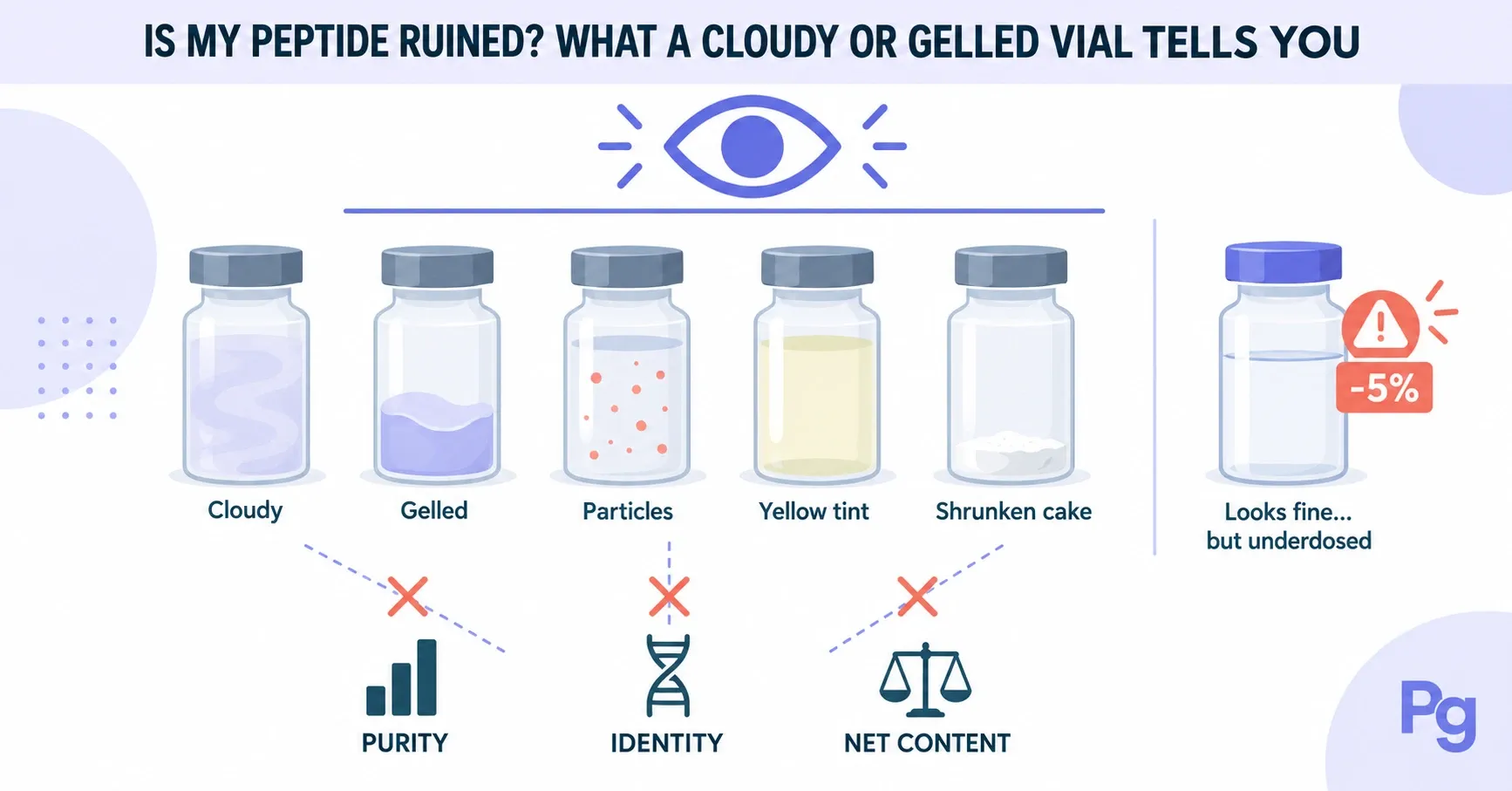
Injecting a cloudy or particulate solution. Inspect before drawing, not after injecting.
How do you check the injection before and after?
Six checks bracket the procedure, four before the needle enters and two after it leaves. Before: the vial's written concentration, the solution's clarity, the barrel reading against your figure, and the site's condition. After: the site's immediate appearance, and the sharp's position in the container rather than on the surface. Every one resolves to a yes or a no, none requires equipment, and each of them catches a different failure that the next step cannot.
Check | What it confirms | How | Red flag |
|---|---|---|---|
Concentration written on the vial | A dose can be calculated at all | Read it before drawing | An open vial with no concentration on it |
Date on the vial | The in-use period is knowable | Read it against any labelled limit | Tesamorelin's label: discard after 7 days |
Solution clarity | The contents are still what you mixed | Visual inspection before drawing | Cloudiness or visible particles |
Barrel reading against your figure | The volume is what you calculated | Hold it up before the site is swabbed | Any discrepancy — stop and recalculate |
Site condition | The tissue can absorb | Look and feel before swabbing | Lump, bruise, redness or a recent reaction |
Sharp in the container | The procedure is finished safely | Immediate, uncapped | A used needle anywhere else |
Two of those rows are inherited rather than performed here. The concentration and the date were written at reconstitution, and if they are missing, this procedure cannot fix it — the vial has to go back to reconstituting peptides step by step. What a certificate can and cannot say about injectable material is covered in peptide sterility testing under USP 71 and endotoxin testing and the LAL assay.
Which injection-technique claims survive the evidence?
Two of these nine claims are supported by trial data, and neither is a technique claim. Injection site reactions are common and measured — 25% on tesamorelin's label, 13.2% on bremelanotide's — and the approved route for every labelled peptide here is subcutaneous. Most of the rest are conventions that may well be sensible and have simply never been tested, which is a different verdict from false, and the table says which is which.
Claim | Evidence | Verdict |
|---|---|---|
Injection site reactions are common | 25% on tesamorelin's label; 17% vs 6% in trials; 13.2% vs 8.4% on bremelanotide's | Correct — measured in RCTs |
Rotating sites reduces reactions | No trial has compared rotation schemes for any peptide here | Untested, mechanistically reasonable |
A specific rotation interval is required | No source for any interval | Convention only |
A specific needle gauge is required | No approved label here specifies one for a research vial | Not sourced |
The transfer needle can be reused for the injection | Blunted and no longer sterile after a stopper | False |
Recapping a needle is safe if done carefully | Recapping is the action behind most needlestick injuries | False |
A leaked dose should be topped up | The lost fraction is unmeasurable | False — creates a larger unknown |
A missed dose should be doubled next time | No evidence, and usually no validated schedule either | False |
Good technique compensates for a mislabelled vial | Salt form and fill variance are fixed before you open it | False |
What do 11,852 independent lab tests say about what is in the syringe?
Technique controls how material enters tissue and nothing about what the material is. Peptigrity tracks 530 shops and 11,852 independent lab tests across 118 peptides, with 1,283 community reviews (verified August 2026), and trust scores weight community reviews and independently verified HPLC purity equally at 50% each. On the compounds used above, purity is rarely the failure — quantity is, and a fill running 23.6% over label is a dosing error no injection technique detects or corrects.
Compound | Purity Index | Tests · shops | Quantity finding |
|---|---|---|---|
Tesamorelin | 99.41% average HPLC | 497 tests, 227 verified vendors | One sample +23.6% above labelled quantity |
PT-141 | 99.70% average HPLC | 242 tests, 225 verified shops | −3.3% to +16.3% |
Tirzepatide | 99.75% average HPLC | 930 tests, 227 shops selling | +2.6% to +26.7% |
Tesamorelin price data shows 60 shops in stock, a median of $7.00/mg and a lowest tracked price of $3.50/mg on a 20 mg vial, across 73 comparable offers ranging to $22.00/mg (verified 8 August 2026), and PT-141 price data shows 65 shops in stock at a median of $4.40/mg, lowest $2.00/mg on a 10 mg vial (verified 10 August 2026). Those figures exclude shipping, taxes and customs, coupon codes, bulk tiers, multi-vial kits and account-gated pricing.
Those certificates are ones vendors chose to publish, which is a selection-biased sample rather than a random survey of the market, and it remains the largest analytical dataset available. Individual results with the testing laboratory named sit in the lab test database, per-compound averages in the Purity Index, and vendor-level detail on the tesamorelin compound page.
The trial that would settle this
Injection technique for peptides has never been tested against itself, and the outcome measure already exists. The study that would settle this page randomises site rotation schemes against a fixed single site on a compound with a known injection-site reaction rate — tesamorelin, where the label records 25% — and counts reactions. Nothing about that design is difficult or expensive. It has simply never been run, which is why every rotation interval in circulation is convention.
Element | Requirement | Why it is the gap |
|---|---|---|
Design | Randomised, within-patient or parallel, assessor-blinded | Rotation guidance is convention, not measurement |
Arms | Structured rotation versus a fixed single site | The one technique choice with a plausible mechanism |
Primary endpoint | Injection site reaction rate | Already measured on labels: 25% and 13.2% |
Compound | A labelled daily subcutaneous peptide | Tesamorelin: 1.28 mg daily, 7 doses per vial |
Secondary arms | Needle gauge and length; angle and pinch technique | Not sourced anywhere — pure convention |
Duration | At least 26 weeks | Matches the window that produced 17% vs 6% |
Closest existing evidence | Adverse-event tables from 543 tesamorelin and 263 placebo patients | Measures the consequence, not the technique |
Frequently Asked Questions
Can I use the same needle to mix the vial and to inject?
No. A needle that has been pushed through a rubber stopper is blunted and no longer sterile, and reusing it puts both problems into tissue at once. Use a fresh sterile syringe and needle for the injection, and put the transfer needle straight into the sharps container rather than back into its cap.
How often can I use the same injection site?
There is no sourced interval. No trial in this fact base has compared rotation schemes for any peptide, so every specific "wait N weeks" figure in circulation is convention rather than measurement. What is measured is the consequence: injection site reactions occurred in 25% of patients on tesamorelin's label under supervised conditions.
What if some of the dose leaks back out?
The lost fraction cannot be measured, so the replacement amount cannot be calculated, and topping up converts a small unknown into a larger one. Record it, use light pressure with clean gauze rather than rubbing, and take any question about compensating for it to a clinician rather than to a forum.
Should I aspirate before injecting subcutaneously?
This page holds no sourced answer. No approved peptide label in this fact base instructs aspiration for subcutaneous self-administration, and no trial here has compared it, so any instruction either way is convention. That is a question for a clinician, who can answer it for your route, site and circumstances rather than in general.
What needle gauge should I use?
Peptigrity does not publish one, because no approved peptide label in this fact base specifies a gauge for a self-administered research vial. Gauge runs inversely to bore width, so a higher number is a thinner needle, and that relationship is definitional rather than a recommendation. Equipment options are compared in our injection equipment guide.
What do I do if I miss a dose?
Where an approved label exists, follow it. Where none does, there is no missed-dose rule, because there is no validated dosing schedule for one to belong to — and doubling the next dose has no evidence behind it. Compound-specific situations are covered in our retatrutide missed-dose article and the semaglutide and tirzepatide dosing pages.
Where technique ends and the evidence question starts
Injection technique decides two things and no others: whether the material enters tissue cleanly, and whether the tissue survives the next hundred doses. It does not decide whether the compound works, whether the amount in the barrel is the amount on the label, or whether any human study supports the schedule you are following. Those were settled before the vial arrived, and the labelled 25% injection site reaction rate is what correct technique looks like rather than what failure looks like.
Browse the growth hormone peptides category, or our complete peptide guide with 118 compounds (verified August 2026). For per-injection volume, use the tesamorelin calculator alongside the reconstitution calculator, and settle the route in subcutaneous versus intramuscular injection. Whether a compound has a dose worth measuring at all is sorted in the peptide dosage guide. Compare shops through independent lab tests and community-verified shop reviews.
This article is for educational and informational purposes only and does not constitute medical advice. Peptides discussed may be investigational compounds not approved by the FDA (or equivalent regulators in your jurisdiction) for human use. Always consult a qualified healthcare provider before using any peptide or research compound. Peptigrity is an independent review platform and does not sell, endorse, or recommend specific products or vendors.