A peptide label states gross weight. Salt counterions, residual water and residual solvent all sit inside that number, and the fill itself is a fourth variable nobody measured. The chemistry costs a few per cent. The fill has cost 94%.
Both gaps are correctable once they are separated. Run the arithmetic through the peptide dosing calculator and check a completed draw with the reverse dose calculator. The compounds carrying the widest measured variance sit in the weight loss and metabolic peptides category, which is also where the dose steps are smallest.
Why is a vial labelled 10 mg not 10 mg of peptide?
Four separate quantities sit between the label and the peptide, and only one of them is chemistry you can predict. Salt counterions add mass — up to 17% on SS-31. Residual water and residual solvent add more, unmeasured. Then the fill itself varies, and on this platform it has run from a gonadorelin vial at 57.6% below label to a cagrilintide vial at 94% above. The first three shift the number a few per cent. The fourth has doubled it.
Contributor | What it is | Typical magnitude | Is it measured? |
|---|---|---|---|
Salt counterion | TFA, acetate or hydrochloride bound to the peptide | 5% to 17% on documented compounds | Only if the salt form is stated |
Residual water | Moisture retained by a lyophilised cake | Unstated on almost all certificates | Rarely |
Residual solvent | Process solvent left after lyophilisation | Unstated on almost all certificates | Rarely |
Fill variance | How much powder actually went in the vial | −57.6% to +94% on record here | Only where a quantitative assay was run |
Purity | Proportion of the contents that is one species | Typically 98% to 99.9% | Routinely — this is the one test everybody runs |
Note which row is measured and which rows are not. The market tests the variable that moves least and leaves the variable that moves most to chance, which is the single structural fact behind this page.
What is net peptide content, and how is it measured?
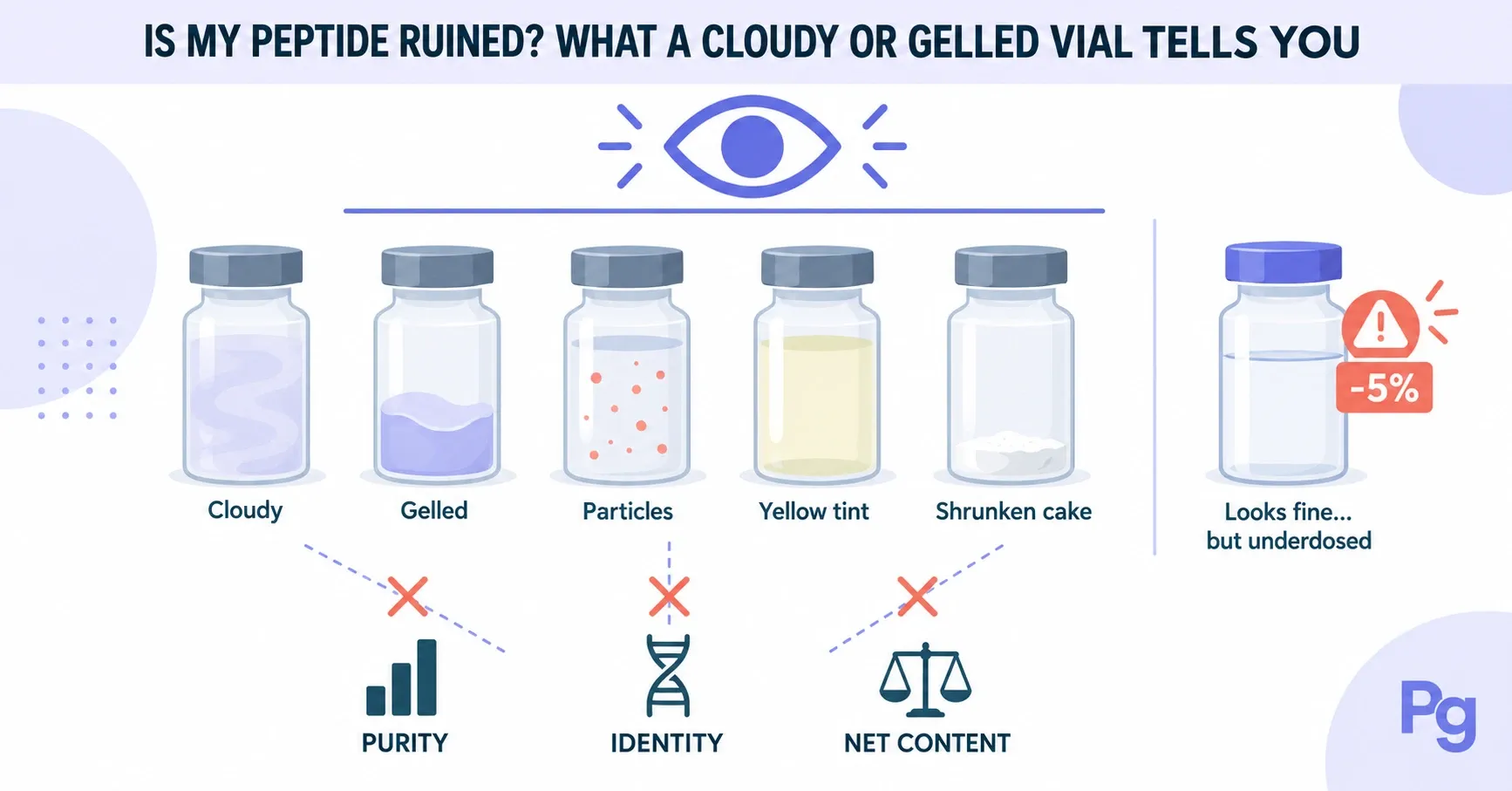
Net peptide content is the mass of actual peptide in the vial, as distinct from the gross weight on the balance. It is reported either as a net content figure or through amino acid analysis, both of which are routine in pharmaceutical manufacturing and largely absent from this market. Purity does not substitute for it: purity is a ratio describing what proportion of the contents is one species, and net content is an amount. A certificate carrying purity alone has measured the ratio and left the amount undeclared.
HPLC purity assay | Quantitative content assay | |
|---|---|---|
Question answered | What proportion is one species | How many milligrams are there |
Output | A percentage | A mass in mg |
Detects an underfilled vial | No | Yes |
Detects a wrong molecule | No | No |
Availability on certificates | Routine — 11,852 tests on this platform | Occasional, usually on request |
Method | Reversed-phase chromatography, peak area | Net content or amino acid analysis |
Those two are natural rivals only in the sense that buyers accept one in place of the other. They measure different things, and neither substitutes for the other any more than a percentage substitutes for a weight.
The absence of a net content figure does not indicate a shortfall. It inflates the apparent dose by an unknown amount, which is a harder problem than a known shortfall, because there is no correction to apply. A missing quantity figure is listed as one of ten document defects in red flags in peptide certificates of analysis; here it is the whole subject.
How much mass do salt counterions add?
Counterions add between roughly 5% and 17% of the weighed mass on the compounds where the numbers are published. MOTS-c is supplied at three molecular weights — 2,174.6 free base, 2,234.64 acetate and 2,288.6 TFA salt — a 114 dalton spread and more than 5% of what the scale reads, so a vial labelled 10 mg of TFA salt holds roughly 9.5 mg of peptide. SS-31 is steeper: 639.79 free base against 749.2 trihydrochloride is a 17% difference, leaving a sixth of the dose undefined when the form is unstated.
Compound | Free base | Salt form | Gap |
|---|---|---|---|
MOTS-c | 2,174.6 | 2,234.64 acetate · 2,288.6 TFA | 114 Da, more than 5% |
SS-31 | 639.79 | 749.2 trihydrochloride | 17% |
Semax | 813.93 | 874.0 acetate, CAS 2828433-33-4 | Roughly 7% |
Any acetate salt | Varies | Adds roughly 60 Da per acetate | Proportional to peptide size |
The general rule is that acetate adds about 60 Da per acetate to the weighed material without changing the peptide ion, so a balance and a mass spectrometer can disagree while both are correct. None of this is a defect. It becomes one when the certificate is silent, because the dose calculation then uses a different quantity than the fill did.
Two supply-side cases show how the omission travels rather than staying with the chemist. Sigma-Aldrich supplies Semax research material as a TFA salt while quoting molecular weight on a free-base basis. PubChem carries acetate-salt entries for cagrilintide separately from the free base, so two records describe different masses of the same active peptide. The arithmetic, and the separate confusion around C-terminal amidation, is in TFA versus acetate versus amidate salt forms.
What do residual water and residual solvent contribute?
Both add mass and neither is declared on the certificates circulating in this market. A lyophilised peptide cake retains moisture, and peptides are hygroscopic enough that the retained fraction changes with handling and storage. Process solvent from synthesis and purification can remain in the cake too. Neither is the analyte, both are on the balance, and the standard peptide certificate reports no figure for either — which is why net peptide content exists as a measurement separate from gross weight in the first place.
The proportional effect is the same on every vial, but the consequence is not. Compounds dosed in micrograms take the same percentage error on a much smaller absolute quantity, and they are also the compounds where the syringe graduations are coarsest relative to the dose.
DSIP is the clean illustration: community practice doses it in the 200 to 500 microgram range, so an undefined salt-plus-water fraction on that vial is not a rounding error in the way it might be on a 60 mg GLP-1 vial. The same reasoning applies to any compound where the intended dose is a small fraction of the vial.
What does measured fill variance look like across this platform?
Wider than the chemistry, by an order of magnitude, and it runs both ways. Nine compounds on this platform carry documented single-sample anomalies with dates and laboratories attached, from a gonadorelin vial labelled 5 mg that measured 2.12 mg to a cagrilintide vial labelled 10 mg that measured 19.4 mg. The purity results sitting beside those measurements were unremarkable. These are not degraded or adulterated products; they are correctly made peptide in the wrong amount.
Compound | Label | Measured | Variance | Purity record alongside |
|---|---|---|---|---|
Cagrilintide | 10 mg | 19.4 mg | +94% (June 2026) | 99.62% across 254 tests |
IGF-1 LR3 | — | 72% over label | +72% (June 2026), range +1% to +72% | 98.51% across 125 tests |
Gonadorelin | 5 mg | 2.12 mg | −57.6% (April 2025, Vanguard) | 99.48% across 7 tests |
Survodutide | — | — | −13% to +36.9% | 99.59% across 37 tests |
Follistatin | 1 mg | 0.6 mg | −40% (May 2026), others +2% to +32% | 99.02% across 7 tests |
SNAP-8 | — | — | 0% to +30.3% | 99.38% across 74 tests |
Tirzepatide | 10-65 mg | 10.71-68.1 mg | +2.6% to +26.7% | 99.75% across 930 tests |
Mazdutide | 20 mg | 15.18 mg | −24.1% (April 2026) | 99.80% on that sample |
Thymosin alpha-1 | 13 mg | 10.56 mg | −18.8%, range to +14.6% | 99.51% across 217 tests |
Four more compounds extend the picture without adding extremes. Retatrutide runs −4% to +22.5% across the platform's largest dataset at 1,150 tests, Selank reaches +28.6% with a 12.86 mg fill on a 10 mg label, Semax runs −2.1% to +22.3%, and melanotan II −7.3% to +16%. PEG-MGF had a March 2026 sample labelled 5 mg test at 6.35 mg. Read live figures on the Purity Index and individual results in the lab test database rather than treating any single number here as current.
The denominators matter as much as the anomalies. Gonadorelin's 57.6% shortfall is one result out of seven; follistatin's 40% shortfall is one out of seven; tirzepatide's range sits on 930 tests. A single bad result in a seven-test dataset and a range across 930 tests are different kinds of evidence, and only the second describes a compound rather than a batch.
Which direction does fill variance run, and why is an overage not generosity?
Overage predominates in this dataset, which inverts the intuitive worry. The largest anomalies on record are all above label — +94% on cagrilintide, +72% on IGF-1 LR3, +36.9% on survodutide, +30.3% on SNAP-8, +26.7% on tirzepatide, +22.5% on retatrutide — against three substantial shortfalls at −57.6%, −40% and −24.1%. A vial containing more than the label says is not a vendor being generous. It is the same absence of fill control, pointing the other way.
The direction changes what goes wrong rather than whether something does. A shortfall produces an underdose and a wasted purchase. An overage produces an unintended dose escalation, and on titrated compounds that lands squarely in the adverse-event range the titration schedule exists to avoid.
There is also a selection effect worth naming. A buyer who suspects a vial is underfilled has a reason to submit it for testing, and a buyer whose vial works has none, so submitted samples are not a random draw in either direction. The honest reading is that both directions are documented and neither frequency is established.
Why are purity and quantity independent variables?
Because one is a ratio and the other is an amount, and no ratio constrains an amount. Mazdutide settles it: an April 2026 sample labelled 20 mg assayed at 15.18 mg — a 24.1% shortfall — while testing 99.80% pure. Both numbers are true. The material was very nearly homogeneous and there was a quarter less of it than the label claimed. AHK-Cu shows the inverse combination, with one June 2026 test returning 50.63% purity alongside a 10.6% quantity shortfall while the remaining tests clustered above 99%.
The asymmetry in testing is the practical problem. Purity is cheap, fast and routine, so it is the number vendors publish and buyers read. Quantitative content is a separate assay, usually available on request and usually not requested. That means the market measures the variable with the narrowest observed spread and leaves the widest one undeclared, which is set out from the purity side in what HPLC testing measures.
A useful habit is to read the two figures as separate lines rather than as one impression of quality. A vial can be homogeneous and underfilled, heterogeneous and correctly filled, or wrong on both counts, and a certificate reporting only one of them has addressed half the question at best.
Which compounds does a fill error matter most on?
The ones titrated in the smallest steps, which in this dataset are also the ones with the widest measured variance. Tirzepatide is titrated in 2.5 mg increments and runs +2.6% to +26.7%; retatrutide moves in 1-2 mg steps and runs −4% to +22.5%; cagrilintide sits at 2.4 mg as a component of CagriSema, whose trial produced gastrointestinal adverse events in 79.6% of participants at the correct dose; survodutide titrates toward 6.0 mg, with 89.7% of trial participants reporting gastrointestinal adverse events.
Compound | Titration step or target | Measured variance | Why the overlap matters |
|---|---|---|---|
Tirzepatide | 2.5 mg increments | +2.6% to +26.7% | A 27% overage exceeds a full titration step |
Retatrutide | 1-2 mg steps | −4% to +22.5% | Same arithmetic on a smaller step |
Cagrilintide | 2.4 mg as a CagriSema component | +94% on one sample | Roughly double the intended component dose |
Survodutide | Titrated toward 6.0 mg | −13% to +36.9% | GI adverse events already at 89.7% on label dose |
IGF-1 LR3 | Micrograms | +1% to +72% | Signature adverse effect is hypoglycaemia |
IGF-1 LR3 is the case where direction and mechanism line up most directly: a 72% overage on a compound whose signature adverse effect is hypoglycaemia has an obvious route to harm, and it sits on the lowest purity index of any well-tested compound on this platform at 98.51%. Where the error lands in practice, and how the units convert, is worked through on the tirzepatide compound page and in tirzepatide dosing and reconstitution.
How do you recompute a dose when the assayed mass differs from the label?
Recalculate the concentration from the assayed mass, not the printed one, and everything downstream follows. Concentration is peptide mass divided by diluent volume, so a quantitative result that disagrees with the label changes the first number in the chain and therefore every draw taken from that vial. The mazdutide sample above makes a clean worked example: 20 mg on the label, 15.18 mg assayed, reconstituted with 2 mL. The label arithmetic gives 10 mg/mL. The assayed arithmetic gives 7.59 mg/mL, roughly a quarter less in every syringe.
Worked example — recalculating from an assayed mass. This is arithmetic on stated inputs, not a recommendation to use any compound at any amount.
Step | Label basis | Assayed basis |
|---|---|---|
Input: vial content | 20 mg (printed) | 15.18 mg (measured) |
Input: diluent added | 2 mL | 2 mL |
Concentration | 20 ÷ 2 = 10 mg/mL | 15.18 ÷ 2 = 7.59 mg/mL |
A 0.10 mL draw delivers | 1.0 mg | 0.759 mg |
Error against intent | — | 24.1% short |
Run the same figures through the reconstitution calculator and the peptide dosing calculator, then check a draw you have already made with the reverse dose calculator, which works backwards from volume to delivered amount and catches transcription errors the forward calculation cannot see. The full sequence with every step shown is in how to calculate peptide doses.
Where no quantitative assay exists — the usual case — the honest description is that the concentration is unknown within a range rather than known to be correct. No calculator resolves that, and pretending otherwise is the error this page exists to prevent.
Which net-content claims survive scrutiny?
Six of eight hold as stated, one is unsupported and one is commonly inverted. The claims resting on chemistry and on named measurements survive, because they are facts about what was weighed and what was found. The claims about market-wide frequency do not survive, because every figure on this page comes from samples somebody chose to submit rather than from a random draw across the market.
Claim | What the fact base supports | Verdict |
|---|---|---|
A label states gross weight, not peptide mass | Counterion, water and solvent all sit inside the figure | Holds |
Salt form can move mass by double digits | SS-31 17%; MOTS-c 114 Da, more than 5% | Holds |
Purity does not measure quantity | Mazdutide 15.18 mg at 99.80% pure | Holds |
Quantity is the more variable axis | −57.6% to +94% against a purity spread of roughly two points | Holds |
Overage is more common than shortfall here | Six large overages against three large shortfalls | Holds for submitted samples only |
Underfilling is the main risk | The largest anomalies run above label | Inverted — overage predominates |
Fill errors are rare across the market | Submitted samples are not a random draw | Unsupported in either direction |
A quantitative assay fixes the dose calculation | It changes the first input; everything downstream follows | Holds |
Two of those verdicts are corrections rather than judgements about strength of evidence. "Inverted" and "Unsupported" describe what the measurements can and cannot reach, and they will stay true whatever a future dataset shows about frequency.
What do 11,852 independent lab tests establish about fill accuracy?
They establish that large fill errors occur, with compound names and dates attached, and nothing about how often. Peptigrity tracks 530 shops, 11,852 independent lab tests, 118 peptides and 1,283 community reviews (verified August 2026), with trust scores weighted 50% community reviews and 50% independently verified lab purity. Cagrilintide, which holds the widest anomaly here, records 99.62% average purity across 254 independent tests from four laboratories — ILS, Kovera, Janoshik and Freedom Diagnostics — across 224 shops selling (verified August 2026).
That dataset has a limit worth stating plainly, since it is our own largest asset. Every result exists because somebody submitted a sample and published the outcome, so the 11,852 tests are evidence that a 19.4 mg fill in a 10 mg vial happened, and not evidence about the proportion of unsubmitted vials that would fail. Fill accuracy is also underrepresented within it, because most submissions are purity-only.
Cagrilintide price data shows 47 shops in stock, median $11.90/mg, lowest $3.00/mg on a 10 mg vial (verified 10 August 2026), across 55 compared offers with vial prices from $30.00 to $263.99. Those figures exclude shipping, taxes and customs, coupon codes, bulk tiers, multi-vial kits and account-gated pricing. A per-milligram price computed from a label that overstates content by 24% is wrong by the same margin, so the cagrilintide compound page and the weighting behind every score in how we calculate trust scores are the place to compare rather than a single listing.
The trial that would settle how much peptide is in a vial
No study has bought vials at random across this market, assayed net peptide content on every one, and published the distribution. That is the measurement everything on this page approximates, and it does not exist. What exists is a large body of submitted samples with a known selection bias, which establishes that severe fill errors occur and cannot establish a base rate — a distinction this page keeps making because collapsing it is the easiest way to overstate the case.
Element | What it would need |
|---|---|
Design | Random-sample purchase study across tracked shops, blinded at assay |
Sampling frame | Vials bought anonymously, not vendor-submitted samples |
Measurements | Net peptide content, gross weight, salt form and HPLC purity on every vial |
Primary endpoint | Distribution of measured net content against labelled content |
Secondary endpoints | Whether variance clusters by vendor, by compound or by vial size; correlation between purity and fill accuracy |
Comparator | Vials from vendors publishing quantitative content on the certificate |
What exists today | 11,852 submitted tests, nine named anomalies with dates, and no random sampling |
What to ask for before the money moves
Ask for the quantity figure by name, because it is the one field nobody volunteers. A batch-matched certificate should carry a quantitative content or amino acid analysis result in milligrams, a declared salt form, and a purity percentage — three separate lines answering three separate questions. Where a vendor supplies only purity, the vial's peptide mass is undeclared rather than confirmed, and the correct response is to treat the label as an upper bound instead of a measurement.
Check | What it confirms | How | Red flag |
|---|---|---|---|
Quantitative content | How many milligrams are present | mg recovered, on your lot | Purity quoted as though it were quantity |
Salt form named | Which mass was weighed | Free base, acetate, TFA or HCl | Not stated — up to 17% undefined |
Net peptide content | Peptide versus counterion, water and solvent | Net content or amino acid analysis | Absent — inflates the apparent dose |
Batch match | The figures describe your vial | Lot number matching the vial label | A specimen certificate from an earlier run |
Purity read separately | Homogeneity, and only that | HPLC percentage on the same lot | Read as a proxy for amount |
Recalculation done | The dose uses the measured mass | Concentration from assayed mg | Dosing from the printed label after a disagreement |
Where the vendor cannot answer, the remaining option is independent testing, which is the only route that closes the gap on a vial already in hand — the process is set out in how to get your peptides independently tested.
Browse the weight loss and metabolic peptides category, or our complete peptide guide with 118 compounds (verified August 2026). For per-injection volume, use the peptide dosing calculator alongside the reconstitution calculator, and check a completed draw with the reverse dose calculator. Compare shops through independent lab tests and community-verified shop reviews, and see how to verify peptide quality before you buy for the surrounding sequence.
Frequently Asked Questions
Does a 99% purity result mean the vial contains what the label says?
No. Purity is a ratio and fill is an amount, and no ratio constrains an amount. A mazdutide sample tested 99.80% pure while holding 15.18 mg against a 20 mg label, a 24.1% shortfall. The purity figure was accurate and told you nothing about the quantity. Only a quantitative content assay, reported in milligrams, answers that question.
How much does the salt form change the weight?
Between roughly 5% and 17% on compounds where the figures are published. MOTS-c ships at 2,174.6 free base, 2,234.64 acetate and 2,288.6 TFA salt, so a 10 mg TFA vial holds about 9.5 mg of peptide. SS-31 is 639.79 free base against 749.2 trihydrochloride, a 17% gap. Acetate generally adds around 60 daltons per acetate to the weighed material.
Is an overfilled vial a problem?
Yes, on any compound titrated in small steps. The largest anomalies on this platform run above label: +94% on cagrilintide, +72% on IGF-1 LR3, +26.7% on tirzepatide. A 27% overage exceeds a full 2.5 mg tirzepatide titration step, which means dosing by label delivers an escalation nobody chose, in the direction that produces the gastrointestinal effects people discontinue for.
What is amino acid analysis and why does it matter?
It is one of the two ways net peptide content is established, alongside a direct net content figure. The analysis hydrolyses the peptide and quantifies the constituent amino acids, giving a mass of actual peptide rather than a gross weight that includes counterions, water and solvent. It is routine in pharmaceutical manufacturing and rarely offered in this market, which is why the quantity axis usually goes unmeasured.
How common are fill errors across the peptide market?
Unknown, and this page will not estimate it. Every figure here comes from samples somebody chose to submit for testing, which is not a random draw — a buyer suspecting a bad vial has a reason to test it, and a satisfied buyer has none. The platform's 11,852 tests establish that severe errors occur, with dates and compounds attached, and not how often.
What should I do if my vial assays differently from the label?
Recalculate the concentration from the assayed mass rather than the printed one, because every downstream figure depends on that first division. A 20 mg label assaying at 15.18 mg in 2 mL is 7.59 mg/mL, not 10 mg/mL. Then verify the draw with the reverse dose calculator, and treat the discrepancy as information about the vendor's fill control rather than about that single vial.
This article is for educational and informational purposes only and does not constitute medical advice. Peptides discussed may be investigational compounds not approved by the FDA (or equivalent regulators in your jurisdiction) for human use. Always consult a qualified healthcare provider before using any peptide or research compound. Peptigrity is an independent review platform and does not sell, endorse, or recommend specific products or vendors.