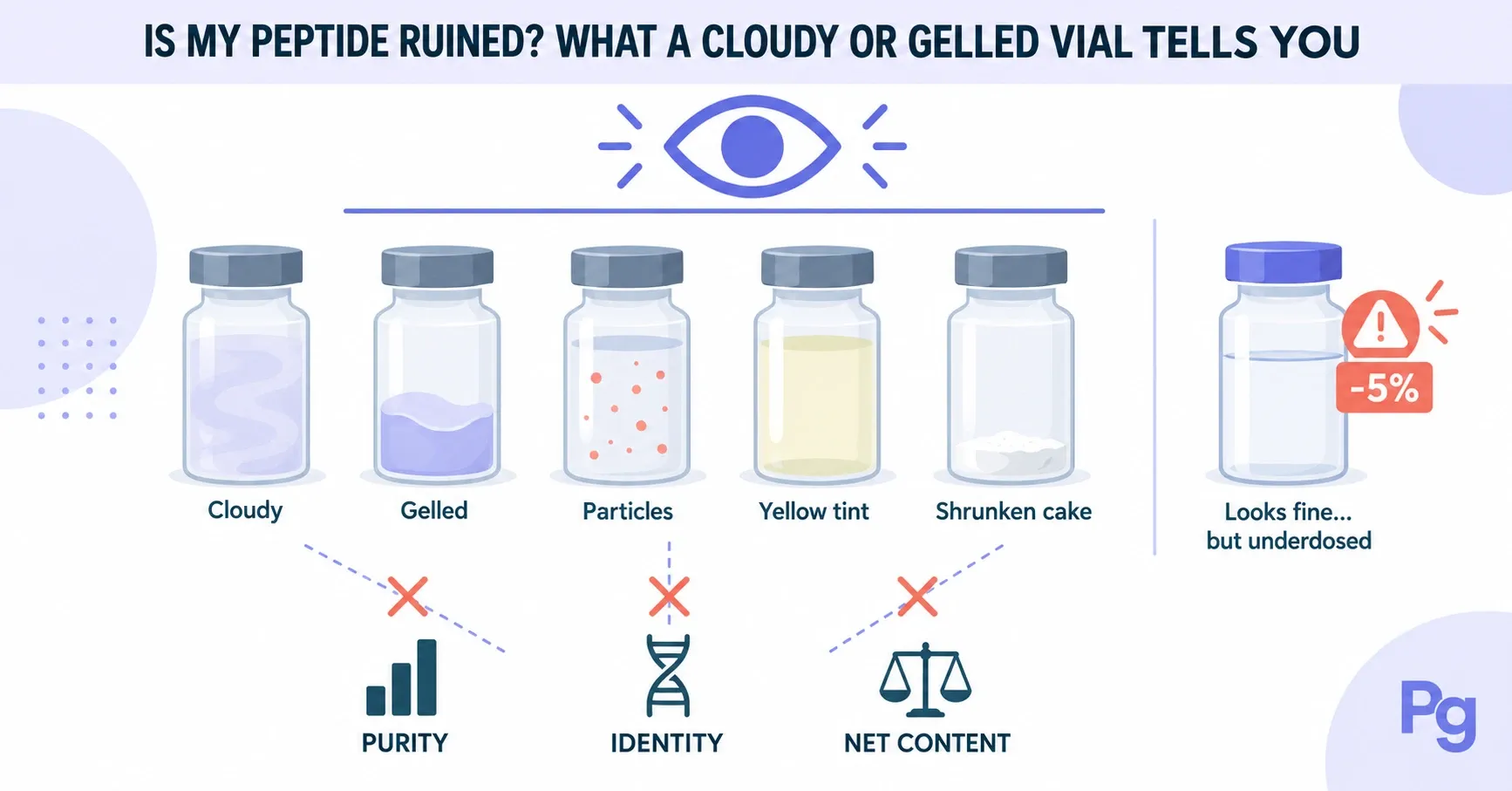
A cloudy peptide vial is not proof of a failed batch and a clear one is not proof of a good one, because the most common failure in Peptigrity's lab-test records, a vial short of the milligrams on its label, turned up in 7.24 % of 12,513 net-content tests (verified September 2026) and cannot be seen. Net content is the measured amount of peptide in a vial, and the lab record counts a vial as underdosed below 95 % of its label. What the eye can judge is narrower: whether the powder dissolved, and whether anything is floating in the liquid.
Some widely sold peptides cloud for documented chemical reasons rather than defects, while a gel, visible particles or a haze that forms in a vial that was clear are reasons to stop using it. Cloudiness, gel, particles, a yellow tint, a vial with no vacuum and a collapsed powder cake each have a known cause, and none of them shows how pure the peptide is or whether it is the right molecule. The underdose rate comes from Peptigrity's Purity Index, which weights 11,458 indexed tests by recency and publishes that rate alongside its purity figures (verified September 2026).
The short version
A vial's appearance shows whether a peptide dissolved cleanly; it does not show how pure the peptide is, whether it is the right molecule, or how many milligrams the vial holds.
Some peptides cloud for documented chemical reasons: FDA records low solubility for semaglutide below pH 6 and a water solubility of 2 mg/mL for AOD-9604.
A clear vial can still fail: 7.24 % of 12,513 net-content tests on Peptigrity came in under 95 % of the label (verified September 2026).
Visible particles, a gel, or cloudiness that appears after a vial was clear are reasons not to inject from it.
No vacuum, a shrunken powder cake or a faintly yellow NAD+ solution is not, on its own, evidence of a bad batch; a lab test of that batch is.
What does a cloudy peptide vial mean?
A cloudy peptide vial means something in the liquid has not dissolved: peptide beyond what the liquid can hold, peptide molecules clumping into aggregates, or, in a vial that was clear for days, possibly microbial growth. When the haze appeared narrows it down. Haze that forms as the liquid meets the powder is a dissolving problem; haze that develops in a vial that was clear is a change after mixing. For semaglutide, FDA records low solubility anywhere between pH 2 and 6.
Whether a peptide stays dissolved depends on the liquid's pH, the concentration, the temperature and the salt the peptide is sold as. pH is the acidity scale, running from 0 (strongly acidic) through 7 (neutral) to 14 (strongly alkaline). The diluent is the liquid added to dissolve the powder, and the one buyers use most, bacteriostatic water (community-reported), sits on the acidic side of neutral: Hospira's Bacteriostatic Water for Injection: Package Insert / Prescribing Info lists 0.9 % benzyl alcohol "added as a bacteriostatic preservative" and a pH of 5.7 (range 4.5–7.0). A bacteriostatic preservative slows bacterial growth; it does not keep a punctured vial sterile.
A haze at the moment of mixing says nothing against the powder, which can still be exactly what the label says. A haze that appears later has two possible causes, slow clumping of the peptide or contamination introduced after mixing, and no home check tells them apart.
Is retatrutide supposed to be cloudy?
Retatrutide has no published reference for how its solution should look: no manufacturer or regulator has described a mixed retatrutide solution, so a research vial has no documented normal to be judged against (searched September 2026). Semaglutide, a weight-loss peptide from the same drug family, does have data. FDA records that semaglutide dissolves freely above pH 6 and poorly below it, and bacteriostatic water is labeled at pH 5.7. Peptigrity found no published measurement of whether retatrutide behaves the same way.
The semaglutide figures come from FDA's 213051Orig1s000 Product Quality Review(s), the chemistry review for the oral semaglutide tablet, which gives an isoelectric point of 5.4 and "low solubility at pH range 2-6". The isoelectric point is the pH at which a molecule carries no net electric charge, and semaglutide's low-solubility range spans it. The approved tirzepatide injection, from the same family, is made up near neutral: the MOUNJARO (tirzepatide) Injection, for subcutaneous use label lists sodium chloride and sodium phosphate at "a pH of 6.5 – 7.5" and describes a clear, colorless to slightly yellow solution.
A research vial of retatrutide holds a freeze-dried powder, dried from a frozen solution under vacuum, that the buyer dissolves in a diluent of their choosing. The final pH depends on that diluent and on whatever the powder contains, and the certificates on Peptigrity carry no pH field. Cloudy retatrutide in bacteriostatic water is one of the most-asked mixing questions in peptide forums (community-reported). The compound itself is profiled on Peptigrity's Retatrutide guide, which carries its trial record and regulatory status.
The lab record shows retatrutide powder testing at high purity. Peptigrity holds 1,316 single-vial certificates of analysis, the lab's report on a tested sample, on its Retatrutide lab tests page, with a purity index of 99.69, weighted toward newer tests, and a median measured content of 110 % of the label; 11 of 1,311 measured vials came in under 90 % (verified September 2026). None of those certificates records how the vial looked once mixed, so the record cannot show whether cloudy vials tested any differently.
Why do AOD-9604 and HGH Fragment 176-191 turn cloudy?
AOD-9604 has a documented solubility limit: FDA's 2024 briefing document reports it soluble in water up to 2 mg/mL, so a 5 mg vial mixed with 1 mL of diluent sits at 2.5 times that concentration. FDA adds that the molecule's disulfide bridge, a sulfur–sulfur link inside the peptide, can lead to aggregate formation. HGH Fragment 176-191, a separate compound, has no published solubility figure (searched September 2026); reports of it clouding are community-reported.
Both FDA statements come from the FDA Briefing Document - Pharmacy Compounding Advisory Committee (PCAC) Meeting, December 4, 2024, which gives the same 2 mg/mL water figure for AOD-9604 acetate, links the disulfide bridge to "degradation by reducing the disulfide bond and aggregate formation", and describes the substance as not physically and chemically well characterized. The figure is for water; Peptigrity found no published measurement in bacteriostatic water or any other diluent.
AOD-9604 and HGH Fragment 176-191 are separate compounds that are often confused. Peptigrity profiles AOD-9604 on its own page, with its trial history and its certificates. The native fragment has a separate profile, HGH Fragment 176–191, and a solubility figure measured for one molecule does not transfer to the other. Buyers commonly report both compounds clouding or gelling in bacteriostatic water and clearing when mixed with dilute acetic acid (community-reported).
Does the salt form change how a peptide dissolves?
The salt form can change how a peptide behaves in solution, and for many research peptides it goes undeclared. Peptides cut free and purified with trifluoroacetic acid come out as trifluoroacetate (TFA) salts unless the maker swaps the counter-ion. The counter-ion is the small charged partner a peptide is sold with, and a 2020 review reports that counter-ions alter peptides' structure and aggregation case by case. Only a certificate that names the salt form, with a matching mass result, shows which one a vial holds.
The review, The Role of Counter-Ions in Peptides—An Overview (Sikora et al., 2020), explains that cleavage and purification are carried out with TFA, so cationic (positively charged) peptides come out as trifluoroacetate salts, that most peptide drugs are supplied as acetate salts, and that the counter-ion has to be chosen peptide by peptide. A cloudy vial of one salt form therefore says nothing about the same peptide sold as another salt. How the counter-ion changes the milligrams on the scale, and the two certificate fields that must agree, are set out in TFA vs Acetate vs Amidate, Peptigrity's salt-form explainer.
What can a vial's appearance tell you about purity, and what can it not?
A vial's appearance tells you whether the peptide dissolved and whether anything visible is in it; it cannot tell you purity, identity or net content, the three things a lab measures. FDA's semaglutide data show why a haze proves little: the pharmaceutical-grade drug substance itself has low solubility below pH 6. Clarity proves as little in the other direction. On Peptigrity, 7.24 % of 12,513 net-content tests measured under 95 % of the labeled amount (verified September 2026).
Each of the three measurements answers a different question. Purity is the share of the peptide content that is the main compound, measured by HPLC (high-performance liquid chromatography). Identity is whether that main compound is the molecule on the label, confirmed by mass spectrometry, which weighs the molecule. Net content is how many milligrams are in the vial. A vial can be 99 % pure and the wrong molecule, and Why a Peptide Can Be 99 Percent Pure and Still Be Entirely the Wrong Molecule lists seven attributes, from identity to fill quantity, that a purity figure cannot see.
The table sets out each sign buyers ask about, the cause the sources document, and the check that settles it.
Sign in the vial | Documented cause | What it cannot tell you | The check that answers it | Stop sign |
|---|---|---|---|---|
Cloudy the moment it is mixed | Solubility limit reached at that pH and strength (semaglutide: low solubility below pH 6; AOD-9604: 2 mg/mL in water) | Purity, identity, net content | HPLC purity and mass-spec identity on the same batch | Haze that thickens, or particles that do not disperse |
Cloudy after days of being clear | Aggregation after mixing, or contamination | The cause: aggregation or contamination | A sterility test | Any haze that was not there at mixing |
Gel | Peptide chains locked into a network (β-sheet aggregation) | The amount still dissolved | None (the dose is no longer evenly spread) | Any gel |
Floating particles | Aggregates, glass or stopper fragments, outside debris | The particle's origin | Laboratory particle analysis | Any visible particle |
Yellow or brown tint | An expected tint in some products (tirzepatide label; NAD+ specification), or a chemical change after mixing | The amount of intact compound left | HPLC on the same batch | A color that appears or deepens after mixing |
No vacuum | Inert-gas sealing by design, or a leak or puncture | Identity, purity, net content | A lab test, plus a look at the cap and stopper | A missing cap or a stopper already pierced |
Shrunken, cracked or collapsed cake | Freeze-drying variation (shrinkage and cracks: no shown effect; collapse: more moisture, slower dissolving) | Identity, purity, net content | Net-content and purity tests | A melted-looking layer (meltback) |
Each stop sign in the last column is a reason to stop drawing from the vial whatever its certificate says; the checks in the fourth column are the only way to settle the questions in the third.
Peptigrity's own records show why clarity proves little. The composite Purity Index stands at 99.51 across 11,458 indexed tests, and 0.27 % of 13,148 published purity tests fell below 95 % purity, while 7.24 % of 12,513 net-content tests came in underdosed (verified September 2026): on this record, vials are far more often short than impure, and a short vial looks like any other. The certificate records note the sample's form as the lab received it, for example "Lyophilized Powder", and carry no field for vacuum, the color of a mixed solution or whether it dissolved clear, so the platform cannot say whether vials that clouded tested any differently.
Why does a peptide turn into a gel?
A peptide turns into a gel when its molecules link into a network instead of staying separate in solution, a change a 2023 formulation review traces to the chains shifting into β-sheet, a flat fold that lets neighboring chains stack and lock together. Concentration speeds it: the review notes that peptides aggregate faster at higher concentrations. Calcitonin and leuprolide are among the peptide drugs documented to form gel-like aggregates. A gelled vial has no even concentration, so no draw from it has a known dose.
The review, Designing Formulation Strategies for Enhanced Stability of Therapeutic Peptides in Aqueous Solutions: A Review (Nugrahadi et al., 2023), lists changes in pH, temperature and ionic strength, the amount of dissolved salt, among the triggers that raise a peptide's tendency to aggregate, alongside concentration. In a gel the chains have joined into a structure that holds the liquid, rather than floating as separate clumps.
Buyers report gelling most often with AOD-9604 and HGH Fragment 176-191, usually at strong concentrations (community-reported). A gel that forms at mixing and a gel that forms in the fridge days later have the same practical consequence. Do not inject from a gelled vial: the peptide is concentrated in the gel and thinned everywhere else, so no volume drawn from it holds a known amount, and a lump of aggregated peptide is itself a particle.
What are the particles floating in a peptide vial?
Particles in a peptide vial fall into the 3 groups FDA uses for injectable drugs: inherent particles from the product itself, such as peptide aggregates; intrinsic particles from the process or container, such as glass flakes or rubber from the stopper; and extrinsic particles that come from the surrounding environment. The eye can see a particle but not tell which group it belongs to, and FDA's draft guidance lists inflammation, granulomas and infection at the injection site among the risks of injecting visible particles.
FDA's draft guidance, Inspection of Injectable Products for Visible Particulates (December 2021), defines inherent particles as "an innate product characteristic", names glass delamination and rubber stopper degradation among the intrinsic sources, and lists phlebitis (inflammation of a vein), inflammatory reactions, granulomas and infections at injection sites among the local risks, with greater danger when particles enter a vein. A granuloma is a small, firm lump of inflamed tissue that forms around foreign material. The guidance tells manufacturers of injectable drugs how to inspect for particles; none of the certificate records on Peptigrity carries a visible-particle result for any research vial (verified September 2026).
Some particles have an ordinary explanation that still rules the vial out. Rubber shed by the stopper and flakes of glass from the vial wall are foreign material, not peptide, and nothing at home can tell them from a clump of aggregated peptide. Do not inject from a vial that holds visible particles, whatever its certificate says.
Stop and seek care: swelling of the face or throat, difficulty breathing or hives after an injection are signs of a serious allergic reaction; spreading redness, warmth or pus at an injection site with fever is an infection; severe or persistent abdominal pain with vomiting on a GLP-1 drug can be pancreatitis; confusion, sweating or shaking on an IGF-1 or insulin-adjacent compound can be hypoglycaemia. Call your local emergency number (911 in the US, 112 in the EU, 999 in the UK, 000 in Australia) or go to an emergency department, and bring the vial and its label. Research-use vials are not approved products in any jurisdiction, even where a prescription product of the same molecule exists; no article on this site replaces a clinician who knows your history.
What does a yellow or brown solution mean?
A yellow tint is not automatically a defect: the approved tirzepatide label describes its injection as clear and colorless to slightly yellow. What matters is change. A research vial's certificate describes the powder, not the mixed solution, so the color the solution had on the day it was mixed is the only baseline, and a solution that turns yellow or brown after mixing has changed in a way no one can measure by eye. The tirzepatide label's own rule is not to use a discolored solution.
The label wording is exact: "It should appear clear and colorless to slightly yellow. Do not use MOUNJARO if particulate matter or discoloration is seen." The rule carries over to a research vial only as a principle, since that reference description belongs to one approved product. Note the color on mixing day, write it on the vial with the date and the concentration, and treat any color that appears or deepens afterwards as a reason to stop using the vial and, if the batch matters to you, to have it tested.
Is yellow NAD+ a sign of a bad batch?
A faintly yellow NAD+ solution is not, on its own, a sign of a bad batch: a laboratory specification for NAD+ describes a 50 mg/mL solution in water as clear, colorless to faintly yellow. NAD+ (nicotinamide adenine dinucleotide) is a coenzyme, a helper molecule for enzymes, not a peptide. What the color cannot show is how much NAD+ the vial still holds; Peptigrity found no published study that links the depth of the color to the remaining content (searched September 2026).
The specification is the product listing for β-Nicotinamide adenine dinucleotide lithium salt from Saccharomyces cerevisiae ≥95%, a laboratory reagent, whose solubility line reads "H2O: soluble-50 mg/mL, clear, colorless to faintly yellow". It describes a freshly made reagent solution, not a research vial, and it says nothing about a solution that darkens toward brown over days, a change that counts as a stop sign.
The lab record for this compound sits on Peptigrity's NAD+ lab tests page: 359 single-vial certificates with a recency-weighted purity index of 99.10, and 17 of 352 measured vials under 90 % of their label (verified September 2026). Those shortfalls are the failures a color cannot show. A shop that declines to replace a faintly yellow vial has the reference specification on its side; a color that keeps deepening after mixing, or a batch code with no certificate behind it, is a stronger basis for a complaint.
Does a vial with no vacuum mean the peptide is fake?
A vial with no vacuum is not evidence that the peptide is fake. Freeze-dried vials may be pumped below atmospheric pressure and may be filled with an inert gas such as nitrogen before stoppering, according to a 2021 engineering article on vial closures, so some vials hold no vacuum by design. A vial that was sealed under vacuum and lost it has leaked or been punctured, which can let in moisture, oxygen or microbes, but neither case shows what molecule is inside.
The article, Safeguarding Vial Container Closure Integrity: A Systematic Approach (Zeng, 2021), published in the journal of the International Society for Pharmaceutical Engineering, explains that a freeze-dried vial "may be vacuumed to a pressure below the ambient pressure and may be filled with an inert gas (e.g., nitrogen)" before it is stoppered and capped, and that where a vacuum is specified to help reconstitution (dissolving the powder), losing it can lead to incomplete reconstitution. It also warns that any breach of the closure can let in oxygen, carbon dioxide, moisture or microorganisms, with a risk to the product's stability that depends on the molecule. Container closure integrity is a vial's ability to keep its contents sealed off from the outside.
A vial that pulls the diluent in as the needle enters was sealed under vacuum and still holds it; a vial that does not was either sealed near normal pressure or has leaked, and a buyer cannot tell which. Peptigrity's certificate records carry no vacuum field, so the platform has no data on whether vials that lost vacuum tested any differently (verified September 2026), and forum threads that call a missing vacuum harmless rest on no measurement either (community-reported). Do not use a vial whose flip-off cap is missing, whose metal crimp turns, or whose stopper already shows a needle mark: each means the closure has been breached.
What does a shrunken, collapsed or melted powder cake mean?
A shrunken or cracked powder cake has never been shown to affect the quality of a freeze-dried product, according to a 2017 industry review of cake appearance. A collapsed cake can hold more residual moisture and take longer to dissolve. Meltback, a melted-looking collapse caused by ice still present late in drying, usually leads a manufacturer to reject the batch. None of these tells you which molecule is in the vial or how many milligrams it holds.
Freeze-drying, or lyophilization, removes water from a frozen solution under vacuum, and the dry solid left in the vial is called the cake. The review, Lyophilized Drug Product Cake Appearance: What Is Acceptable? (Patel et al., 2017), opens by stating that cake appearance "may or may not be critical with respect to product quality (i.e., safety and efficacy)". It reports that collapse lowers the cake's surface area, which can raise residual moisture and lengthen reconstitution, that the moisture rather than the look is what can harm stability, and that fogging, a powder film on the glass above the cake, is cosmetic.
Two documented causes fit powder that still has not dissolved after 30 minutes of gentle swirling: it has reached its solubility limit in that diluent at that strength, as AOD-9604 does above 2 mg/mL in water, or it comes from a cake that dried badly and holds too much moisture. Neither shows what the powder is. Freeze-drying is one of the last steps before a vial is sealed, and How Are Peptides Made? follows a peptide from resin to vial, including the synthesis impurities that no cake, however neat, can reveal.
What should you do with a vial that looks wrong?
Treat a vial that looks wrong as a question about the batch, not a verdict on it. Write down when the change appeared, stop using the vial if it holds particles or a gel or clouded after it was clear, and check the batch before blaming or clearing the shop. Only a lab test answers purity, identity and net content; a base panel costs $150–$325 according to Peptigrity's testing guide (verified September 2026).
Write down when the change appeared: as the diluent met the powder, or after the vial had been clear.
Compare what you mixed with the published figures: bacteriostatic water's labeled pH of 5.7, and any solubility figure for the compound, such as 2 mg/mL for AOD-9604.
Stop drawing from a vial that holds visible particles or a gel, or that clouded after it was clear.
Photograph the vial, its label and its batch code in good light.
Look the batch code up in Peptigrity's Peptide COA lookup to see whether a certificate exists for that lot.
Choose a test panel with how to test your peptides, which sets out what each panel answers, what it costs and how long it takes.
Pick a lab from Where peptides get verified, Peptigrity's directory of 33 testing labs, 19 of them with public certificate-lookup portals (verified September 2026).
A vial that arrived warm, sat out overnight or went through a house move raises a different question, whether the molecule itself degraded, and the eye cannot answer it at all. The storage failures a purity figure misses, and why NAD+ behaves differently from a peptide in solution, are covered in Why a Badly Stored Peptide Still Passes an HPLC Purity Test, Peptigrity's storage guide.
Frequently Asked Questions
Is it safe to inject from a cloudy peptide vial?
No one can call a cloudy vial safe, because the eye cannot tell undissolved peptide from aggregates or contamination. FDA's draft guidance on injectable products lists inflammation, granulomas and infection at the injection site among the risks of visible particles. Talk to a clinician if an injection site turns red, hot, swollen or painful, or you develop a fever, after using a vial that was cloudy or held particles, because those are signs of inflammation or infection that need an examination.
Does adding acetic acid fix a cloudy peptide?
Acetic acid helps only a peptide that dissolves better in acid, and some peptides do the opposite. FDA's data show semaglutide with low solubility between pH 2 and 6 and free solubility above pH 6, so acidifying a semaglutide solution pushes it further into its poor-solubility range. Peptigrity found no published study of acid rescue for any research peptide (searched September 2026); acid-first mixing for AOD-9604 and HGH Fragment 176-191 is a community practice, not a tested method.
Why did my vial turn cloudy a week after mixing?
A vial that clouds after it was clear has changed since mixing, through aggregation or through contamination, and the two look the same. Bacteriostatic water's preservative slows bacterial growth rather than keeping a punctured vial sterile. Stop using the vial; a sterility test, which Peptigrity's testing guide lists as a 48–72-hour PCR screen (a DNA-based check) or a 14–15-day culture (verified September 2026), is what separates the two causes.
My vial looks almost empty. Is there any peptide in it?
The size of the powder cake does not measure milligrams; only a net-content test does. On Peptigrity, 7.24 % of 12,513 net-content tests came in under 95 % of the labeled amount (verified September 2026), and no certificate records the size of the cake. A small, broken or scattered cake is not evidence of a short fill either way.
Is a cloudy or discolored vial proof the shop sold a bad product?
No: appearance can neither prove a bad product nor clear a good one. A certificate for the same batch, or an independent test of the vial itself, is the evidence that can. The batch code printed on the vial is what connects a complaint to a certificate, which is why it belongs in any photo you send the shop.
This article is for educational and informational purposes only and does not constitute medical advice. Peptides discussed may be investigational compounds not approved by the FDA (or equivalent regulators in your jurisdiction) for human use; research peptides are sold for laboratory use and are not manufactured, tested or labelled to pharmaceutical standards. Peptigrity does not recommend doses: every dose figure above is an approved-label value, a published-trial value or a community report, and is labelled as such — a community report is not a recommendation. Self-injection carries risks of infection, allergic reaction and dosing error; signs of a serious allergic reaction, an injection-site infection with fever, severe abdominal pain, or confusion and sweating on an IGF-1 or insulin-adjacent compound are medical emergencies — call your local emergency number. Always consult a qualified healthcare provider before using any peptide or research compound. Peptigrity is an independent review platform and does not sell, endorse, or recommend specific products or vendors.