Every peptide dose is two numbers multiplied by a third: how much powder is in the vial, how much liquid you added, and how much of the result you draw. Get one wrong and the error is silent.
This page shows the working for each step, then the errors that produce ten-fold and thousand-fold mistakes. Run the same figures through the peptide dosing calculator, the reconstitution calculator and the reverse dose calculator — every worked example below is arithmetic on stated inputs, and none of it is a recommendation to use any compound at any amount.
What is the peptide concentration after reconstitution?
Concentration is peptide mass divided by diluent volume, and it is the number every later step depends on. A 10 mg vial reconstituted with 2 mL of bacteriostatic water gives 5 mg per mL, which is also 5,000 micrograms per mL. Nothing about the compound changes that arithmetic — the same division applies to semaglutide, MOTS-c and a vial of something with no human data at all. Concentration is a property of your preparation, not of the molecule.
Worked example 1 — concentration
Step | Value |
|---|---|
Input: vial label | 10 mg |
Input: diluent added | 2 mL |
Calculation | 10 mg ÷ 2 mL |
Result | 5 mg/mL, or 5,000 mcg/mL |
Write that figure on the vial. It is the single number you will reuse for every dose drawn from that vial, and reconstituting a second vial with a different volume changes it entirely. The reconstitution calculator performs the same division, and the bacteriostatic water calculator works the other way, from a target concentration back to a diluent volume.
Two inputs, not one, decide the result. The vial label is chosen by the manufacturer; the diluent volume is chosen by you. That second choice is the only variable in this entire article you fully control, which is why it is worth choosing deliberately rather than defaulting to 2 mL because that is what a forum post used. The procedure for adding it is in reconstituting peptides step by step.
How much liquid does one dose occupy?
Injection volume is dose divided by concentration. At 5 mg/mL, a 250 microgram dose occupies 0.05 mL, because 250 mcg is 0.25 mg and 0.25 ÷ 5 = 0.05. The units must match before you divide: convert the dose to milligrams, or convert the concentration to micrograms per millilitre, but never mix the two in one division. That single mismatch is the most common source of a ten-fold error in this arithmetic.
Worked example 2 — volume per dose
Step | Value |
|---|---|
Input: concentration from example 1 | 5 mg/mL |
Input: intended dose | 250 mcg |
Convert | 250 mcg = 0.25 mg |
Calculation | 0.25 mg ÷ 5 mg/mL |
Result | 0.05 mL |
The same division run in micrograms gives the identical answer: 250 mcg ÷ 5,000 mcg/mL = 0.05 mL. Consistency is what matters, not which unit you pick. The peptide dosing calculator handles the conversion, and it is worth running the calculation by hand once first so you can tell when a tool has been given the wrong input.
A practical limit falls out of this immediately. At 5 mg/mL, a 250 mcg dose is one twentieth of a millilitre, and measuring one twentieth of a millilitre accurately depends entirely on the syringe you are using — which is the next section.
What do the units on an insulin syringe mean?
Units on a U-100 insulin syringe are volume markings, not amounts of peptide. U-100 means 100 units per millilitre, so one unit is 0.01 mL — and that relationship never changes regardless of what is in the syringe. A 1 mL barrel is marked to 100 units, a 0.5 mL barrel to 50 units and a 0.3 mL barrel to 30 units. To convert directly: units equal dose in milligrams, divided by concentration in mg/mL, multiplied by 100.
Worked example 3 — millilitres to units
Step | Value |
|---|---|
Input: volume from example 2 | 0.05 mL |
Definition | 1 unit = 0.01 mL on a U-100 syringe |
Calculation | 0.05 mL × 100 units per mL |
Result | 5 units |
Run as a single expression, that is 0.25 mg ÷ 5 mg/mL × 100 = 5 units. The multiplication by 100 is the whole conversion, and it is the step people drop.
The barrel size sets your resolution, and resolution is why the choice matters. A 5-unit draw sits near the bottom of a 100-unit barrel where each graduation covers a large proportion of the dose, while the same 5 units on a 30-unit barrel is spread across a longer scale. Where a dose lands at a fraction of a unit, the honest response is to change the concentration rather than to estimate between marks. Equipment options are covered in peptide injection equipment.
One term to keep separate: a unit on an insulin syringe is not an International Unit. IU is a measure of biological activity used for compounds such as hCG and oxytocin, whose trials have run intranasal dosing up to 48 IU per day. The two abbreviations look alike in a forum post and mean unrelated things.
How do you convert between micrograms and milligrams?
One milligram is 1,000 micrograms, so 250 mcg is 0.25 mg and 2.5 mg is 2,500 mcg. Divide by 1,000 going from mcg to mg; multiply by 1,000 going the other way. The reason this trivial conversion causes real harm is that peptide doses straddle the boundary — approved labels run in milligrams while community figures for growth hormone secretagogues run in micrograms, so the same page frequently carries both.
From | To | Operation | Example |
|---|---|---|---|
mcg → mg | milligrams | ÷ 1,000 | 250 mcg = 0.25 mg |
mg → mcg | micrograms | × 1,000 | 2.5 mg = 2,500 mcg |
mL → units | U-100 units | × 100 | 0.16 mL = 16 units |
units → mL | millilitres | ÷ 100 | 40 units = 0.4 mL |
mg → mL | injection volume | ÷ concentration in mg/mL | 1.28 mg ÷ 8 mg/mL = 0.16 mL |
Two directions of error follow, and they are not symmetrical. Entering 250 into a field expecting milligrams asks for 1,000 times the intended amount, which no syringe on the list above can physically hold at ordinary concentrations — an error the equipment itself catches. Entering 0.25 into a field expecting micrograms asks for a thousandth of the intended amount, which draws a volume too small to measure and fails silently. The large error is loud; the small one is quiet.
How does vial size change the arithmetic?
Vial size changes everything downstream, because concentration is mass over volume and the mass is fixed by the label. The same 2 mL of diluent produces 2.5 mg/mL in a 5 mg vial, 5 mg/mL in a 10 mg vial and 15 mg/mL in a 30 mg vial. A 250 mcg dose is therefore 10 units, 5 units or 1.7 units respectively — and the third of those is not measurable on any of the barrels described above.
Worked example 4 — one dose, three vial sizes, same diluent
Vial label | Diluent | Concentration | Volume for 250 mcg | U-100 units |
|---|---|---|---|---|
5 mg | 2 mL | 2.5 mg/mL | 0.10 mL | 10 units |
10 mg | 2 mL | 5 mg/mL | 0.05 mL | 5 units |
30 mg | 2 mL | 15 mg/mL | 0.017 mL | 1.7 units — not measurable |
The fix for the third row is more diluent, not a steadier hand. Reconstituting the same 30 mg vial with 6 mL returns 5 mg/mL and puts the dose back at 5 units. Diluent volume exists to be chosen, and choosing it so that a dose lands between roughly 10 and 50 units on the barrel you own is a legitimate reason to depart from whatever volume a protocol specifies.
The same effect runs the other way at approved-label doses. At 5 mg/mL, semaglutide's 0.25 mg starting amount is 5 units, its 2.4 mg maintenance amount is 48 units, and the 7.2 mg dose approved in March 2026 is 144 units — more than a 1 mL barrel holds. A concentration chosen for the first week of an escalation does not survive to the end of it. Compound-specific tools handle this directly: the semaglutide calculator, the tirzepatide calculator and the cost-per-dose calculator for what a vial size does to price.
Does the label milligram equal the peptide milligram?
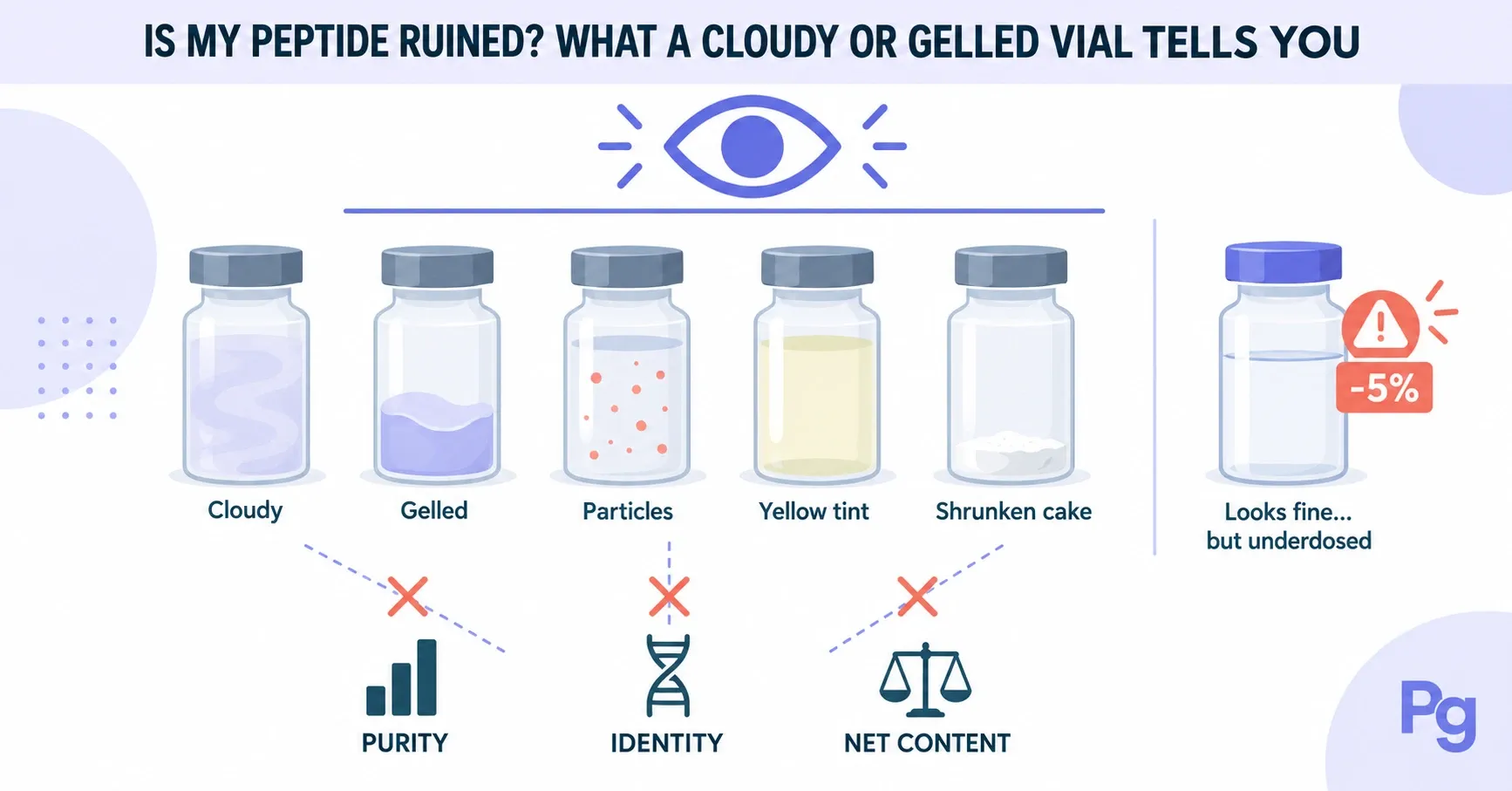
Often not, and this is the assumption that quietly invalidates every calculation above. A vial labelled 10 mg of MOTS-c TFA salt contains roughly 9.5 mg of peptide, because free base, acetate and TFA forms span 114 daltons — over 5% of the mass being weighed. Fill quantity varies independently: tirzepatide runs +2.6% to +26.7% against label, IGF-1 LR3 runs +1% to +72%, and purity is a proportion while net content is a quantity.
Worked example 5 — recalculating from the salt form
Step | Label assumption | Corrected |
|---|---|---|
Vial label | 10 mg | 10 mg TFA salt |
Peptide mass | 10 mg | ≈ 9.5 mg |
Diluent | 2 mL | 2 mL |
Concentration | 5 mg/mL | 4.75 mg/mL |
5-unit draw delivers | 250 mcg | 237.5 mcg |
Worked example 6 — recalculating from an assayed quantity
Step | Label assumption | Corrected |
|---|---|---|
Vial label | 10 mg tirzepatide | 10 mg, assayed +26.7% |
Peptide mass | 10 mg | 12.67 mg |
Diluent | 2 mL | 2 mL |
Concentration | 5 mg/mL | 6.34 mg/mL |
50-unit draw delivers | 2.5 mg | 3.17 mg |
That second table is the practical case, not a hypothetical. Vials labelled 10 to 65 mg have tested between 10.71 and 68.1 mg, and a 26.7% overage on a drug titrated in 2.5 mg steps runs toward the gastrointestinal adverse effects people discontinue for. IGF-1 LR3's +72% sits on a compound whose known class effect is hypoglycaemia, which makes an unnoticed overage a different kind of problem. Where an assayed figure exists for your batch, calculate from the assay. The chemistry behind the salt spread is in TFA versus acetate versus amidate peptide salt forms, and the quantity problem in why 10 mg isn't 10 mg. The MOTS-c calculator works from the number you give it, so a mislabelled salt form propagates straight through it.
What does an approved label do to the arithmetic?
An approved label removes the guesswork and, on one compound, removes a step you would otherwise get wrong. Tesamorelin's current label specifies an 11.6 mg multi-dose vial reconstituted with 1.3 mL of bacteriostatic water to 8 mg/mL, with a 1.28 mg daily dose — which is 0.16 mL, or 16 units. Dividing 11.6 by 1.3 yourself returns 8.92 mg/mL and a different answer. Where a label states the reconstituted concentration, the label is the number to use.
Worked example 7 — the approved case
Step | Value |
|---|---|
Vial | 11.6 mg, multi-dose (EGRIFTA WR, BLA 022505) |
Diluent per label | 1.3 mL bacteriostatic water |
Concentration per label | 8 mg/mL |
Daily dose per label | 1.28 mg |
Calculation | 1.28 mg ÷ 8 mg/mL × 100 |
Result | 0.16 mL, or 16 units |
In-use period | 7 doses, discard after 7 days |
Naive division would give 1.28 ÷ 8.92 = 0.14 mL, about 14 units — roughly a tenth less than the label's figure. The label is the source of truth, and it is quoted here rather than paraphrased for that reason. This presentation is also new: the move to the 11.6 mg vial and the drop from 1.4 mg to 1.28 mg came through supplement SUPPL-20 in March 2025, so guidance describing a 2 mg single-dose vial gets both the concentration and the volume wrong. The tesamorelin calculator works from the current figures.
Compound | Route | Amount | Frequency | Duration | Evidence level |
|---|---|---|---|---|---|
Tesamorelin | Subcutaneous | 1.28 mg at 8 mg/mL | Once daily | Indefinite; vial discarded after 7 days | Approved label |
Semaglutide | Subcutaneous | 0.25 mg escalating to 2.4 mg; 7.2 mg approved March 2026 | Once weekly | Chronic | Approved label |
Tirzepatide | Subcutaneous | 5, 10 and 15 mg in SURMOUNT-1 | Once weekly | 72 weeks in trial | Approved label |
PT-141 | Subcutaneous | 1.75 mg in 0.3 mL, fixed-dose autoinjector | Max 1 per 24 hours | "More than 8 doses per month is not recommended" | Approved label |
Research-market vial | Chosen by the buyer | Chosen by the buyer | Chosen by the buyer | Chosen by the buyer | Varies — often none |
PT-141 is the one row where the arithmetic disappears entirely: the approved product is a fixed-dose autoinjector delivering 1.75 mg in 0.3 mL, so there is no vial to reconstitute and no volume to calculate. Which amount to use is a separate question from how to measure it, and it is answered by the evidence tier in the peptide dosage guide.
How do you run the calculation backwards?
Reverse calculation answers two questions the forward version does not: what a draw you have already made actually delivered, and how many doses remain. A 20-unit draw from a 5 mg/mL vial is 0.20 mL, which delivers 1 mg or 1,000 mcg. And a 2 mL vial at 0.05 mL per dose holds 40 nominal doses before residual volume and dead space are accounted for, which they should be.
Worked example 8 — reverse
Step | Value |
|---|---|
Input: volume drawn | 20 units |
Convert | 20 ÷ 100 = 0.20 mL |
Input: concentration | 5 mg/mL |
Calculation | 0.20 mL × 5 mg/mL |
Result | 1 mg, or 1,000 mcg |
Doses remaining from 2 mL at 0.05 mL each | 40 nominal, fewer in practice |
Run this check before the first injection from a new vial rather than after, because it catches transcription errors the forward calculation cannot see. If the reverse answer does not match the dose you set out to give, one of your three inputs is wrong. The reverse dose calculator does the same operation, and the peptide log sheet is where the concentration and date belong once a vial is open.
Which calculation errors actually cause harm?
Three error classes account for most of the damage, and they are not equally visible. The U-100 unit error treats syringe graduations as amounts of peptide, so "10 units" becomes a dose rather than 0.1 mL. The mcg-to-mg slip moves the decimal by three places and fails silently when it runs small. The label-milligram assumption treats the printed mass as peptide mass, which the salt form and fill variance both contradict. Each produces a wrong amount with no warning at the point of injection.
Units read as micrograms or milligrams. A unit is 0.01 mL and nothing else. Two vials at different concentrations deliver completely different amounts at the same unit mark, which is why a protocol quoting units without a concentration is unusable. Always convert through millilitres.
International Units confused with syringe units. IU measures biological activity, not volume. The abbreviations differ by one letter and the quantities are unrelated.
A decimal shifted by three places. 250 mcg and 250 mg differ by a factor of 1,000. The large error is usually caught by the syringe not holding the volume; the small error draws an unmeasurable amount and passes unnoticed.
The label milligram assumed to be peptide milligram. TFA salt on a 10 mg MOTS-c vial means roughly 9.5 mg of peptide, and fill variance runs from −4% on retatrutide to +72% on IGF-1 LR3.
Purity read as quantity. A 99% pure vial can be substantially underfilled. Purity is a proportion, net content is a quantity, and they fail independently.
Concentration changed mid-vial. Topping up an open vial with extra diluent invalidates every dose calculated before it. Write the concentration on the vial at reconstitution.
Rounding at very small volumes. Below roughly two units the graduations stop being informative. Change the concentration instead of estimating between marks.
A protocol's diluent volume copied without its vial size. The volume only means something alongside the mass it was added to.
Which dose-arithmetic claims survive the evidence?
Three of these nine claims hold. Concentration arithmetic is deterministic, a U-100 unit is 0.01 mL by definition, and an approved label's stated concentration overrides your own division. The rest fail: units are not doses, purity is not quantity, 2 mL is a convention rather than a standard, and the printed milligram figure on a research vial is an assumption rather than a measurement.
Claim | Evidence | Verdict |
|---|---|---|
Concentration is mass divided by diluent volume | Arithmetic on stated inputs | Correct |
One U-100 unit is 0.01 mL | Definition of the U-100 graduation | Correct |
A label's stated concentration beats your own division | Tesamorelin: label 8 mg/mL, division gives 8.92 | Correct — use the label |
"10 units" is a dose | Units are volume; the amount depends on concentration | False |
High purity means the stated quantity is present | Purity is a proportion, net content a quantity | False |
2 mL is the standard reconstitution volume | No standard exists; diluent volume is a choice | Convention only |
A 10 mg label means 10 mg of peptide | TFA salt spans 114 Da; fill variance to +72% | False |
Bigger vials are easier to dose | A 30 mg vial in 2 mL puts 250 mcg at 1.7 units | Backwards |
The calculator removes the need to check | A tool works from the inputs it is given | False |
What do independent lab tests say about the numbers on the label?
Peptigrity tracks 530 shops and 11,852 independent lab tests across 118 peptides, with 1,283 community reviews (verified August 2026), and trust scores weight community reviews and independently verified HPLC purity equally at 50% each. Identity is rarely the failure mode on the compounds used above; quantity is. Tirzepatide records 99.75% purity across 930 tests from five named laboratories across 227 shops selling, with variance running +2.6% to +26.7% (verified August 2026).
Compound | Purity Index | Tests · shops | Quantity variance |
|---|---|---|---|
Tirzepatide | 99.75% | 930 tests, 227 shops selling | +2.6% to +26.7% |
Retatrutide | 99.67% | 1,150 tests, 230 shops selling | −4% to +22.5% |
IGF-1 LR3 | 98.51% | 125 tests, 220 verified shops | +1% to +72% |
MOTS-c | 99.43 | 494 tests, 23 laboratories | Salt form frequently unstated |
Tirzepatide price data shows 14 shops in stock, median $5.67/mg, lowest $1.17/mg on a 60 mg vial (verified 9 August 2026) across 48 compared offers with vial prices from $19.99 to $465.00. Those figures exclude shipping, taxes and customs, coupon codes, bulk tiers, multi-vial kits and account-gated pricing. Per-vial-size medians matter here for the same reason vial size matters to the arithmetic: 5–10 mg runs a median $9.60/mg against $3.85/mg for 40–120 mg.
Individual results with the testing laboratory named sit in the lab test database, per-compound averages in the Purity Index, and vendor-level detail on the tirzepatide compound page. These compounds sit in the weight loss and metabolic peptides category.
How do you check your own arithmetic before injecting?
Five checks catch nearly every error above, and all five resolve to a yes or a no. Confirm the concentration is written on the vial, confirm the dose and the concentration are in the same units before dividing, confirm the volume converts to a measurable number of graduations, confirm the salt form and any assayed quantity on the certificate, and run the calculation backwards to see whether it returns the dose you started from. A mismatch at any step means an input is wrong.
Check | What it confirms | How | Red flag |
|---|---|---|---|
Concentration on the vial | Every later dose uses the same figure | Written at reconstitution, with the date | An open vial with no concentration recorded |
Matching units | The division is valid | Both sides in mg, or both in mcg | mcg divided by mg/mL |
Measurable volume | The syringe can show the dose | Result falls at a readable graduation | Under 2 units, or over the barrel capacity |
Salt form | Which mass was weighed | Named on the CoA, matching the MS result | Not stated — a silent >5% offset |
Assayed quantity | Peptide mass actually present | Net content or amino acid analysis on the batch | Purity quoted as if it were quantity |
Reverse check | The three inputs agree | Volume × concentration returns the intended dose | Any answer that does not match |
The trial that would settle this
The arithmetic needs no trial. What needs one is the input the arithmetic depends on: an independent, blinded audit of net peptide content against label across the research market. Every calculation on this page assumes the vial contains what it claims, and the recorded variance — from −4% to +72% — says that assumption fails often enough to matter. Peptigrity's own lab test data is the closest existing substitute, and it is a sample rather than an audit.
Element | Requirement | Why it is the gap |
|---|---|---|
Design | Blinded purchase, third-party assay, pre-registered vendor sample | Current testing is vendor-submitted or buyer-submitted, not randomised |
Primary measure | Net peptide content against label, per vial | The number every dose calculation assumes |
Secondary measure | Salt form declared versus salt form found | A 114 Da spread that no purity figure reveals |
Coverage | Across vial sizes, since fill error may not scale | Variance is recorded from −4% to +72% |
Reporting | Per-vendor, per-batch, published | Individual certificates are batch-specific and rarely comparable |
Closest existing evidence | 11,852 independent lab tests across 118 peptides (verified August 2026) | Large, but not a randomised market audit |
Frequently Asked Questions
How many units is 250 mcg?
It depends entirely on the concentration, which is why the question cannot be answered without one. At 5 mg/mL, 250 mcg is 0.05 mL, which is 5 units on a U-100 syringe. At 2.5 mg/mL the same dose is 10 units, and at 15 mg/mL it is 1.7 units. A protocol that quotes units without stating a concentration is unusable.
How much bacteriostatic water should I add to a vial?
There is no standard volume, and the choice is yours rather than the manufacturer's, unless an approved label states one. Tesamorelin's label specifies 1.3 mL into an 11.6 mg vial for 8 mg/mL. For a research vial, pick a volume that puts your intended dose at a readable number of graduations on the syringe you actually own.
Why does my calculator give a different answer to the vendor's chart?
Usually because one of you is working from the label mass and the other from an assayed or salt-corrected mass. A 10 mg TFA-salt vial holds roughly 9.5 mg of peptide, and fill variance across this platform's data runs from −4% to +72%. Check which input each figure used before deciding either is wrong.
Is a syringe unit the same as an International Unit?
No. A unit on a U-100 insulin syringe is a volume marking equal to 0.01 mL. An International Unit is a measure of biological activity used for compounds such as hCG and oxytocin, whose trials have run intranasal dosing up to 48 IU per day. The abbreviations look alike and measure unrelated things.
Does purity tell me how much peptide is in the vial?
No. Purity reports the proportion of the sample that is a single species; net peptide content reports how much peptide is present. They fail independently, which is why a 99% pure vial can be substantially underfilled while a tirzepatide vial has tested 26.7% over its label.
What if my dose works out to less than one unit?
Change the concentration rather than estimating between graduations. Reconstituting with more diluent lowers the concentration and raises the number of units for the same dose — a 30 mg vial in 6 mL rather than 2 mL moves a 250 mcg dose from 1.7 units to 5 units. The arithmetic is the same; the resolution is not.
Where the arithmetic ends and the evidence question starts
This page answers how much liquid a chosen amount occupies. It does not answer whether that amount is supported by anything, and the two questions fail for different reasons. The arithmetic is deterministic and identical for every compound; the evidence behind the amount ranges from a regulator-reviewed label to no human dose-ranging study at all. Getting the volume right on a number nobody has validated produces a precisely measured guess.
Browse the weight loss and metabolic peptides category, or our complete peptide guide with 118 compounds (verified August 2026). For per-injection volume, use the peptide dosing calculator alongside the reconstitution calculator. Compare shops through independent lab tests and community-verified shop reviews.
This article is for educational and informational purposes only and does not constitute medical advice. Peptides discussed may be investigational compounds not approved by the FDA (or equivalent regulators in your jurisdiction) for human use. Always consult a qualified healthcare provider before using any peptide or research compound. Peptigrity is an independent review platform and does not sell, endorse, or recommend specific products or vendors.