Sterility testing under USP <71> answers one question: were viable organisms present in the material. It is the test that matters most on anything injected, it is rarely performed on research-market vials, and it is not the same test as endotoxin.
Those two are commissioned together on pharmaceutical injectables and separately or not at all here, which is why the endotoxin and LAL assay guide is the companion to this page. The category where sterility outranks everything else is animal-tissue-derived material in the bioregulator peptides family, and thymalin is the sharpest case in this corpus.
What is USP <71>, and what does a sterility statement establish?
USP <71> is the compendial sterility test, and a pass establishes that no growth was detected under the conditions of the test on the batch submitted. That is a narrower claim than "the product is sterile," and the narrowness is the point. It is a batch-level result on a sample, not a property certified for a product line, and it says nothing about identity, quantity, purity or pyrogen load. On research-market vials this fact base records it as rarely performed at all.
This article does not reproduce the compendial procedure, because this fact base does not carry it and inventing method detail would be the same defect it warns readers about elsewhere. What a buyer needs is upstream of the method: whether a sterility result exists for the lot in hand, what it covers, and what it leaves to other assays. On the compound articles across this platform, the sterility row reads "USP <71> sterility testing" in the method column and "Not performed" in the red-flag column, on injectables including glutathione and NAD+.
How is sterility testing different from endotoxin testing?
They ask different questions and one can pass while the other fails. Sterility asks whether viable organisms are present. Endotoxin asks whether bacterial lipopolysaccharide is present, including from organisms that are already dead. Endotoxin survives sterilisation, so filtering out bacteria removes the organisms and leaves the residue, which is precisely the failure mode behind the Class I recall of an NAD+ injection FDA classified on 21 October 2025. Neither test substitutes for the other and a certificate carrying only one has answered only one question.
Sterility, USP <71> | Endotoxin, LAL | |
|---|---|---|
Question asked | Are viable organisms present? | Is bacterial lipopolysaccharide present? |
Survives sterilisation? | The organisms do not | The endotoxin does |
Result format | A statement of no growth detected | A number in EU/mL |
Batch-specific | Yes | Yes |
Documented failure in this corpus | Rarely performed, so rarely failed on paper | Class I recall, 21 October 2025 |
What it cannot address | Pyrogens from dead organisms | Live contamination |
Sterility and endotoxin are the natural rivals on this axis in the sense that buyers substitute one for the other, and they should not. The pairing is standard on pharmaceutical injectables for exactly this reason. What an LAL number means, and how often the field is blank, is set out in endotoxin testing and the LAL assay.
Why does sterility matter more on an injectable than anything else on the certificate?
Because nothing downstream catches a sterility failure. A purity error is visible in a later assay, a quantity error is recoverable through arithmetic, and a storage error usually announces itself — but non-sterile material injected into tissue has no subsequent step that detects or corrects it. That asymmetry is why the injection and equipment guides on this platform rank sterility failures first among the three error classes they catalogue, ahead of dose failures and tissue failures, on consequence rather than frequency.
The practical implication runs backwards from the needle. Aseptic technique at the point of injection protects against contamination introduced during handling; it does nothing about material that arrived non-sterile. Technique guidance is genuinely useful harm reduction and is covered in how to inject peptides and peptide injection equipment, but it operates on one half of the problem. The other half is settled before the vial ships.
Which category of compound does sterility testing matter most for?
Animal-tissue-derived injectables, where it and endotoxin outrank purity outright. Thymalin is the sharpest case in this corpus: an injectable derived from the thymus glands of calves and cattle under one year of age, where purity testing cannot perform its usual identity function because there is no declared analyte to measure against. The same applies to Cortexin, Retinalamin and Epithalamin. For that group, pyrogen contamination is the realistic failure mode and the microbial tests carry the weight the identity tests cannot.
Group | What purity testing establishes | What actually matters | Priority order |
|---|---|---|---|
Synthetics (Epitalon, Vilon, Pinealon, Vesugen) | Confirms identity against a known mass | Identity, then quantity | MS, net content, endotoxin |
Extracts (Thymalin, Cortexin, Retinalamin, Epithalamin) | No reference mass exists — a category error | Microbial quality | Endotoxin and sterility, ahead of purity |
That inversion is unusual enough to state twice. On almost every other compound this platform covers, mass spectrometry is the check that does most of the work. On an undefined tissue extract, it has nothing to compare against, and the tests that still function are the ones asking about the material's microbial state rather than its molecular identity. The full argument sits in thymalin science and the science of Khavinson bioregulators.
Why can purity testing not substitute on an animal-derived extract?
Because there is nothing declared for it to measure. Thymalin's Russian registration names the active substance as "thymus extract," 10 mg per vial, with no sequence, no molecular weight and no CAS number. HPLC purity is the percentage of total peak area attributable to one analyte, and there is no analyte; mass spectrometry needs a target mass, and there is none. A 99% figure on that certificate is not a weaker version of identity verification. It is a different kind of statement.
Property | Thymalin |
|---|---|
Active substance | "Thymus extract," 10 mg per vial |
Source material | Thymus glands of calves and cattle under one year of age |
Sequence | None declared |
Molecular weight | None declared |
CAS number | None |
Registration | ЛП-№(005867)-(РГ-RU), 21 June 2024, indefinite |
Manufacturer | Samson-Med, Russia |
Form | Lyophilisate for intramuscular injection |
Endotoxin reported | 2 of 12 displayed tests |
Sterility | Rarely performed |
The manufacturer's own description is a polypeptide complex, which is accurate and also complete. Read the last two rows of that table against the first three. This is injectable material of undeclared composition, derived from animal tissue, and the two tests that would still say something useful about it are reported on a small minority of the record. Ask a vendor for the microbial results on the specific batch before asking about purity; if only one document is available, that is the one worth having.
Is "sterile filtered" the same as a sterility result?
No — one is a process claim and the other is a measurement. "Sterile filtered" describes something a manufacturer says was done upstream; a USP <71> result describes something a laboratory measured on a batch. The difference matters twice over, because filtration removes organisms without removing endotoxin, and because a process description carries no batch, no laboratory and no date. A house statement that material "meets sterility standards" belongs in the same category: it names no result and cannot be checked against a lot number.
The same reading rule that governs the endotoxin field governs this one. An absent sterility result means the test was not performed, not that the material passed, and a result on a different batch is a document about someone else's vial. Both patterns are catalogued in red flags in peptide certificates of analysis.
What is beyond-use dating, and who actually sets it?
The label sets it where one exists, and where none exists nobody does. Tesamorelin's approved label is the single sourced in-use period in this fact base: an 11.6 mg multi-dose vial reconstituted with 1.3 mL of bacteriostatic water to 8 mg/mL, giving seven doses, with the vial discarded after seven days. Compounded preparations run under USP <795> and <797>, which impose beyond-use dating and documented stability. A research-market vial has no label, no documented stability and therefore no defensible in-use period at all.
Situation | What sets the dating | Evidence level |
|---|---|---|
Approved product | The label — tesamorelin: 7 doses, discard after 7 days | Approved label |
Compounded preparation | USP <795> and <797>, beyond-use dating plus documented stability | Compendial standard |
503B outsourcing facility | USP plus CGMP, which 503A pharmacies are not subject to | Regulatory |
Research-market vial | Nothing. No label, no documented stability | No data |
The last row is the one most readers are in, and it is deliberately empty. Borrowing tesamorelin's seven days for an unlabelled compound attaches a figure that belongs to EGRIFTA WR's label to material that has no stability study behind it — and for at least one heavily sold compound the gap is explicit, since no published stability study exists for BPC-157. Dry-powder and reconstituted storage are a separate axis again, handled in how to store peptides.
What does a multi-dose vial change?
It changes the number of times the stopper is punctured, which is the whole reason preserved diluents exist. Tesamorelin's presentation history makes it concrete: EGRIFTA SV was a 2 mg single-dose vial reconstituted with 0.5 mL of diluent, and EGRIFTA WR is an 11.6 mg multi-dose vial reconstituted with 1.3 mL of bacteriostatic water to 8 mg/mL, giving seven doses and discarded after seven days. One vial is entered once. The other is entered seven times across a week, and the diluent instruction changed with the presentation.
EGRIFTA SV | EGRIFTA WR (current) | |
|---|---|---|
Vial | 2 mg, single-dose | 11.6 mg, multi-dose |
Reconstitution | 0.5 mL diluent | 1.3 mL bacteriostatic water, to 8 mg/mL |
Doses per vial | One | Seven |
In-use period | — | Discard after 7 days |
Daily dose | — | 1.28 mg, down from 1.4 mg |
Route to the change | SUPPL-12, July 2019 | SUPPL-20, 25 March 2025 |
Two corrections belong with that table, because both errors run in the same direction. The preservative does not sterilise anything — it inhibits growth in a fluid that was already sterile — and it does not set an in-use period by itself; the seven days come from the label, not from the water. The full treatment is in bacteriostatic water versus sterile water, with the arithmetic in the bacteriostatic water calculator, the tesamorelin calculator and the reconstitution calculator.
Does a sterile diluent make the peptide sterile?
No, and this is the most consequential misconception on the subject. Sterility and pyrogens are properties of the material in the vial, not of the water added to it. A bottle of sterile water for injection is sterile in its own container; adding it to lyophilised powder of unknown microbial state produces a solution whose microbial state is still unknown. The diluent contributes its own sterility and nothing else, and no choice of water, no filtration step at home and no aseptic technique retrospectively certifies the powder.
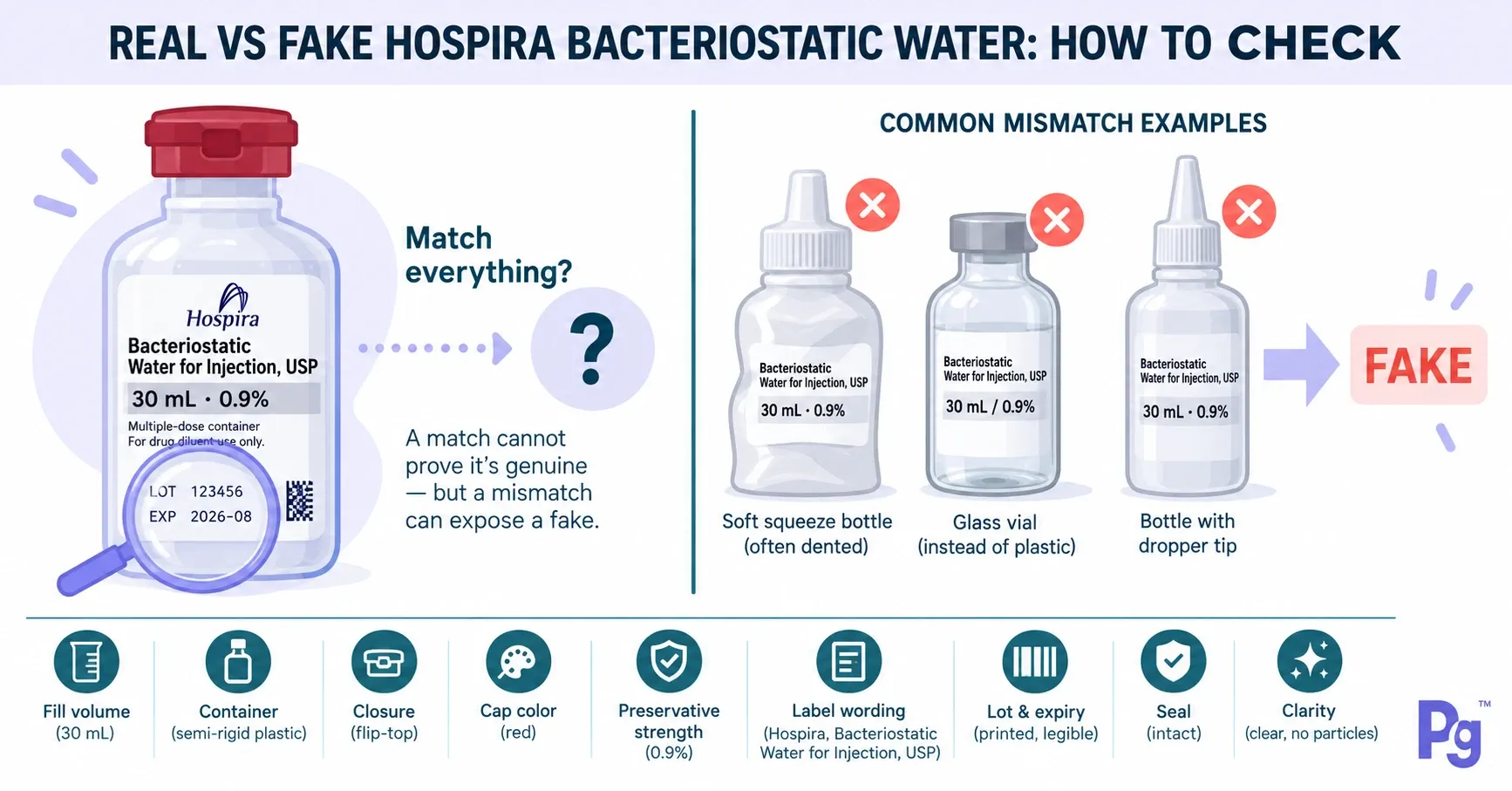
The same holds in reverse for the preservative. Bacteriostatic water inhibits bacterial growth between entries into an already-sterile fluid; it does not clean a contaminated one and it does not replace swabbing the stopper. The failure mode worth naming is the pattern mismatch rather than the choice itself: using unpreserved sterile water and then treating the vial as a multi-dose container for a week runs the diluent that has no preservative in exactly the pattern a preservative exists for.
What can a sterility result not tell you?
Everything except whether viable organisms were detected in one sample of one batch. A sterility pass says nothing about endotoxin, identity, quantity, purity, salt form, folding or chirality, and it says nothing about the vial after it has been opened. The last of those is the one people extend furthest: sterility is measured before the stopper is punctured, and every entry after that is a handling question rather than a certificate question. The test is a snapshot of the material as manufactured.
A sterility result cannot establish | The test that does | Case from this corpus |
|---|---|---|
Whether pyrogens are present | Endotoxin, LAL | Endotoxin survives sterilisation |
Which molecule is in the vial | Mass spectrometry | PT-141 and melanotan II differ by about 1 Da on 1,025 |
How much peptide is in the vial | Net peptide content | Thymalin quantity variance −10.4% to +16.5% |
Whether the material is homogeneous | HPLC purity | Meaningless on an extract with no declared analyte |
Whether a metal is present | Elemental analysis | Copper-free GHK returns a clean HPLC result |
Whether the vial is still sterile after entry | Nothing — it is a handling question | Seven punctures across seven days on a labelled multi-dose vial |
The bottom row is where the certificate stops and the user starts. That boundary is not a criticism of the test; it is the reason technique guidance exists as a separate discipline, and the reason the in-use period on a labelled product is stated in days rather than left open.
How often is sterility testing actually performed on research-market vials?
Rarely, and the corpus records it as an absence rather than as a measured rate. On thymalin — an injectable derived from animal tissue, where this test carries more weight than purity — sterility is rarely performed. Across the compound verification tables on this platform, the sterility row's red flag reads "Not performed" as the expected state, on injectables including glutathione and NAD+. This platform publishes purity test counts, not sterility test counts, so what follows is a description of what the certificates show rather than a survey.
That distinction is worth holding onto, because the honest claim here is narrower than the alarming one. We can say that sterility results are largely absent from the certificates in front of us. We cannot say what proportion of research-market vials would fail if tested, because nobody has tested a random sample and published the result. Reporting frequency is not contamination frequency, and the two get conflated constantly.
Which sterility claims survive scrutiny?
Three hold, four fail. The label-versus-nothing split on beyond-use dating is real, the sterility-endotoxin distinction is real, and the multi-dose instruction is documented on an approved label. What fails is the family of substitutions: preservative for sterilant, sterile diluent for sterile product, process claim for test result, and a purity percentage offered as evidence of microbial quality on material that has no declared analyte in the first place.
Claim | What the record shows | Verdict |
|---|---|---|
An approved label sets the in-use period | Tesamorelin: 7 doses, discard after 7 days | True — labelled |
A research vial has a beyond-use date | No label, no documented stability | False — no data |
Bacteriostatic water sterilises the vial | It inhibits growth in an already-sterile fluid | False |
A sterile diluent makes the peptide sterile | Sterility is a property of the material in the vial | False |
"Sterile filtered" is a sterility result | A process claim, not a batch measurement | Category error |
Sterility testing covers pyrogens | Endotoxin survives sterilisation | False |
Purity testing establishes microbial quality on thymalin | No declared analyte exists to measure | Category error |
Sterility outranks purity on animal-derived injectables | Endotoxin and sterility ahead of purity, on this corpus's own reasoning | True |
What does platform data show for thymalin?
It shows a deep-looking purity record on material where purity is the wrong measurement. The Purity Index records thymalin at 97.89% average across 46 tests from three named laboratories — Janoshik, Freedom Diagnostics and Chromate — against 219 verified vendors (verified August 2026), with displayed individual results running 99.20% to 99.94% and quantity variance from −10.4% to +16.5%. Only 2 of the 12 displayed tests include an endotoxin result, and sterility is rarely performed.
Two disclosures belong here. We flag an inconsistency on our own compound page: the stated average of 97.89% is lower than the stated lowest displayed test of 99.20%, meaning the average is computed over a different test set or one figure is wrong, and we are correcting it. More importantly, none of those numbers carries the meaning it would carry for a defined peptide, because a purity percentage on an undefined extract measures homogeneity against no declared standard. We publish them because they are what the laboratories reported. This is one of the few entries on the platform where we would tell you to weight the number at close to zero.
Thymalin price data shows 14 shops in stock, a median of $4.30/mg and a low of $2.50/mg on a 20 mg vial (verified 10 August 2026), with vial prices from $25.00 to $138.00. Those figures exclude shipping, taxes and customs, coupon codes, bulk tiers, multi-vial kits and account-gated pricing. Peptigrity tracks 530 shops, 11,852 independent lab tests, 118 peptides and 1,283 community reviews (verified August 2026), weighting community reviews and independently verified purity equally at 50% each — a weighting with no microbial term in it at all. Listings sit on the thymalin compound page and every result behind the figures in the independent lab tests database.
The trial that would settle whether research-market vials are sterile
No study has bought research-market vials at random, run USP <71> on every one, and published the failure rate. The absence of sterility results on certificates is documented; the sterility of the material is not, in either direction. Everything on this page describes what the paperwork establishes, and the paperwork on this question is mostly missing rather than mostly negative — a distinction the article holds to deliberately, because the alarming reading and the supported reading are not the same claim.
Element | What it would need |
|---|---|
Design | Blinded purchase-and-assay study, vials bought as an ordinary customer |
Sample | Weighted toward animal-tissue-derived injectables, where the prior is strongest |
Primary endpoint | USP <71> pass rate across vendors, reported with the sampling frame |
Secondary endpoint | Paired LAL results on the same vials, since the two questions come apart |
Comparator | 503B outsourcing facility material, subject to CGMP |
Why nobody has run it | Sterility testing is slower and dearer than HPLC, and no vendor is asking the question |
What to ask for before the money moves
Six requests, and the first two are the ones nobody makes. Ask for a USP <71> sterility result and an LAL endotoxin result on your lot number, then the purity certificate from a named third-party laboratory, a net content figure, the source material if it is animal-derived, and the batch date. On a tissue extract, reverse the usual order and lead with the microbial pair, because the identity tests cannot do their job on that material at all.
Check | What it confirms | How | Red flag |
|---|---|---|---|
Sterility | No growth detected on this batch | USP <71> result on your lot | "Not performed", or "sterile filtered" offered instead |
Endotoxin (LAL) | Pyrogen load, which sterility does not cover | A figure in EU/mL on the same lot | Blank field on an injectable |
Source material | What the vial is made from | Stated species and tissue | An extract sold with a sequence or a molecular weight |
Net peptide content | Quantity, separate from purity | Net content or amino acid analysis | Purity quoted as quantity |
Third-party purity | Homogeneity, where an analyte exists | HPLC from a named laboratory | A purity figure on an undefined extract |
In-use period | Whether anyone has defined one | The label, if there is a label | A seven-day figure borrowed from tesamorelin |
The third row is the thymalin-specific one and it inverts the usual advice. On a defined peptide, a stated sequence and mass are reassuring. On a bovine thymus extract, a stated sequence means the vendor has substituted a different compound or made the figure up, because neither exists in the product's own registration.
Frequently Asked Questions
What is USP <71> sterility testing?
USP <71> is the compendial sterility test referenced on certificates for injectable products. A pass establishes that no growth was detected under the conditions of the test on the batch submitted. It is a batch-level result on a sample rather than a certification of a product line, and it addresses viable organisms only.
Is sterility testing the same as endotoxin testing?
No. Sterility asks whether viable organisms are present; endotoxin asks whether bacterial lipopolysaccharide is present, including from organisms already dead. Endotoxin survives sterilisation, so a product can pass sterility and still carry a pyrogenic load. Pharmaceutical injectables are tested for both, and research-market vials frequently for neither.
Which peptides need sterility testing most?
Animal-tissue-derived injectables. Thymalin, Cortexin, Retinalamin and Epithalamin are undefined extracts with no declared analyte, so purity and mass spectrometry cannot perform their usual identity function, and the microbial tests carry the weight instead. Thymalin is derived from the thymus glands of calves and cattle under one year of age.
Does bacteriostatic water make a vial sterile?
No. The preservative inhibits bacterial growth in a fluid that was already sterile, which is a narrower claim than keeping something clean. It does not sterilise contaminated material, does not replace swabbing the stopper, and does not set an in-use period on its own. Where a period exists it comes from the product's label.
How long can a reconstituted peptide vial be used?
For an approved product, as long as the label says: tesamorelin's 11.6 mg multi-dose vial gives seven doses and is discarded after seven days. For a research vial there is no label and no documented stability, so no in-use period can be quoted honestly. Borrowing tesamorelin's seven days for another compound attaches a figure to material it does not describe.
What does "not performed" mean on the sterility line of a certificate?
It means the test was not run. It carries no information about the material, and it is the expected state across research-market certificates rather than a signal about one vendor. A result on a different batch is equally uninformative about the vial in hand, since sterility is a property of a production lot.
Browse the bioregulator peptides category, or our complete peptide guide with 118 compounds (verified August 2026). For per-injection volume, use the tesamorelin calculator alongside the reconstitution calculator. Compare shops through independent lab tests and community-verified shop reviews.
This article is for educational and informational purposes only and does not constitute medical advice. Peptides discussed may be investigational compounds not approved by the FDA (or equivalent regulators in your jurisdiction) for human use. Always consult a qualified healthcare provider before using any peptide or research compound. Peptigrity is an independent review platform and does not sell, endorse, or recommend specific products or vendors.