MOTS-c ships at three different molecular weights. If the certificate does not say which one was weighed, your dose is wrong by more than 5% before you draw anything up. That is the check most buyers never make.
It is an unusual compound to shop for, because the supply chain is in better shape than the evidence base. MOTS-c sits in the immune support and longevity peptides category, identity and pricing sit on the MOTS-c compound page, and the evidence picture is in MOTS-c: FDA searched the literature and found no documented human administration. This page is about the vial, the label and the certificate.
What is MOTS-c, and why does source quality matter?
MOTS-c is a 16-residue mitochondrial-derived peptide, sequence MRWQEMGYIFYPRKLR, CAS 1627580-64-6, encoded inside MT-RNR1 rather than the nuclear genome. Source quality matters for two reasons specific to this sequence: it ships at three different molecular weights depending on salt form, and it carries methionine at positions 1 and 6, both of which oxidise readily and each of which adds 16 daltons when it does. Neither problem shows up on a purity percentage.
Property | Value |
|---|---|
Sequence | Met-Arg-Trp-Gln-Glu-Met-Gly-Tyr-Ile-Phe-Tyr-Pro-Arg-Lys-Leu-Arg (MRWQEMGYIFYPRKLR) — 16 residues |
CAS | 1627580-64-6 |
MW | 2,174.6 free base · 2,234.64 acetate · 2,288.6 TFA salt |
Encoded by | MT-RNR1 — the mitochondrial 12S ribosomal RNA gene |
Class | Mitochondrial-derived peptide (MDP) |
The underlying biology is real and worth stating before the caveats, because MOTS-c is not a marketing construct. It belongs to a small family of peptides transcribed from mitochondrial DNA rather than the nuclear genome, discovered by Pinchas Cohen's group at the University of Southern California, and that discovery changed how the field thinks about mitochondrial signalling. Preclinically it activates AMP-activated protein kinase, promotes glucose uptake and improves metabolic parameters in mice, including aged mice, where it improved physical capacity. That aged-mouse result is where the "exercise mimetic" label comes from.
What makes sourcing distinctive is that neither of this compound's two real failure modes is an identity problem in the usual sense. Nobody is shipping a different molecule under the MOTS-c name. They are shipping the right molecule at an unstated mass, or the right molecule with oxygen added to it, and both pass HPLC. The category context is in peptides for energy and mitochondrial function.
What is the regulatory status of MOTS-c?
MOTS-c is an unapproved new drug with no compounding route as of August 2026. FDA's own reviewers evaluated it and recommended against listing on the 503A bulks list, citing the absence of human administration studies alongside immunogenicity risk from aggregates and peptide-related impurities; the Pharmacy Compounding Advisory Committee then voted 7 to 5, with 2 abstentions, to recommend listing anyway. WADA prohibits MOTS-c at all times under S4.4.1, AMPK activators.
Because that vote is advisory and FDA has issued no decision, no compounding route exists, so this page has no compounded-MOTS-c section. On the FDA page current 22 April 2026, MOTS-c sits in the table of bulk drug substances nominated but withdrawn — off the active Category 2 list because the nominator withdrew the nomination, not because FDA cleared it. The committee voting against its own agency's reviewers at the meeting of 23–24 July 2026 is the live regulatory node here, and it is routinely reported as though FDA were about to approve something. It is not. Our FDA peptide regulation timeline tracks what happens next.
The sport ban is the one part of this compound's status that involves no judgement call. MOTS-c is prohibited under S4.4.1, AMPK activators, on the 2026 Prohibited List — a named mechanistic category, not an inference from the S0 catch-all — at all times, in and out of competition. Any tested athlete using MOTS-c is committing an anti-doping rule violation, and do peptides show up on drug tests covers what that means in practice.
There is a quiet irony in the pairing. WADA bans MOTS-c on the strength of a mechanism established in mice, while FDA declines to endorse it for the absence of evidence in humans. Both are reading the same literature and asking different questions of it.
Claim you will meet while shopping | What the record says | Verdict |
|---|---|---|
"FDA approved it for compounding" | Advisory recommended 7–5 with 2 abstentions; FDA has not acted | False |
"Improves metabolic health in humans" | FDA found no human administration study at all | No human data |
"It's an exercise mimetic" | Mouse physical-capacity data; no human trial | Extrapolation |
"Improves insulin sensitivity" | Mouse and cell data; no human trial | No human data |
"Higher levels correlate with health" | True of endogenous levels — a different question | Misapplied |
"Anti-aging" | Aged-mouse data only | Preclinical |
"Safe at commonly used doses" | No human dose-ranging study exists | Unknown |
"It's not banned, it's just a peptide" | WADA S4.4.1, AMPK activators, at all times | True — it is banned |
"Activates AMPK" | Robust preclinical data | Preclinical, established |
"Encoded in mitochondrial DNA" | MT-RNR1, well established | True |
Read that verdict column downward and the shape is unusual. Nothing in it is refuted, because refuting a claim requires a trial that returned a negative result, and no trial has returned anything. The comparison that makes this concrete is the compound sold next to it.
Compound | Human trials | Regulatory status | WADA |
|---|---|---|---|
MOTS-c | One, recruiting, no results | Unapproved; PCAC 7–5 against FDA's advice | Prohibited, S4.4.1 |
Multiple phase 2/3, most missed primaries | FDA-approved Sep 2025 — Barth syndrome only | Not listed | |
Many RCTs; biomarker moves, function does not | Supplement / unapproved injectable | Not listed | |
Zero, ever | Unapproved | Not listed |
SS-31 holds an approval and a far worse trial record than its marketing implies, because it actually ran trials and trials produce failures. MOTS-c has no failures on its record for the same reason it has no successes.
Why does the MOTS-c salt form change your dose?
The MOTS-c salt form changes your dose because the three supplied forms differ by up to 114 daltons: 2,174.6 free base, 2,234.64 acetate and 2,288.6 TFA salt. That is more than 5% of the mass being weighed, so a vial labelled 10 mg of TFA salt contains roughly 9.5 mg of peptide. It is chemistry rather than a defect, and it becomes a defect only when the certificate does not say which form was weighed.
Form | MW | What a 10 mg label means |
|---|---|---|
Free base | 2,174.6 | The reference mass every rodent-derived protocol implicitly assumes |
Acetate | 2,234.64 | Heavier than free base — the certificate has to state it for the arithmetic to close |
TFA salt | 2,288.6 | Roughly 9.5 mg of peptide |
The spread is 114 Da, and the reason it matters is that the error is silent. A missing salt line does not make a certificate look incomplete, produce a visible discrepancy or lower the purity figure. It simply means your dose calculation used a different quantity than the scale did, in a direction you cannot infer from anything else on the page. Read the salt form before you read the purity percentage — on a compound with no clinical literature it is one of the very few checks that actually resolves to a number, and it costs nothing. The chemistry is set out in TFA versus acetate versus amidate peptide salt forms, and the closely related quantity problem in why 10 mg isn't 10 mg.
Two consequences follow for anyone doing the arithmetic. The MOTS-c calculator converts a vial and a volume into a per-injection dose, but it is working from the number you give it, so a mislabelled or unlabelled salt form propagates straight through. And because every protocol in circulation is scaled from mouse experiments that assumed free base, a TFA-salt vial dosed as though it were free base compounds an estimate with an unstated offset.
7 things to check before ordering MOTS-c
Seven checks cover MOTS-c, and two of them are specific to this sequence rather than to peptides generally: the salt form stated on the certificate, and mass spectrometry clean of the +16 Da adducts that methionine oxidation produces at positions 1 and 6. The rest are the full 16-mer mass at 2,174.6 daltons, third-party HPLC against a platform figure of 99.43, net peptide content, endotoxin, and a price check against a $4.50 per milligram median.
The salt form, named on the certificate. Free base, acetate or TFA — 2,174.6, 2,234.64 or 2,288.6. This is the first thing to look for and the most commonly missing. A certificate that reports 99% purity without naming the salt has told you the sample was homogeneous while withholding the number your dose depends on, and a 10 mg TFA vial delivering roughly 9.5 mg of peptide is the size of the gap.
Mass spectrometry confirming the full 16-mer. The target is 2,174.6 Da free base for the complete MRWQEMGYIFYPRKLR sequence. A 16-residue peptide has fifteen places to come up short, and a truncated product still elutes as a clean peak. Insist on a batch-matched result rather than a specimen certificate from an earlier lot, and read it against the salt form declared in check 1 so the two numbers are consistent, as mass spectrometry for peptides explains.
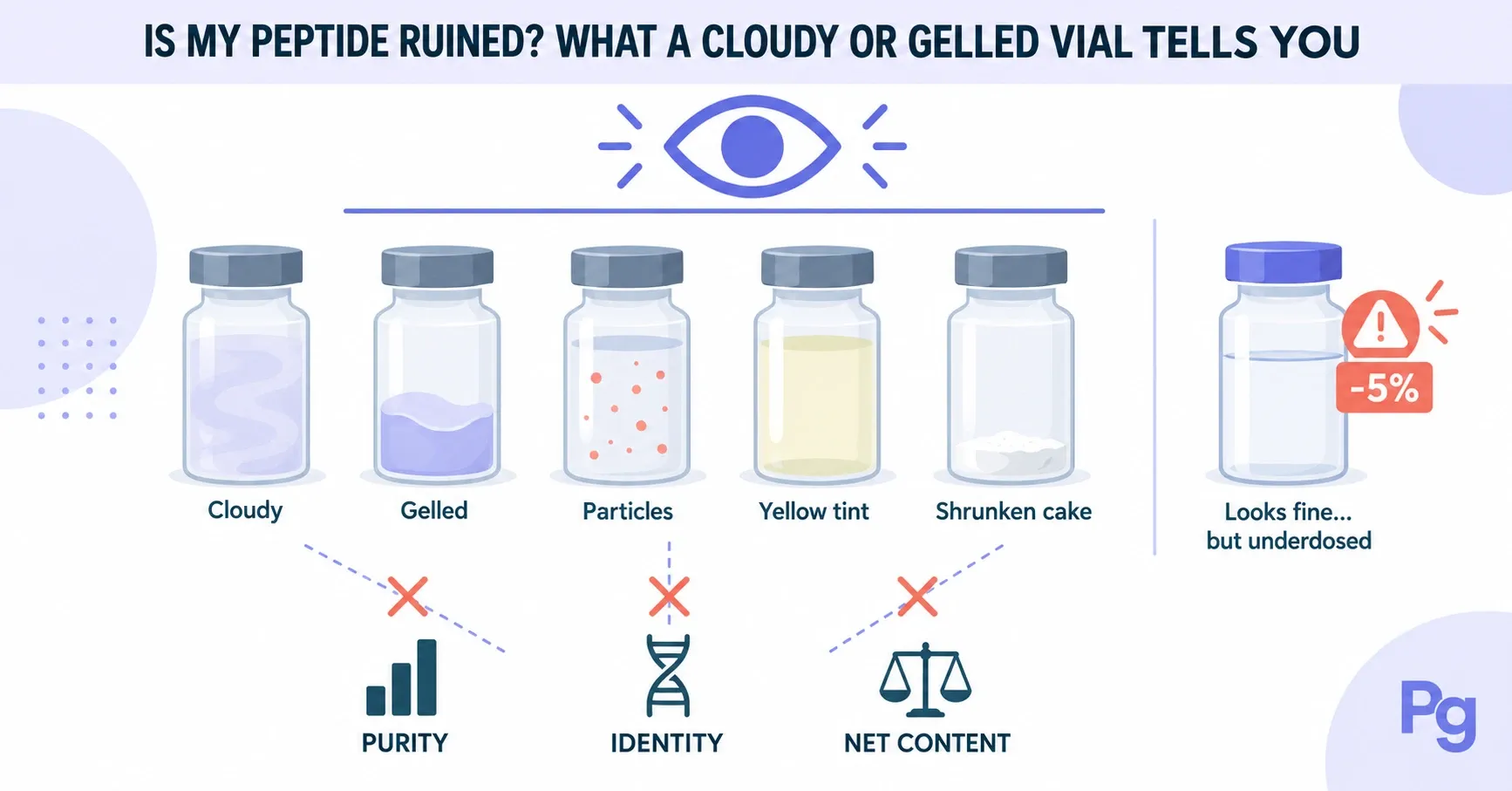
No +16 Da adducts, and evidence the vial was kept cold. MOTS-c carries methionine at positions 1 and 6, and methionine oxidises readily, each event adding 16 Da. Oxidised MOTS-c can still show high HPLC purity while being a different molecule from the one in the mouse studies, which makes storage matter more here than for most peptides. Ask about cold-chain handling and shipping conditions, not just the certificate, and see how to store peptides.
Third-party HPLC purity from a named laboratory. MOTS-c's platform figure is 99.43 across 494 recency-weighted tests from 23 laboratories, against a composite of 99.50, so this is one of the better-characterised compounds on the market and a vendor quoting a vague "high purity" is underperforming a public benchmark. Read the current number live on the Purity Index and require the lab to be named, as third-party peptide testing labs sets out.
Net peptide content, as a separate line from purity. Purity is a proportion and net content is a quantity, and they fail independently: a 99% pure vial can be substantially underfilled. On MOTS-c this stacks with the salt-form question, because both errors move the same direction — less peptide than the label implies — and neither is visible in the purity figure.
An LAL endotoxin result on the same batch. FDA's published concern about this substance is specifically immunogenicity risk from aggregates and peptide-related impurities, which makes the pyrogen axis more than a formality for injectable material. An absent LAL result means the batch was not tested rather than that it passed, as peptide endotoxin testing explains.
Shop-level reviews, a price check, and what none of it establishes. The median is $4.50/mg across 72 shops in stock, and trust scores weight community reviews and independently verified purity equally at 50% each. Screen the vendor with what to look for in a peptide shop and community-verified shop reviews. Then note the limit: a perfect certificate confirms a vendor shipped the right molecule at the right mass, and FDA reported finding no clinical study evaluating administration of MOTS-c in human subjects at all.
Check | What it confirms | How to verify | Red flag |
|---|---|---|---|
Salt form stated | Which of 2,174.6 / 2,234.64 / 2,288.6 you are weighing | Salt form named on the CoA, matching the MS result | Not stated — a >5% dose error, silently |
Mass spectrometry | The full 16-mer, not a truncation | Batch-matched CoA carrying the MS trace | HPLC purity only, no mass |
Methionine oxidation | Met1 and Met6 intact | MS showing no +16 Da adducts | Only a purity percentage; no cold-chain answer |
Net peptide content | Peptide versus salts and water | Net content or amino acid analysis figure | Purity presented as quantity |
HPLC purity | Proportion of a single species | Named third-party lab, read live against 99.43 / 494 tests / 23 labs | Vague "high purity", or the vendor's own document only |
Endotoxin (LAL) | No pyrogens in injectable material | LAL result on the batch | Field blank, against FDA's aggregate concern |
Price and shop record | The offer sits inside a known spread | $4.50/mg median across 72 shops | Outlier pricing plus an unreviewed shop |
Notice what the top three rows have in common. None of them is answered by a purity percentage, and all three are answered by a mass spectrum read against a declared salt form. On MOTS-c, one document does almost all the work, and it is not the one vendors lead with.
Where does MOTS-c rank on Peptigrity's lab test database?
MOTS-c holds one of the deepest datasets on this platform: 99.43 across 494 recency-weighted tests from 23 laboratories (verified August 2026), against a platform composite of 99.50. Price data shows 72 shops in stock at a median of $4.50/mg (verified August 2026). Those 494 tests establish that vendors are shipping the correct molecule at high homogeneity, and they say nothing at all about what it does in a person.
That coexistence is the defining feature of this compound as a purchase. FDA searched the published literature for humans given MOTS-c and reported finding none; at the time it wrote that, this platform was tracking 494 independent lab tests across 72 shops holding stock. Supply-chain quality and clinical evidence are independent variables, and MOTS-c is the cleanest example of the two coming apart. Individual certificates are searchable in the lab test database, and the live figure sits on the Purity Index. Peptigrity tracks 530 shops and 11,852 independent lab tests across 118 peptides, with 1,283 community reviews (verified August 2026).
On cost, MOTS-c price data publishes shops in stock and median price per milligram. At a median of $4.50/mg, MOTS-c is one of the more expensive compounds a buyer in this category will price, which raises the value of the salt-form check rather than lowering it: paying for TFA counter-ion by the milligram is a real cost, not a rounding error. Compare within a single vial-size band, since fixed per-vial costs push the per-milligram figure down as fill size rises. Those figures exclude shipping, taxes and customs, coupon codes, bulk tiers, multi-vial kits and account-gated pricing.
The trial that would settle this is the phase 1 nobody has run, and no amount of certificate quality substitutes for it.
Element | Requirement | Why |
|---|---|---|
Phase 1 | Human dose-ranging and pharmacokinetics | Neither exists; every current protocol is extrapolated from mice |
Population | Adults with a defined metabolic phenotype | "Exercise mimetic" is not an indication |
Design | Randomised, double-blind, placebo-controlled | Nothing in humans has ever been controlled |
Primary endpoint | Hyperinsulinaemic-euglycaemic clamp or equivalent | The mouse claim is insulin sensitivity; measure it directly |
Comparator | Exercise | If the claim is exercise mimicry, exercise is the benchmark |
Duration | 12 weeks minimum | Metabolic adaptation takes longer than a single dose |
NCT07505745 — sponsored by Hudson Biotech in Shenzhen, opened February 2026, target enrolment 120, still recruiting with nothing reported — may begin to answer some of it. Until it does, the honest description of the human evidence base is that it is empty, and a buyer should price the compound accordingly.
Frequently Asked Questions
What purity standard should MOTS-c meet?
The platform figure is 99.43 across 494 recency-weighted tests from 23 laboratories, against a composite of 99.50, so MOTS-c is well characterised and a vendor should be able to beat a vague claim with a named lab and a batch-matched certificate. Read the current number live rather than trusting one quoted in prose. Purity is not the binding constraint on this compound, though — salt form and oxidation state are.
How much does MOTS-c cost?
Seventy-two shops were in stock at a median of $4.50 per milligram (verified August 2026). Compare within one vial-size band, because fixed per-vial costs fall away as fill size rises and make larger vials look cheaper per milligram than the product warrants. At that price the counter-ion you are paying for is worth identifying. Those figures exclude shipping, taxes, coupon codes and bulk tiers.
Is MOTS-c legal to buy, and is it banned in sport?
MOTS-c is an unapproved new drug with no compounding route as of August 2026, sitting in FDA's "nominated but withdrawn" table rather than on the active Category 2 list. In sport it is unambiguous: prohibited at all times under WADA S4.4.1, AMPK activators, which is a named mechanistic category rather than an S0 inference. Any tested athlete using it commits an anti-doping rule violation.
How do I confirm I received the full 16-mer and not an oxidised or truncated version?
Ask for a batch-matched mass spectrum and read it against the declared salt form. The complete sequence is 2,174.6 Da as free base; a lower mass suggests truncation, and peaks heavier than expected by 16 Da per oxidation event suggest oxidation at methionine 1, methionine 6, or both. HPLC purity will not show you any of this, because an oxidised or shortened peptide can still be a single clean species.
What dose of MOTS-c is supported by evidence?
None. No published human dose-ranging study and no human pharmacokinetic study exists, so there is no measured half-life, no bioavailability figure and no established therapeutic window. Every milligram-per-week protocol in circulation is scaled allometrically from mouse experiments, which is a rough estimate under good conditions and is not a substitute for a phase 1 trial.
If the purity data is this good, why the caution?
Because purity and efficacy are separate questions, and this compound separates them further than most. The 494 tests across 23 laboratories establish that vendors are selling the correct molecule at high homogeneity. Nothing in that dataset speaks to what the molecule does in a human body, because FDA looked for a study in which a human was given it and reported finding none.
Browse the immune support and longevity peptides category, or our complete peptide guide with 118 compounds (verified August 2026). For per-injection volume, use the MOTS-c calculator alongside the reconstitution calculator. Compare shops through independent lab tests and community-verified shop reviews.
This article is for educational and informational purposes only and does not constitute medical advice. Peptides discussed may be investigational compounds not approved by the FDA (or equivalent regulators in your jurisdiction) for human use. Always consult a qualified healthcare provider before using any peptide or research compound. Peptigrity is an independent review platform and does not sell, endorse, or recommend specific products or vendors.