What to look for in a peptide shop is evidence you can check, and the evidence on file shows far more short-filled vials than impure ones: of the certificates behind Peptigrity's peptide COA benchmarks that measured the contents, 6.8% found less than 95% of the labeled amount, against 0.28% of results with purity under 95% (verified October 2026). A shop's purity promise, its own testimonials and its "lab-tested" banner are claims. A third-party test on the batch you would receive, other buyers' order histories and a payment you can dispute are evidence.
A certificate of analysis (COA) is a laboratory's report on one batch: what was measured, against which label, and when. This checklist runs 10 checks in the order a buyer meets them, four on Peptigrity's records and six on the shop itself, and for each one it says what the evidence proves and what it cannot. A shop can pass most of them and still ship a bad vial, so the last section covers the one check no shop record replaces.
The short version
A good peptide shop publishes third-party lab tests for the compounds it sells, on certificates whose lot numbers match the vials it ships.
Almost every certificate on Peptigrity was published by the shop that sold the vial, so the record shows what shops chose to make public rather than a random check (verified October 2026).
Fill quantity, not purity, is the weak point in those records: 6.8% of certificates that measured the contents found under 95% of the labeled amount, against 0.28% with purity under 95% (verified October 2026).
A Trust Score is a 0–100 summary of buyer reviews and lab purity alone, with no direct measure of how a shop takes payment, ships, handles complaints or who runs it.
A payment you can dispute and a small first order limit what a failed order costs, and only a test of the vial you received shows what it holds.
Which 10 checks should a peptide shop pass before you order?
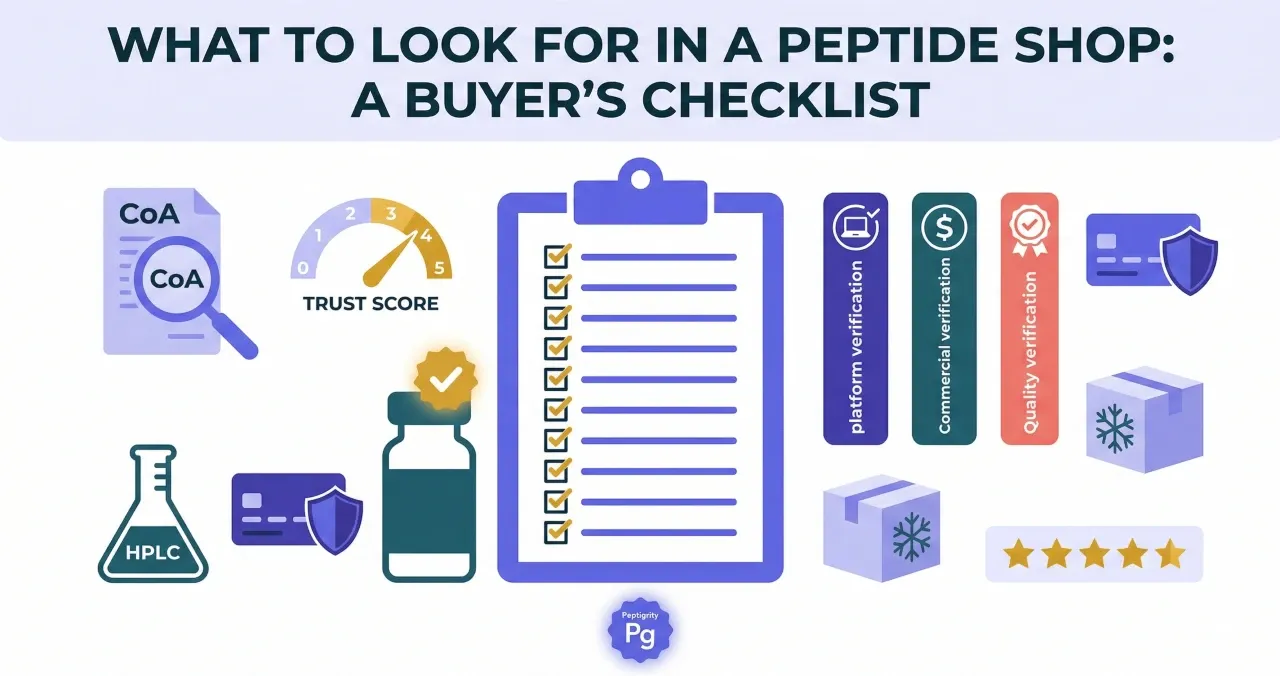
A peptide shop worth ordering from passes 10 checks: (1) a listing with a Trust Score you can read, (2) third-party lab tests for the compound you want, (3) certificates that match a lot and a lab, (4) buyer reports on delivery and service, (5) its own web address, (6) a payment you can dispute, (7) tracked shipping, (8) a price in line with tested shops, (9) a policy for failed tests and damage, and (10) a business you can identify.
The first four run on Peptigrity's records before you contact the shop, and the other six run on the shop's site and checkout. The table sets out what each check confirms, how to run it, and the result that should stop an order.
Check | What it confirms | How to verify | Red flag |
|---|---|---|---|
1. Listing and Trust Score | That independent records exist for the shop | Find the shop in the directory and read its score, label, review count and test count | No listing, or a listing with no reviews and no tests |
2. Lab tests for your compound | That a third-party lab tested what the shop sells | Look up the compound and the shop in the lab-test database, and note the test dates | No third-party test for the compound you want |
3. Certificate for your lot | That the certificate describes the batch you would receive | Match the certificate's lot number to the vial and look it up in the COA lookup | No lot number, a mismatched lot, or a report the lab cannot confirm |
4. Buyer reports | That other buyers' orders arrived and problems were handled | Read the sub-ratings and text of the shop's reviews, then the forum's vendor board | Reviews silent on delivery and service, or complaints left unanswered |
5. Web address | That you are on the shop's own site | Compare the address with the shop's listing and check the domain's registration date | A near-miss spelling, or a domain younger than the shop's claimed history |
6. Payment recourse | That you can recover money from a failed order | Look for a credit card or a buyer-protected method at checkout | Crypto, wire or payment-app payment only, or a request to pay as friends and family |
7. Shipping | That the parcel is trackable and packed to arrive intact | Read the shipping policy and the delivery notes in reviews | No tracking, or no stated ship-from country |
8. Price | That the price matches shops with tests on file | Compare the per-milligram price within the same vial-size band | A price far below the band, with no test for the batch |
9. Quality-issue policy | That the shop answers for failed tests and broken vials | Find a written policy with a claim window and read how the shop answers complaints | No written policy, or "all sales final" even for failed tests |
10. Who runs the shop | That someone identifiable stands behind the orders | Look for a business name, a registration and contact channels that answer | Messaging-app contact only, and no business name |
No row settles the question alone. A shop can carry a high score and confirmed certificates and still take only cryptocurrency, and a shop with a model refund policy can have no test on file for the compound you want. Each row covers a failure the others miss.
What does a shop's Trust Score on Peptigrity actually measure?
A peptide shop's Trust Score on Peptigrity is a number from 0 to 100 built from two inputs: buyer reviews and the purity results in third-party lab tests, weighted 50% each as of October 2026. Each half counts for more as data builds up, reaching full weight at 24 reviewers and 50 tested lots from the last 2 years, so a shop with no third-party test on file cannot score above 50. The score has no direct measure of payment, shipping, refunds or who runs the shop.
Two adjustments keep thin data from moving the number too far. Each half is pulled toward the platform average until a shop has enough reviews or tests, and the smoothed purity average is scored in bands, with 99.0% and above in the top band, so once a shop has enough tests, small differences in purity stop moving its score. A shop with one five-star review and no lab test works out at about 9 under the formula, which How Peptigrity actually works sets out with its smoothing constant and its change history (updated 19 October 2026). Scores update automatically as new reviews and tests are published.
A shop's verification label tells you which data the score rests on. Lab Verified tells you a third-party lab test is on file, Reviews Only tells you buyers have reviewed the shop but no test is on file, and Provisional tells you there is too little data to score with confidence. No label says who supplied the tested vial, how recent the test is, or whether it covers the compound you want.
In the peptide suppliers directory, shops can be ranked by Trust Score or viewed by their lab record, and a Claimed tag marks the 154 shops whose owners have proved control of the shop's domain or one of its contact channels and can reply to buyers (verified October 2026). The methodology describes no check of who the owner is, and a claim changes nothing about the score. No shop can pay to modify its score, boost its ranking or suppress negative reviews, and a shop cannot ask for its page to be removed.
A shop with no reviews and no tests is undocumented, not proven bad, and the same is true of a shop that is not listed at all. Either way, the checks below carry the whole decision, and a missing shop can be added through the site's Submit a Shop form so the next buyer has a page to read.
What do a shop's lab tests, certificates and reviews tell you?
A shop's lab tests, certificates and reviews on Peptigrity tell you what the shop has documented: which compounds a third-party lab has tested, which lots those results describe, and how other buyers' orders went. They do not tell you what your next vial holds. Of the 11,793 certificates behind the COA benchmarks, 11,790 were published by the shop that sold the vial (verified October 2026), so the record shows what shops chose to make public.
Does the shop have third-party lab tests for the compound you want?
A good shop has third-party lab tests on file for the specific compound you plan to buy, from a named laboratory, recent enough to describe current stock. The peptide lab tests database lists results by compound and by shop, and each result shows the lab, the test date and who supplied the vial. A shop with 40 results for one compound and none for yours has no record for yours.
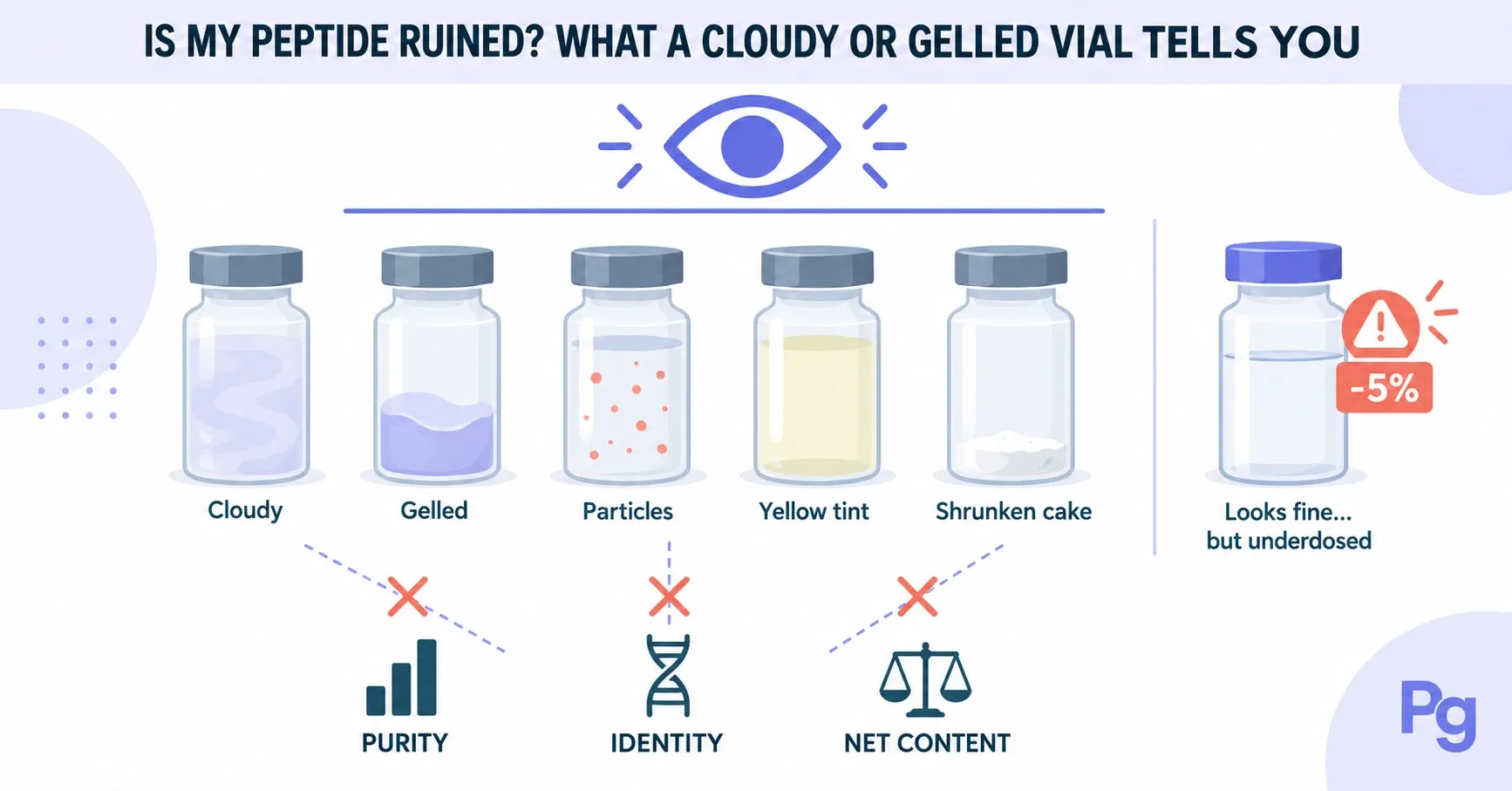
Read which measurement each result reports, because there are three and they answer different questions. Purity is the share of the peptide content that is one compound, measured by HPLC (high-performance liquid chromatography). Identity is whether that compound is the molecule on the label, measured by mass spectrometry. Net content is how many milligrams are actually in the vial. A vial can pass on purity and fail on the other two, and purity alone rarely separates shops: more than 98 of every 100 results in the database are 98% pure or higher (verified October 2026).
Peptigrity does not accept reports from a shop's own in-house lab, and it lists, but leaves out of every score and count, the certificates a shop's supplier ran before the batch reached the shop (verified October 2026). Of the 35 peptide testing labs in the directory, 21 publish a public lookup portal where a certificate can be checked against the lab's own copy (verified October 2026).
Does the certificate match a lot, and does the lab confirm it?
A certificate counts only when it describes the batch you would receive and the lab that issued it can confirm it. Check that it names the laboratory, shows a test date and carries a lot number, the batch code printed on the vial, that matches your vial. On Peptigrity, 12,053 of the 13,520 certificates on file carry a lot number, and 3,527 have been confirmed on the issuing lab's own portal (verified October 2026).
Typing a lot number into the peptide COA lookup returns every certificate on file for that lot, what the lab measured against the label, and one of three statuses: confirmed on the lab's portal, on file but not yet checked, or could not be confirmed. A certificate for your lot describes that production run, not how your particular vial was stored or shipped.
A usable certificate shows five things: the lot number, a chromatogram (the trace the instrument prints) rather than a typed purity figure alone, a mass result that confirms identity, the milligrams recovered against the label, and, for an injectable, an endotoxin result. Endotoxin is a fever-causing residue of bacterial cell walls, measured by the Limulus amebocyte lysate (LAL) test in endotoxin units (EU). FDA's inspection guide Bacterial Endotoxins/Pyrogens puts the approximate threshold pyrogen dose for humans at 5.0 EU per kilogram of body weight for most injected drugs. A blank endotoxin field means the test was not run, not that the vial passed.
Peptigrity's guide Red Flags in Peptide Certificates of Analysis sets out the document defects that make a certificate worthless, from a test date that predates the vial to a purity figure quoted as though it were a quantity.
What do other buyers report about the shop?
Other buyers' reports show how a shop handles orders, delivery and problems, which no lab test measures. Each review on a shop's Peptigrity page carries an overall rating, sub-ratings for quality, delivery, service and pricing and, where the reviewer answered, whether they would buy again. Read for patterns across reviews rather than the headline score: a shop rated well on quality and poorly on service ships good vials and handles problems badly.
Reviews are limited to one per shop per registered account, can be edited for 24 hours and then lock, and negative reviews are not suppressed (verified October 2026). The record is thin: Peptigrity's 976 reviews cover fewer than 170 of the 789 shops it lists (verified October 2026), so most shops have no buyer reviews at all.
For the parts of an order a review does not capture, such as a parcel stuck for weeks or a shop that stops answering, the forum's Peptide source & vendor talk board is where buyers compare notes on orders, shipping and support, and where Peptigrity's staff log shop closures. A buyer's post there is one buyer's account.
Which checks do you run on the shop's own site and checkout?
Six checks run on the shop itself, because Peptigrity's score does not measure them directly: whether the web address is the shop's own, whether checkout offers a payment you can dispute, how the order ships, whether the price fits what tested shops charge, what happens when a test fails or a vial breaks, and who stands behind the business. Each can be run before you pay, and each covers a failure that a perfect certificate would not reveal.
Is the web address the shop's own?
The web address is the shop's own when it matches the address on the shop's independent listing, not only the link in a forum post, an ad or a message. Peptigrity sends buyers to a listed shop through a peptigrity.com/go/ link that counts the referral and carries no commission, so you can compare the address you were sent with the one on file. A near-miss spelling is a reason to stop.
A domain's registration record is public: ICANN Lookup, run by the body that coordinates domain names, shows a domain's current registration data. A recent registration for a shop that claims years in business is a question to put to the shop, because a rebrand or a new domain explains it and an invented history does not.
Not every shop has a website. The directory lists 40 shops with none, and its channel filters count 56 shops selling on Telegram and 60 on WhatsApp (verified October 2026); for those, the same check means matching the channel to the contact channels on the shop's listing. Shops in this market also close, and a closed shop's name can outlive it: Peptigrity's staff have logged several 2026 closures on the forum's vendor board, one of them with a warning about new sites using the closed shop's name.
Does checkout offer a payment you can dispute?
A shop worth paying offers at least one payment method you can dispute if the order never arrives, such as a credit card or a PayPal payment for goods and services. Bank and wire transfers, cryptocurrency, payment apps and gift cards are hard to reverse, and the Federal Trade Commission's alert A way to spot scams: how someone asks you to pay (July 2026) treats a seller who will take only those as a likely scammer and recommends a credit card where possible.
PayPal's help page Does PayPal cover my purchase if there's a problem? lists Friends and Family payments among those its Purchase Protection does not cover, so a shop that asks to be paid that way is asking you to give up the protection.
Orders that never arrive are a documented risk of buying drugs online. For the study Multifactor Quality and Safety Analysis of Semaglutide Products Sold by Online Sellers Without a Prescription: Market Surveillance, Content Analysis, and Product Purchase Evaluation Study (Ashraf et al., 2024), researchers placed test orders with six illegal online pharmacies; none of the three prefilled pens they ordered arrived, and the sellers then asked for extra payments, such as a US $1,200 "insurance fee", to release the parcels from customs. A payment you can dispute is what lets a buyer recover from a loss like that.
Payment is not a Trust Score input, so refund experiences show up in the service notes of a shop's reviews, and Peptide Shop Payment Methods compares the recourse each method leaves you. A small first order limits what any failure costs.
How does the shop ship?
A good shop ships tracked, states where it ships from and packs vials so they arrive sealed, with the freeze-dried powder intact and the label readable. Whether a cold pack matters depends on the compound, the season and the transit time, which Peptigrity's guide Peptide Shipping works through case by case. The delivery sub-rating and delivery notes in a shop's reviews show how its parcels actually arrived.
Peptigrity's directory records a ship-from country for 67 of the 789 shops it lists (verified October 2026), so for most shops the origin is something to confirm on the shop's own site or by asking. An international parcel can be held at customs, and a shop that will not name its origin leaves you unable to judge that risk. Photograph the parcel and the vial when they arrive, because a damage claim needs the evidence.
Does the price fit what tested shops charge?
A fair price sits inside the range that shops with third-party tests on file charge for the same compound and vial size. On the BPC-157 price comparison, vials of 0.5–5 mg had a median of $7.00/mg and vials of 10–80 mg a median of $4.90/mg (verified October 2026), before shipping, taxes and customs, and its lowest figure, $1.19/mg, was an 80 mg vial. A price far below its band is a reason to ask for the batch's certificate, not proof the vial is bad.
The peptide price comparison runs the same check for 72 compounds, read daily from the public storefronts of shops with third-party tests on file and excluding shipping, taxes and customs. Per-milligram cost falls as vial size rises, so compare within your own size band; on the BPC-157 page, offers priced in pounds, euros or Canadian dollars are left out of the comparison, so convert a local price before comparing it.
What happens if a test fails or a vial arrives broken?
A good shop publishes a policy that covers a failed independent test, a broken or leaking vial and a wrong product, with a claim window and the evidence it accepts, such as photos on arrival or a third-party certificate for the batch. Those are the cases that cost buyers money, so this policy matters more than a returns page. How a claimed shop answers its negative reviews shows how it handles problems in practice.
Claimed shops can reply to reviews publicly on their Peptigrity page, so the replies are part of the record. A public reply that offers a replacement or a refund shows the policy being applied; a run of unanswered complaints about failed tests shows a gap between the policy and the practice.
Who runs the shop, and can you verify it?
A shop you can hold to account names the business behind it and gives contact channels that answer, and where it states a country of registration, that country's company register can confirm the name. A Claimed tag on Peptigrity confirms control of a domain or a contact channel, which is not the same as knowing who runs the shop. A shop that names no business gives you no one to hold to its policy, whatever its website promises.
"Research use only" on a product page is the label these compounds are sold under. It describes the vial rather than the sale, and as the grey market for peptides reference explains, nobody upstream of the buyer answers for the batch. Privacy is common in this market and is not a warning sign by itself; complete anonymity combined with messaging-only contact and no written policy is.
What does Peptigrity's data show about the shops it lists?
Peptigrity's data shows plenty of shop-published certificates, very few independent purchases, and fill quantity as the weak point. The platform lists 789 shops and 13,520 published lab tests (verified October 2026), and only 3 of the certificates behind its COA benchmarks came from vials buyers bought themselves. A short fill is about 24 times as common as low purity: 790 of 11,655 certificates that measured content, 6.8%, found under 95% of the labeled amount, against 33 of 11,767, 0.28%, with purity under 95% (verified October 2026).
Readings run high as well as low: 15% of the same certificates, about 1 in 6, came in above 120% of the label. Some laboratories weigh the whole powder, salts and moisture included, and Peptigrity's methodology says it cannot tell such a gross-mass reading from a real overfill, so a high reading is a filling inconsistency rather than a bonus.
The table collects the figures this checklist uses, each read from the page named in the last column (verified October 2026).
Record | Figure | Published on |
|---|---|---|
Shops listed | 789 | Homepage |
Lab tests published | 13,520 | Homepage |
Certificates behind the COA benchmarks | 11,793 | COA benchmarks |
Of those, published by the selling shop | 11,790 | COA benchmarks |
Of those, sent in by buyers | 3 | COA benchmarks |
Of those, commissioned by Peptigrity | 0 | COA benchmarks |
Certificates that measured the contents | 11,655 | COA benchmarks |
Of those, under 95% of the label | 790 (6.8%) | COA benchmarks |
Of those, above 120% of the label | 15%, about 1 in 6 | COA benchmarks |
Purity results under 95% | 33 of 11,767 (0.28%) | COA benchmarks |
Certificates that carry a lot number | 12,053 of 13,520 | COA lookup |
Certificates confirmed on the lab's own portal | 3,527 of 13,520 | COA lookup |
Testing labs listed, and those with a public lookup portal | 35, and 21 | Testing labs directory |
Buyer reviews | 976 | Homepage |
Shops with at least one review | fewer than 170 | Review hub |
Shops claimed by their owners | 154 | Shop directory |
These figures describe what was published, not what a random vial contains. A shop decides which certificates to publish, so the record may differ from what an unannounced purchase would find. We publish the figures because they are what the laboratories reported, and they are why this checklist ends with a test of your own vial.
What can a shop checklist not tell you about your vial?
A shop checklist cannot tell you what your vial contains, because every check describes the shop and its earlier batches, not the vial in your hand. A shop can pass all 10 checks and still ship a short fill, which Peptigrity's records show far more often than low purity. The only direct answer is a third-party test of the vial you received, covering identity by mass spectrometry, purity by HPLC and the milligrams in the vial.
Peptigrity's guide how to test your peptides covers which tests to order, what they cost and how to send a sample to an independent lab. Recording the lot number when a vial arrives lets you look it up later, and adding your result through Submit a lab test puts it on the record for the next buyer.
If a check has already failed, whether a parcel that never arrived, a certificate its lab cannot confirm or a site that turns out to be a copy, How to Spot a Scam Peptide Shop covers how the common scams in this market work and what to do after one.
Frequently Asked Questions
Is a high Trust Score enough to trust a peptide shop?
No: a high Trust Score shows that a shop has good reviews and high purity results on file, and nothing else. It has no direct measure of payment, shipping, refunds or who runs the shop, and almost all of the purity results behind it were published by the shop itself. Treat it as the first of the 10 checks, not the last.
What does it mean if a shop has no reviews or lab tests on Peptigrity?
It means nobody has documented the shop yet, which makes it unknown rather than proven bad. Reviews are the scarcer record: fewer than 170 of the 789 listed shops have even one (verified October 2026). A first order from an undocumented shop carries more risk, so keep it small and pay with a method you can dispute.
Can a shop pay Peptigrity for a better score or to remove bad reviews?
No shop can pay to modify its score, boost its ranking or suppress negative reviews, and a shop cannot ask for its page to be removed. Claiming a page lets the owner reply to reviews, but it changes nothing about the score (verified October 2026).
Two shops have the same lab results — how do you choose between them?
Choose on what a purity figure cannot settle. Compare whether each shop's certificates carry lot numbers the lab confirms and report the milligrams in the vial, then compare payment recourse, written policies and buyer reports on delivery and service. Two shops with identical purity can differ on every one of those.
Is a cheaper peptide shop more likely to sell underdosed vials?
A low price does not by itself point to an underdosed vial: the lowest per-milligram prices are often bulk vials, and price says nothing about a specific batch. Compare within the same vial-size band on Peptigrity's price pages, and treat a price far below that band as a reason to ask for the batch's certificate.
This article is for educational and informational purposes only and does not constitute medical advice. Peptides discussed may be investigational compounds not approved by the FDA (or equivalent regulators in your jurisdiction) for human use. Peptigrity does not recommend doses; any dose figure above is an approved-label value, a published-trial value or a community report, and is labelled as such. Always consult a qualified healthcare provider before using any peptide or research compound. Peptigrity is an independent review platform and does not sell, endorse, or recommend specific products or vendors.