Tirzepatide is titrated in 2.5 mg steps. Across 930 independent lab tests on this platform, vial contents run from 2.6% to 26.7% over label. The increment is smaller than the error, and that is the whole problem.
This page works through reconstitution, the mg-to-unit conversion and the titration ladder, then does the thing most dosing guides skip: it translates a fill overage back into rungs on that ladder. Run your figures through the tirzepatide calculator as you go. Tirzepatide sits in the weight loss and metabolic peptides category, and every worked example here is arithmetic on stated inputs, not a recommendation to use any amount.
How is tirzepatide titrated, and what anchors the ladder?
Tirzepatide is titrated in 2.5 mg steps under its approved labels, and the amounts above that starting point come from a trial record rather than from convention. SURMOUNT-1 randomised 2,539 participants for 72 weeks and tested 5, 10 and 15 mg, producing −15.0%, −19.5% and −20.9% against −3.1% on placebo, all at P<0.001. SURMOUNT-5 used maximum tolerated doses of 10 or 15 mg. Which rung anyone occupies is a prescriber's decision.
Route | Amount | Frequency | Duration | Evidence level |
|---|---|---|---|---|
Subcutaneous | Titration in 2.5 mg increments | Once weekly | Escalation phase | Approved label |
Subcutaneous | 5 mg | Once weekly | 72 weeks in SURMOUNT-1 | Human RCT, −15.0% |
Subcutaneous | 10 mg | Once weekly | 72 weeks in SURMOUNT-1 | Human RCT, −19.5% |
Subcutaneous | 15 mg | Once weekly | 72 weeks in SURMOUNT-1 | Human RCT, −20.9% |
Subcutaneous | 10 or 15 mg maximum tolerated | Once weekly | 72 weeks in SURMOUNT-5 | Human RCT, −20.2% |
Research-market vial | Chosen by the buyer | Chosen by the buyer | Chosen by the buyer | None |
Two things that table does not contain are worth naming. It carries no week-count between rungs, because the interval is a prescribing instruction and this page does not invent one. And it separates label from trial deliberately: 2.5 mg is the increment the label titrates in, while 5, 10 and 15 mg are the arms a randomised trial actually ran. Those are different kinds of fact and a dosing table that merges them is telling you less than it appears to.
At least 20% weight loss was reached by 50% of the 10 mg arm and 57% of the 15 mg arm against 3% on placebo, which is the result behind the "about 21%" figure in circulation. The full record sits in the dual GIP/GLP-1 agonist that beat semaglutide by 6.5 points, and the question of which compounds have a validated dose at all is handled in the peptide dosage guide.
How do you reconstitute a tirzepatide vial and fix a concentration?
Concentration is peptide mass divided by diluent volume, and it is the number every later step inherits. A 30 mg vial reconstituted with 3 mL of bacteriostatic water gives 10 mg/mL. No approved reconstitution instruction exists for a research-market tirzepatide vial — the only regulator-backed peptide reconstitution instruction in this fact base belongs to tesamorelin — so the diluent volume is a choice you make rather than one a label makes for you, and it cannot be undone.
Worked example 1 — concentration
Step | Value |
|---|---|
Input: vial label | 30 mg |
Input: diluent added | 3 mL |
Calculation | 30 mg ÷ 3 mL |
Result | 10 mg/mL, or 10,000 mcg/mL |
Write that figure on the vial with the date, because every dose drawn afterwards depends on it and nothing about the liquid reveals it later. The reconstitution calculator performs the same division and the bacteriostatic water calculator runs it backwards, from a target concentration to the volume that produces it.
The physical procedure — swabbing, running the diluent down the wall, swirling rather than shaking — is set out in reconstituting peptides step by step, and what the preservative in bacteriostatic water does and does not license is in what benzyl alcohol permits in a reconstituted vial. One point carries over from there: no in-use period can be quoted honestly for a research vial, because no label sets one.
What does each 2.5 mg step measure on a U-100 syringe?
A U-100 syringe reads in volume, where one unit is 0.01 mL, so units equal dose in milligrams divided by concentration in mg/mL, multiplied by 100. At 10 mg/mL, a 5 mg dose is 0.5 mL or 50 units, and the top two rungs of the ladder exceed a 1 mL barrel. At 20 mg/mL the entire ladder fits on one barrel, which is the useful contrast: tirzepatide's ladder can be served by a single concentration if you choose one deliberately.
Weekly amount | At 10 mg/mL | At 20 mg/mL |
|---|---|---|
2.5 mg | 25 units | 12.5 units |
5 mg | 50 units | 25 units |
7.5 mg | 75 units | 37.5 units |
10 mg | 100 units — a full 1 mL barrel | 50 units |
12.5 mg | 125 units — will not fit | 62.5 units |
15 mg | 150 units — will not fit | 75 units |
Worked example 2 — one rung, two concentrations
Step | At 10 mg/mL | At 20 mg/mL |
|---|---|---|
Input: intended dose | 7.5 mg | 7.5 mg |
Volume | 7.5 ÷ 10 = 0.75 mL | 7.5 ÷ 20 = 0.375 mL |
Units | 75 units | 37.5 units |
Both columns are examples rather than recommendations, and the right-hand one has a cost the left does not: half-unit readings on rungs that land on odd multiples. That is a resolution problem rather than an impossibility, and it is decided before mixing. The sibling article on the semaglutide dosing chart faces the opposite situation, where no single concentration serves the whole approved range. The general form of this arithmetic is in how to calculate peptide doses, and the tirzepatide calculator runs it directly.
Why is fill quantity the specific risk on tirzepatide?
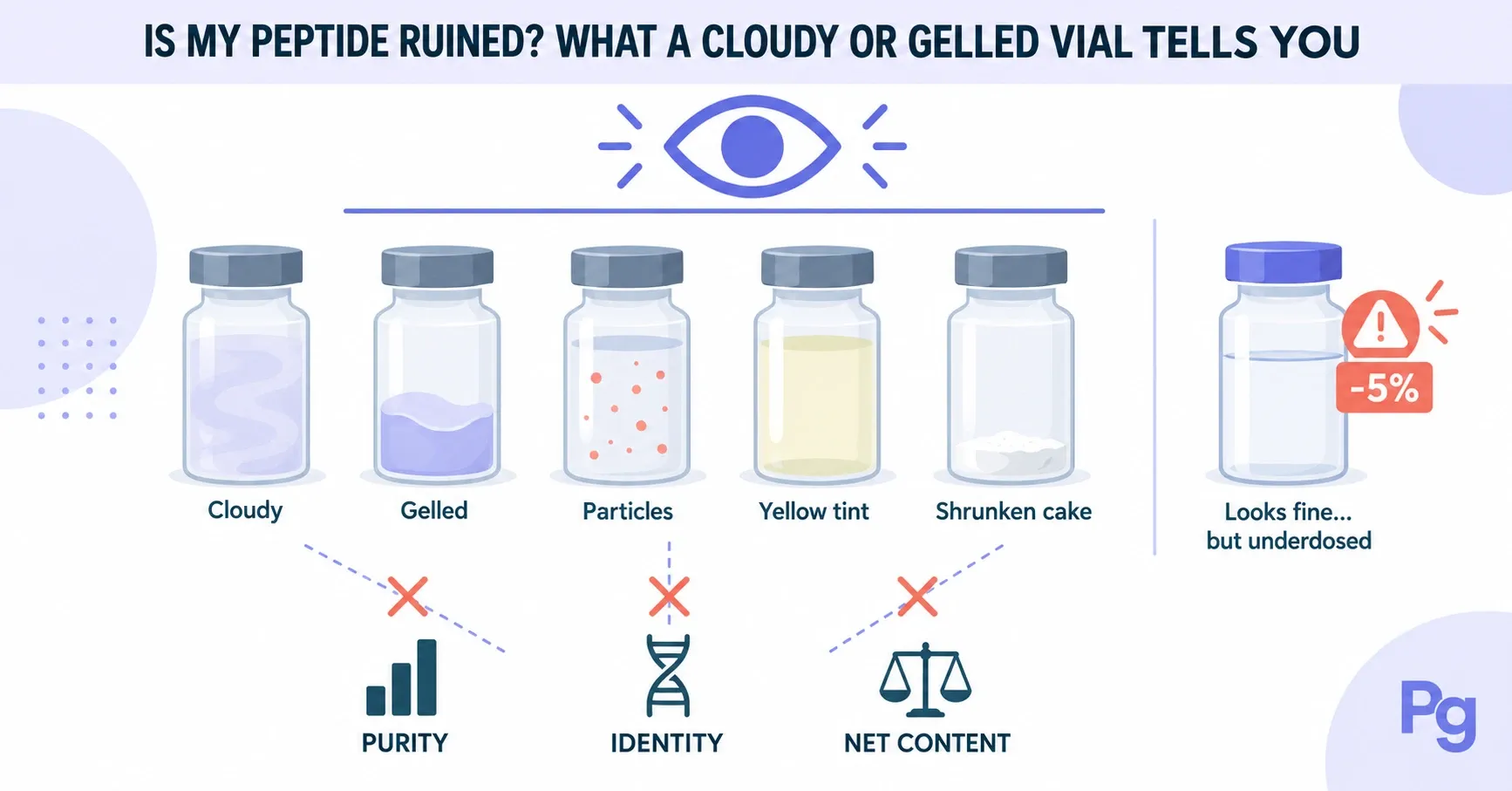
Identity is not the failure mode on this compound. The Purity Index records tirzepatide at 99.75% average purity across 930 independent tests (verified August 2026) from Freedom Diagnostics, Kovera, ILS, Accumark and MZ Biolabs, across 227 shops selling — one of the deepest datasets on this platform. Quantity is the failure mode: variance runs +2.6% to +26.7% against label, with vials labelled 10 to 65 mg testing between 10.71 and 68.1 mg.
That combination is unusual and it inverts the normal advice. On most compounds the useful question is whether the vial contains the right molecule; here the market answers that question well and the open one is how much of it there is. A 99.75% purity figure is a statement about proportion. It says nothing whatsoever about mass, and reading it as reassurance about quantity is a category error rather than an approximation.
The reason it matters more here than almost anywhere else is the size of the increment. The label titrates in 2.5 mg steps, and the recorded variance reaches 26.7% — which on a 10 mg intended dose is larger than a whole step. Purity and net content fail independently and answer different questions, as set out in why 10 mg isn't 10 mg.
What does a 26.7% overage do to your position on the ladder?
Expressed as a percentage, a fill overage sounds like a rounding argument. Expressed in rungs, it is a dose change nobody chose. At the recorded maximum of +26.7%, an intended 10 mg delivers 12.67 mg — past the next rung up — and an intended 15 mg delivers 19.01 mg, which is above the highest dose ever tested in a randomised trial. The bottom of the recorded range, +2.6%, is genuinely trivial. The top of it is not.
Intended rung | At +2.6% | At +10% | At +26.7% | Where +26.7% lands |
|---|---|---|---|---|
2.5 mg | 2.57 mg | 2.75 mg | 3.17 mg | Between rungs one and two |
5 mg | 5.13 mg | 5.50 mg | 6.34 mg | Between rungs two and three |
7.5 mg | 7.70 mg | 8.25 mg | 9.50 mg | Just under the 10 mg rung |
10 mg | 10.26 mg | 11.00 mg | 12.67 mg | Past the 12.5 mg rung |
12.5 mg | 12.83 mg | 13.75 mg | 15.84 mg | Above the 15 mg top rung |
15 mg | 15.39 mg | 16.50 mg | 19.01 mg | Above any dose ever studied |
Worked example 3 — the overage propagating through the arithmetic
Step | If the label is right | If the batch assays +26.7% |
|---|---|---|
Vial label | 30 mg | 30 mg |
Peptide mass present | 30 mg | 38.01 mg |
Diluent | 3 mL | 3 mL |
Concentration | 10 mg/mL | 12.67 mg/mL |
A 100-unit draw delivers | 10 mg | 12.67 mg |
Nothing in that right-hand column is visible at the point of injection. The powder looks the same, the solution looks the same, the barrel reads 100 units either way, and the only thing that differs is the number the calculation was built on. That is what distinguishes this risk from a technique error: technique errors are visible while they happen and this one is not.
Which direction does the error run, and why does the direction matter?
The overage runs toward the effects that make people stop. Gastrointestinal adverse events are this class's dose-limiting problem, and in SURMOUNT-1 discontinuation due to adverse events ran 4.3%, 7.1% and 6.2% across the 5, 10 and 15 mg arms against 2.6% on placebo. Those rates are low for the class — and they were measured on trial material of known content, under a supervised escalation, which is exactly the condition an overfilled research vial does not reproduce.
Read that alongside the previous table and the mechanism is plain. A vial 26.7% over label moves a person up the ladder without telling them, at the moment they believe they are holding steady, and the symptom that results looks like ordinary dose-related nausea rather than like a measurement problem. The natural response — attributing it to the step you think you are on — is the wrong diagnosis of the right symptom.
The adverse-event picture in detail, including what SURMOUNT recorded and what it did not, is in tirzepatide side effects and the SURMOUNT data. Anything about how to respond to symptoms is a clinician's call, not this page's.
Can you correct for an overage, and when can you not?
You can correct for it only when you have a number to correct with, and that number comes from quantitative content testing on your batch. A 30 mg vial that assays at 38.01 mg needs 3.8 mL of diluent rather than 3 mL to return to 10 mg/mL — a single division that restores every unit figure downstream. Without a batch assay there is no correction, because the size of the error is unknown and a range of +2.6% to +26.7% is too wide to split.
Worked example 4 — recalculating the diluent from an assayed mass
Step | Value |
|---|---|
Input: label | 30 mg |
Input: assayed content | 38.01 mg |
Target concentration | 10 mg/mL |
Calculation | 38.01 mg ÷ 10 mg/mL |
Result | 3.8 mL of diluent, not 3 mL |
A 100-unit draw then delivers | 10 mg, as intended |
Two constraints sit on that example. It only works before the diluent goes in, because the volume is irreversible once added and topping up an open vial invalidates every dose calculated from it. And it requires an assay of the batch in your hand, not a certificate for a different lot and not a purity percentage — a 99.75% result and a +26.7% fill can be true of the same vial simultaneously.
Where no assay exists, the honest position is that the concentration is unknown within a recorded range rather than known to be correct. The reverse dose calculator will tell you what a draw delivered on your assumed concentration, which is useful for catching transcription errors and useless for catching this one.
Which tirzepatide dosing and reconstitution errors actually cause harm?
The errors here divide by whether anything downstream catches them, and mostly nothing does. Calculating from the label mass when an assay exists discards the better number. Reading purity as quantity answers a question nobody asked. Topping up an open vial silently invalidates every prior calculation. Each produces a wrong amount that looks identical to a right one at the point of injection, which is why the checks have to happen before the diluent goes in.
Calculating from the label mass when a batch assay is available. The assay is the measurement; the label is the claim. Where both exist, use the measurement.
Reading a 99.75% purity figure as confirmation of quantity. Purity is a proportion and net content is a quantity. They fail independently, and on this compound the second one fails more often.
Topping up an open vial with extra diluent. Every unit figure calculated before the top-up is now wrong, and nothing on the vial records that.
Splitting a 12.5 mg or 15 mg draw across two injections at 10 mg/mL. Two partial volumes are two chances to misread, and the total cannot be verified afterwards. Choose the concentration that holds the rung.
Copying a protocol's diluent volume without its vial size. "3 mL" means nothing without the mass it went into. A 30 mg vial and a 60 mg vial at 3 mL are different drugs as far as the syringe is concerned.
Treating a trial arm as a starting dose. SURMOUNT-1's lowest arm was 5 mg; the label's increment is 2.5 mg. Those are different numbers doing different jobs.
Assuming an unusually cheap vial is simply good value. If the fill runs over, the milligrams paid for and the milligrams present are different figures — favourably on price, unfavourably on dose.
Injection technique errors, from reusing a transfer needle to injecting into a reactive site, are covered in how to inject peptides. As of 30 November 2024, FDA had received more than 215 adverse event reports for compounded tirzepatide. Those are spontaneous reports rather than trial data, and the figures have not been updated since.
What is tirzepatide approved for, and what is it not?
Tirzepatide is approved as Mounjaro (NDA 215866, 13 May 2022) for glycaemic control in type 2 diabetes and as Zepbound (NDA 217806, 8 November 2023) for chronic weight management, both carrying a boxed warning for thyroid C-cell tumours based on rodent findings. Zepbound added obstructive sleep apnoea through supplement SUPPL-13 on 20 December 2024. There is no heart failure, HFpEF or cardiovascular outcome indication on either product.
Mounjaro | Zepbound | |
|---|---|---|
NDA | 215866 | 217806 |
Original approval | 13 May 2022 | 8 November 2023 |
Indication | Glycaemic control in type 2 diabetes | Chronic weight management |
Added since launch | Paediatric extension, SUPPL-39, 19 December 2025 | Obstructive sleep apnoea, SUPPL-13, 20 December 2024 |
Boxed warning | Thyroid C-cell tumours / MTC / MEN2 | Same |
The label is quoted here rather than paraphrased, because on an approved drug the label is the source of truth. Zepbound's current text reads "to treat moderate to severe obstructive sleep apnea (OSA) in adults with obesity," and Mounjaro's covers "adults and pediatric patients 10 years of age and older with type 2 diabetes mellitus." Anything describing Mounjaro as adults-only is out of date.
None of that licenses a research vial. Compounding an essential copy was permitted only while tirzepatide was in shortage, and FDA's shortage database now lists Tirzepatide Injection as "Resolved" — see compounding pharmacy versus research peptide. A dosing page can tell you what a labelled amount converts to; it cannot make an unapproved supply route into a prescription.
Which tirzepatide dosing claims survive the evidence?
Four of these nine claims hold. The ladder is titrated in 2.5 mg steps, SURMOUNT-1 tested 5, 10 and 15 mg, average purity is 99.75% across 930 tests, and 20 mg/mL puts the whole ladder on one barrel. The rest fail: purity does not settle quantity, no reconstitution volume is standard for a research vial, and a 26.7% overage is a dose change rather than a rounding difference.
Claim | Evidence | Verdict |
|---|---|---|
Tirzepatide is titrated in 2.5 mg increments | Approved label | Correct |
5, 10 and 15 mg are the studied weekly doses | SURMOUNT-1, n=2,539, 72 weeks | Correct — human RCT |
Tirzepatide vials are reliably the right molecule | 99.75% across 930 independent tests | Broadly correct |
A high purity result means the fill is right | Variance runs +2.6% to +26.7% | Category error |
A 26.7% overage is a rounding difference | 10 mg intended delivers 12.67 mg | False — that is a rung |
2 mL is the standard diluent volume | No approved reconstitution instruction exists for a research vial | Convention only |
15 mg fits a 1 mL barrel at 10 mg/mL | 150 units against a 100-unit barrel | False |
Tirzepatide is approved for heart failure | No such indication exists on either product | False |
Tirzepatide is banned in sport | Not on the WADA 2026 Prohibited List | False |
One row there needs a caveat rather than a correction. Tirzepatide is not prohibited, but from 1 January 2026 markers of tirzepatide and semaglutide are monitored both in and out of competition. Monitoring is not prohibition; it does mean use is being tracked.
What do 930 independent lab tests and the price data show?
Peptigrity tracks 530 shops and 11,852 independent lab tests across 118 peptides, with 1,283 community reviews (verified August 2026), and trust scores weight community reviews and independently verified HPLC purity equally at 50% each. Tirzepatide price data shows 14 shops in stock, a median of $5.67/mg and a lowest of $1.17/mg on a 60 mg vial (verified 9 August 2026), across 48 compared offers with vial prices from $19.99 to $465.00.
Vial size | Median price per mg (verified August 2026) |
|---|---|
5–10 mg | $9.60/mg |
15–35 mg | $5.69/mg |
40–120 mg | $3.85/mg |
All sizes | Median $5.67/mg · lowest $1.17/mg on a 60 mg vial |
Those figures exclude shipping, taxes and customs, coupon codes, bulk tiers, multi-vial kits and account-gated pricing. Per-milligram price on this compound is partly fictional in a way it is not for most peptides: if the fill runs to +26.7%, the milligrams paid for and the milligrams present are different numbers, in your favour on price and against you on dose. A cheap vial holding a quarter more drug than it claims is not a bargain, it is an unlabelled dose change. Convert per-milligram figures into per-dose cost with the cost-per-dose calculator.
Individual results with the testing laboratory named sit in the lab test database, and vendor-level detail on the tirzepatide compound page.
How do you verify a vial before you calculate from it?
Six checks bracket the arithmetic on this page, and the order is unusual because quantity comes first. Quantitative content testing on your batch is the check that makes every later number meaningful; mass spectrometry at 4,813.0 Da with the C20 diacid attached confirms identity; the salt form states what was weighed; and HPLC is read against the 99.75% platform average rather than against 100%. A purity figure offered as an answer to a quantity question is the red flag here.
Check | What it confirms | How | Red flag |
|---|---|---|---|
Fill accuracy | The vial matches the label | Quantitative content testing on your batch | +26.7% is on record — the main risk here |
Mass spectrometry | 4,813.0 Da with the C20 diacid attached | Batch-matched CoA carrying the MS result | HPLC alone — incomplete acylation shifts the mass |
Salt form | Which mass was weighed | Stated on the CoA | Not stated |
HPLC purity | Proportion of the intended peptide | Third-party CoA, named lab, matched batch | A result far off the 99.75% average |
Endotoxin | No pyrogens | LAL result on the batch | Field blank |
Concentration on the vial | Every later dose can be calculated | Written at reconstitution, with the date | An open vial with no concentration recorded |
The first five rows happen before the vial is yours and the last happens in your kitchen, and neither set substitutes for the other. Why a mass spectrometer is not optional on an acylated peptide is covered in mass spectrometry for peptides, and the vendor-level walkthrough in where to buy tirzepatide.
The trial that would settle this
Tirzepatide's efficacy questions have been answered rather than merely proposed: SURMOUNT-1 in 2,539 participants, SURMOUNT-5 in 751 against semaglutide, SURMOUNT-OSA producing an approved indication. What has never been run is the study this page needs — a blinded, randomised audit of net peptide content against label across the research market, by vial size. Peptigrity's 930 tests are the closest available substitute and they are a sample, not an audit.
Element | Requirement | Why it is the gap |
|---|---|---|
Design | Blinded purchase, third-party assay, pre-registered vendor sample | Current testing is vendor-submitted or buyer-submitted, not randomised |
Primary measure | Net peptide content against label, per vial | The input every dose calculation on this page assumes |
Secondary measure | Whether overage scales with vial size | Vials labelled 10 to 65 mg tested 10.71 to 68.1 mg |
Clinical link | Adverse-event rates against measured content, not labelled content | SURMOUNT-1's 4.3–7.1% discontinuation was measured on known material |
Reporting | Per-vendor, per-batch, published | Individual certificates are batch-specific and rarely comparable |
Closest existing evidence | 930 independent tests, variance +2.6% to +26.7% (verified August 2026) | Deep, but a sample rather than a market audit |
Frequently Asked Questions
How many units is 5 mg of tirzepatide?
It depends on the concentration, which is why no units figure is usable without one. At 10 mg/mL, 5 mg is 0.5 mL, which is 50 units on a U-100 syringe. At 20 mg/mL the same dose is 25 units. Reconstituting the same vial with a different volume changes the answer entirely.
How much bacteriostatic water goes into a 30 mg vial?
There is no standard volume and no approved reconstitution instruction for a research tirzepatide vial, so the choice is yours. Three millilitres gives 10 mg/mL, which puts 2.5 mg at 25 units but leaves the top two rungs beyond a 1 mL barrel. Half that volume gives 20 mg/mL and fits the whole ladder.
Does an overfilled vial really matter on a 2.5 mg ladder?
Yes, because the recorded overage is larger than the increment. At the top of the range, an intended 10 mg delivers 12.67 mg and an intended 15 mg delivers 19.01 mg, which is above any dose tested in a randomised trial. The error is invisible at the point of injection and runs toward the effects people discontinue for.
Can a purity result tell me how much peptide is in the vial?
No. Purity reports the proportion of the sample that is the intended peptide; net content reports how much of it is present. Tirzepatide averages 99.75% purity across 930 independent tests on this platform while quantity variance runs +2.6% to +26.7%, so both can be true of the same vial.
What if a dose exceeds what the barrel holds?
Fix it upstream by choosing a higher concentration before the diluent goes in, rather than splitting the draw across two injections. A 12.5 mg dose is 125 units at 10 mg/mL and 62.5 units at 20 mg/mL. Once a vial is mixed the concentration is fixed, and topping it up invalidates every calculation made from it.
Is tirzepatide banned in sport?
No. Tirzepatide does not appear on the WADA 2026 Prohibited List, and as an approved drug it is not captured by the S0 catch-all, which applies to substances with no regulatory approval for human therapeutic use. From 1 January 2026, markers of tirzepatide and semaglutide are monitored in and out of competition.
Where the ladder ends and the prescription begins
This page converts a labelled increment into a syringe reading and then tells you what the recorded fill variance does to it. It does not decide which rung anyone should occupy, when to move, or whether tirzepatide is appropriate at all — those are prescriber decisions, and every efficacy and tolerability figure quoted here was generated with a prescriber attached and a vial of known content.
The distinctive fact is worth repeating in one line. The approved schedule moves in 2.5 mg steps; the vials on this market run from 2.6% to 26.7% over label. That is not a purity problem, and 930 tests at 99.75% average are exactly why: the market makes this molecule well and fills it inconsistently. Where a batch assay exists, calculate from the assay. Where it does not, the concentration is unknown within a range rather than known to be right, and the arithmetic on this page inherits that uncertainty however carefully it is performed. The two-compound comparison is in comparing semaglutide and tirzepatide.
Browse the weight loss and metabolic peptides category, or our complete peptide guide with 118 compounds (verified August 2026). For per-injection volume, use the tirzepatide calculator alongside the reconstitution calculator. Compare shops through independent lab tests and community-verified shop reviews.
This article is for educational and informational purposes only and does not constitute medical advice. Peptides discussed may be investigational compounds not approved by the FDA (or equivalent regulators in your jurisdiction) for human use. Always consult a qualified healthcare provider before using any peptide or research compound. Peptigrity is an independent review platform and does not sell, endorse, or recommend specific products or vendors.