This comparison has a randomised answer, which is rare. SURMOUNT-5 put 751 adults on maximum tolerated doses of each drug for 72 weeks. Tirzepatide won by 6.5 percentage points. Everything else is trade-offs.
The trade-off this page resolves is efficacy against evidence breadth: tirzepatide takes off more weight, semaglutide carries indications tirzepatide does not have. Both sit in the weight loss and metabolic peptides category, both are prescription medicines, and the full trial records are in tirzepatide: the dual GIP/GLP-1 agonist that beat semaglutide by 6.5 points head-to-head and semaglutide: the nausea rate is 44.2%, not 73%. What follows is the decision, axis by axis.
Which is better for weight loss, semaglutide or tirzepatide?
Tirzepatide beat semaglutide by 6.5 percentage points in SURMOUNT-5, the only randomised head-to-head trial of the two: −20.2% versus −13.7% over 72 weeks in 751 adults at maximum tolerated doses, P<0.001, published in the New England Journal of Medicine in July 2025. Waist circumference fell 18.4 cm against 13.0 cm, and tirzepatide was superior at every weight-loss threshold tested — 10%, 15%, 20% and 25%.
Decision axis | Semaglutide | Tirzepatide | Verdict |
|---|---|---|---|
Weight loss, head-to-head | −13.7% (72 wk) | −20.2% (72 wk) | Tirzepatide, by 6.5 points, P<0.001 |
Waist circumference | −13.0 cm | −18.4 cm | Tirzepatide |
Mechanism | GLP-1 receptor agonist | Dual GIP and GLP-1 | Tirzepatide adds a receptor |
Cardiovascular outcome indication | Yes — Wegovy, March 2024 | None | Semaglutide |
Sleep apnoea indication | None | Yes — Zepbound, 20 Dec 2024 | Tirzepatide |
Durability data | 104 weeks (STEP 5) | 72 weeks | Semaglutide |
Median research-market price | $9.00/mg | $5.67/mg | Tirzepatide, on this platform |
Dominant vial failure mode | Salt-form substitution, underdosing | Overfill to +26.7% | Neither — different problems |
The trial is Aronne et al. (PMID 40353578), NCT05822830, comparing tirzepatide at maximum tolerated 10 or 15 mg against semaglutide at maximum tolerated 1.7 or 2.4 mg. Both arms were titrated to what each participant could actually take, which is the design that makes the comparison fair rather than a contest between an aggressive dose and a cautious one.
What it replaced matters as much as what it found. For three years the field argued this question with arithmetic across studies that were never designed to be compared — SURMOUNT-1's 20.9% against STEP 1's 14.9%, in different populations, over different durations, with different placebo responses. That cross-trial estimate put the gap near two percentage points. The randomised comparison roughly tripled it. Vendor-level detail sits on the tirzepatide compound page and the semaglutide compound page.
What did SURMOUNT-5 not settle?
SURMOUNT-5 compared tirzepatide against semaglutide at 1.7 or 2.4 mg, and FDA approved a 7.2 mg semaglutide dose in March 2026 that the trial never tested. That dose produced −20.7% at 72 weeks in STEP UP (n=1,407), against tirzepatide's head-to-head −20.2%. The trial measured weight rather than cardiovascular events, ran 72 weeks rather than to durability, and enrolled adults with obesity rather than type 2 diabetes. Three questions are therefore still open.
None of the three is small, and the first is the one most likely to move.
The dose the trial tested is no longer semaglutide's highest. STEP UP randomised 1,407 participants to 7.2 mg weekly and reported −20.7% against −17.5% on 2.4 mg and −2.4% on placebo, over 72 weeks. Placing that number next to tirzepatide's −20.2% is cross-trial comparison, not a head-to-head, and the populations, placebo responses and estimands differ. It is still the reason nobody should treat the 6.5-point gap as permanent. Check strengths against the semaglutide dosing chart before converting anything.
A second head-to-head exists, in a different population. SURPASS-2 (Frías et al., NEJM, 2021, PMID 34170647) randomised 1,879 patients with type 2 diabetes over 40 weeks against semaglutide 1 mg. HbA1c fell 2.01 to 2.30 percentage points on tirzepatide versus 1.86, with weight differences of −1.9, −3.6 and −5.5 kg, all P<0.001. That is a genuine randomised comparison — of glycaemic control, in diabetes, at a semaglutide dose well below the weight-management one. It supports the same direction and answers a different question.
Nothing has compared their cardiovascular effects. Semaglutide has two outcome trials; tirzepatide has none with an approved indication attached. No trial has run them against each other on hard endpoints, and none is identified in the record we hold.
What does GIP add that GLP-1 alone does not?
Tirzepatide is a 39-residue synthetic peptide agonising both the GIP and GLP-1 receptors at a molecular weight of 4,813.0 g/mol, while semaglutide is a 31-amino-acid analogue of human GLP-1(7-37) at 4,113.6 g/mol agonising GLP-1 alone. The extra receptor is the substantive difference, and SURMOUNT-5 is the human evidence that it matters rather than a mechanistic inference about what it should do.
Property | Semaglutide | Tirzepatide |
|---|---|---|
Mechanism | GLP-1 receptor agonist | Dual GIP and GLP-1 receptor agonist |
Structure | 31 amino acids, human GLP-1(7-37) analogue | 39 residues, synthetic |
Acylation | C18 fatty-diacid on Lys26 via γGlu/OEG linker | C20 fatty diacid |
Molecular weight | 4,113.6 g/mol | 4,813.0 g/mol |
CAS | 910463-68-2 (PubChem CID 56843331) | 2023788-19-2 (PubChem CID 156588324) |
Half-life | ~7 days | Once-weekly dosing |
Developer / code | Novo Nordisk, NN9535 / NNC 0113-0217 | Eli Lilly, LY3298176 |
Brands | Wegovy®, Ozempic® | Mounjaro®, Zepbound® |
Both molecules solve the same engineering problem the same way. Native GLP-1 is cleared within minutes by DPP-4, so semaglutide substitutes Aib at position 8 to block that enzyme and hangs a fatty-acid chain on Lys26 to drive albumin binding, stretching the half-life to roughly seven days. Tirzepatide's C20 fatty diacid does the equivalent job. Those two choices are why a hormone with a minutes-long natural lifespan became a weekly injection.
The acylation has a consequence that shows up later, on a certificate of analysis. Tirzepatide is a peptide-lipid conjugate rather than a simple synthetic peptide, and incomplete acylation produces material that can look clean on HPLC and still be the wrong molecule by mass. The distance between 4,113.6 and 4,813.0 g/mol is the reason a mass spectrometer is not optional here, and it is a distance a purity percentage cannot see — see mass spectrometry for peptides. One naming point for anyone reading a catalogue: "GLP-1SG" is a catalog code for semaglutide, not a third compound, as covered in GLP-1SG explained.
Which has the better evidence away from the scale?
Semaglutide has the deeper evidence base everywhere except sleep apnoea. It carries cardiovascular outcome data in 17,604 patients (SELECT, hazard ratio 0.80), a MASH indication, oral tablets, and 104 weeks of durability in STEP 5. Tirzepatide answers a question semaglutide has not been asked — moderate to severe obstructive sleep apnoea, an approved Zepbound indication since December 2024 — and extends to paediatric type 2 diabetes.
Compound | Study | Type | n | Result |
|---|---|---|---|---|
Semaglutide | CV outcomes, obesity without diabetes | 17,604 | MACE 6.5% vs 8.0%, HR 0.80 | |
Semaglutide | CV outcomes, type 2 diabetes | 3,297 | MACE 6.6% vs 8.9%, HR 0.74 | |
Semaglutide | SOUL | CV outcomes, oral | 9,650 | HR 0.86 |
Semaglutide | ESSENCE | MASH histology | — | Steatohepatitis resolution 62.9% vs 34.3% |
Semaglutide | STEP 5 | Durability | 304 | −15.2% at 104 weeks |
Semaglutide | Head-to-head vs liraglutide | 338 | −15.8% vs −6.4% | |
Tirzepatide | Obesity, phase 3 | 2,539 | −20.9% at 15 mg vs −3.1% | |
Tirzepatide | SURMOUNT-OSA (Malhotra et al.) | Sleep apnoea | two 52-week trials | AHI −25.3 and −29.3 events/hour vs ~5 |
Tirzepatide | SURPASS-2 | Head-to-head vs semaglutide 1 mg, T2D | 1,879 | HbA1c −2.01 to −2.30 vs −1.86 |
Read the indications rather than the trials and the split is clearer still. Wegovy covers chronic weight management in adults and adolescents aged 12 and over, cardiovascular risk reduction since March 2024, and noncirrhotic MASH with moderate-to-advanced fibrosis since August 2025. Ozempic covers type 2 diabetes, cardiovascular risk and chronic kidney disease since January 2025. Zepbound covers chronic weight management and, since 20 December 2024 via supplement SUPPL-13, moderate to severe obstructive sleep apnoea in adults with obesity. Mounjaro covers type 2 diabetes in adults and, since 19 December 2025 via SUPPL-39, patients aged 10 and over.
There is no heart failure, HFpEF or cardiovascular outcome indication on either tirzepatide product. SUMMIT data exist; an indication does not. Any listing claiming one is wrong.
Both carry a boxed warning for thyroid C-cell tumours, and on both it rests on rodent findings rather than a human observation. Both are contraindicated in personal or family history of medullary thyroid carcinoma or MEN 2. For the adverse-event detail see tirzepatide side effects and the SURMOUNT data and the cross-compound peptide side effects hub.
Which is harder to live with, and what does each cost?
Both are once-weekly injections titrated over months, and neither is comfortably tolerated at the start. Semaglutide produced nausea in 44.2% of STEP 1 participants against 17.4% on placebo, with 4.5% stopping for gastrointestinal reasons. Tirzepatide's discontinuation for adverse events ran 4.3%, 7.1% and 6.2% across the 5, 10 and 15 mg arms against 2.6% on placebo. On price, tirzepatide is the cheaper molecule per milligram on this platform.
Semaglutide | Tirzepatide | |
|---|---|---|
Frequency | Once weekly | Once weekly |
Starting dose | 0.25 mg weekly | Titrated in 2.5 mg steps |
Target dose | 2.4 mg, or 7.2 mg since March 2026 | 10 or 15 mg |
Nausea | 44.2% vs 17.4% placebo (STEP 1) | Dose-related, gastrointestinal |
Discontinued for adverse events | 4.5% for GI events (STEP 1) | 4.3–7.1% vs 2.6% placebo (SURMOUNT-1) |
Chronic use | Approved for chronic use; regain after stopping is documented | Approved for chronic weight management |
Semaglutide's tolerability has a shape, and the shape matters more than the headline percentage. Nausea clusters in the escalation window and fades with continued dosing, which is why a 44.2% incidence coexists with a 4.5% discontinuation rate. The mechanism is not a permanently slower stomach either: Friedrichsen et al. measured ad libitum energy intake 35% lower than placebo — 1,736 versus 2,676 kJ — and found no delayed gastric emptying at week 20.
Price, verified August 2026 | Semaglutide | Tirzepatide |
|---|---|---|
Shops in stock | 8 | 14 |
Median per mg | $9.00 | $5.67 |
Lowest per mg | $3.00 (10 mg vial) | $1.17 (60 mg vial) |
Offers compared | 20 | 48 |
Vial price range | $29.99–$300.00 | $19.99–$465.00 |
Small vials | $14.00/mg (2–5 mg) | $9.60/mg (5–10 mg) |
Large vials | $8.00/mg (10–20 mg) | $3.85/mg (40–120 mg) |
Those figures come from the semaglutide price page (verified 10 August 2026) and the tirzepatide price page (verified 9 August 2026). Those figures exclude shipping, taxes and customs, coupon codes, bulk tiers, multi-vial kits and account-gated pricing.
Per-milligram price is the wrong unit for this comparison, because the two drugs are dosed in different milligram ranges. A 2.4 mg weekly semaglutide dose and a 15 mg weekly tirzepatide dose are not comparable quantities of drug, so a lower price per milligram does not automatically mean a lower price per week. Convert both to cost per dose with the cost-per-dose calculator before comparing anything, and work out injection volume with the semaglutide calculator or the tirzepatide calculator alongside tirzepatide dosing and reconstitution.
Which is legal, and is either banned in sport?
Both are approved prescription medicines in the United States, and both compounding routes are closed. FDA declared the semaglutide injection shortage resolved on 21 February 2025, with enforcement discretion ending 22 April 2025 for 503A pharmacies and 22 May 2025 for 503B outsourcing facilities. FDA's shortage database now lists Tirzepatide Injection as "Resolved" as well. Neither compound appears on the WADA Prohibited List.
Semaglutide | Tirzepatide | |
|---|---|---|
US approval | Wegovy® (obesity, June 2021), Ozempic® (T2D, Dec 2017) | Mounjaro NDA 215866 (13 May 2022), Zepbound NDA 217806 (8 Nov 2023) |
Compounding | Closed — shortage resolved 21 Feb 2025; discretion ended April and May 2025 | Closed — shortage database lists Injection as "Resolved" |
Further restriction | FDA has proposed permanently excluding semaglutide from the 503B bulks list | On neither FDA bulk substances table — absence is not permission |
WADA 2026 | Monitoring Program, not the Prohibited List | Not on the Prohibited List; approval places it outside S0 |
Monitoring | Markers monitored in and out of competition from 1 January 2026 | Same |
The statutory logic is the same for both and worth understanding rather than memorising. Sections 503A and 503B of the Food, Drug and Cosmetic Act permit compounding a drug that is essentially a copy of an approved product only while that product is in shortage. The shortage was the permission, and both shortages have resolved. Belcourt, Sapowadia & White, in Annals of Pharmacotherapy, September 2026, state the consequence directly: "With the shortage of innovator semaglutide or tirzepatide products resolved, compounding pharmacies can only legally sell unique products."
What survives for semaglutide is narrow and patient-specific: 503A compounding under documented clinical-difference exceptions, such as a verified excipient allergy or a strength not commercially available. Compounded semaglutide marketed broadly to consumers is operating outside that framework. We could not verify the specific tirzepatide resolution dates or wind-down deadlines from a primary FDA page, so we are not printing them — the current status is verifiable and it is what matters.
Monitoring is not prohibition, but it is not nothing. From 1 January 2026 markers of semaglutide and tirzepatide are monitored both in and out of competition, so use is tracked at population level even though no anti-doping rule violation attaches. See the FDA peptide regulation timeline, compounding pharmacy versus research peptide and can you get semaglutide without a prescription.
Which vial is harder to verify?
The two compounds fail in opposite directions, so the checks differ. Tirzepatide's identity is broadly reliable — 99.75% average purity across 930 independent tests (verified August 2026) — while its fill quantity runs +2.6% to +26.7% over label. Semaglutide's characteristic failures are salt-form substitution and underdosing: FDA states that semaglutide sodium and acetate "are different active ingredients than are used in the approved drugs."
The Purity Index records tirzepatide at 99.75% across 930 independent tests (verified August 2026), from Freedom Diagnostics, Kovera, ILS, Accumark and MZ Biolabs, across 227 shops selling — one of the deepest datasets on this platform. Vials labelled 10 to 65 mg have tested between 10.71 and 68.1 mg. On a drug titrated in 2.5 mg steps, a 26.7% overage is a dosing error rather than a rounding difference, and it runs in the direction that produces the nausea and vomiting people discontinue for.
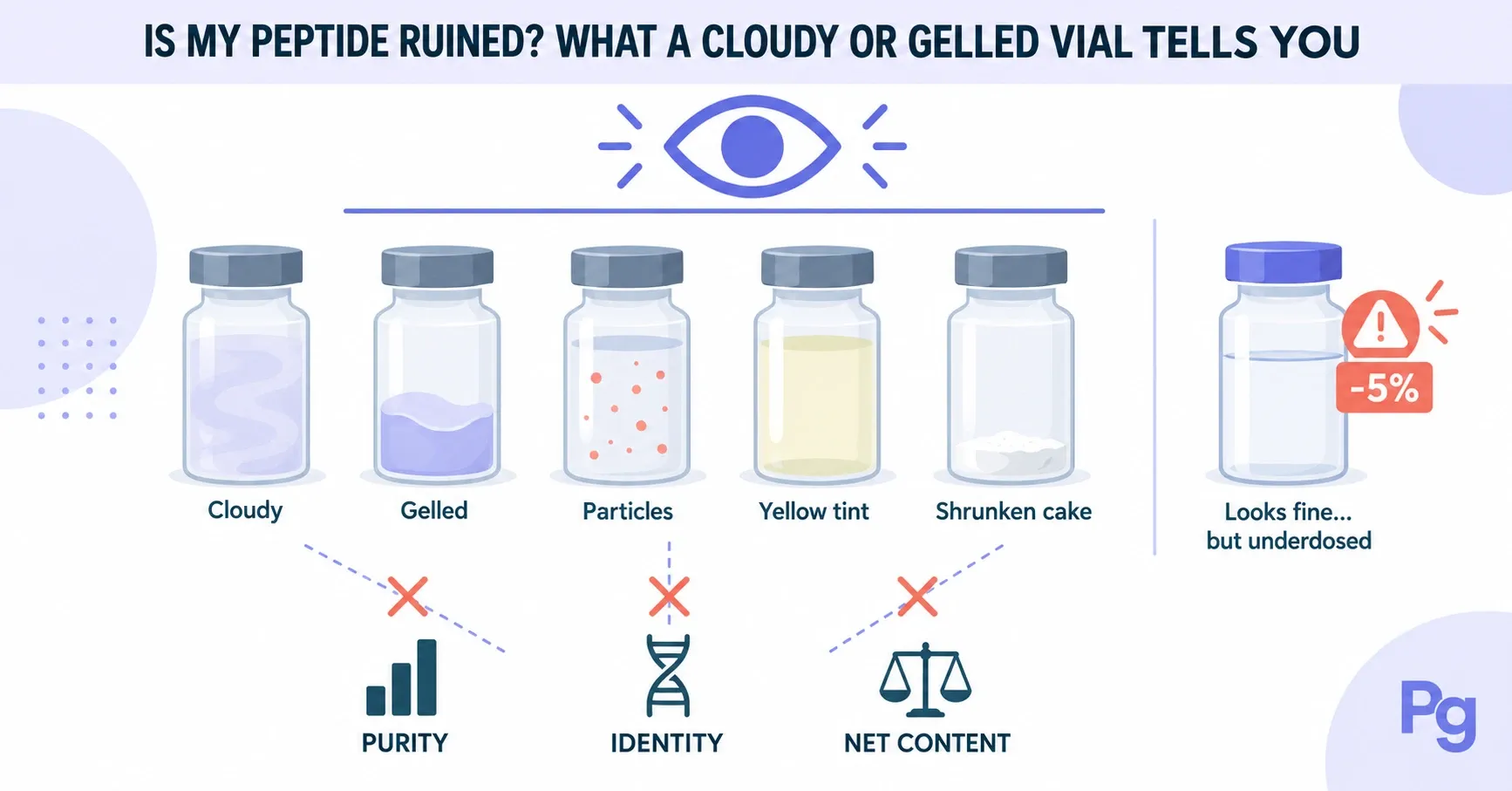
Semaglutide's per-compound purity average and test count are read live from the Purity Index and the price page rather than printed here, because a figure we cannot date is worth less than a page you can refresh. What can be said is the shape of the risk: a vial can be 99% pure and still contain substantially less peptide than the label claims, or contain a salt form no randomised trial has tested. Purity answers a question about proportion, not about identity or quantity.
Check | What it confirms | How | Red flag |
|---|---|---|---|
Mass spectrometry | Which of the two it is — 4,113.6 Da for semaglutide, 4,813.0 Da for tirzepatide with the C20 diacid attached | Batch-matched CoA carrying the MS result | Purity given with no identity test; incomplete acylation shifts tirzepatide's mass while the HPLC trace looks clean |
Salt form | Free base versus a salt FDA calls a different active ingredient | The form written on the CoA | Not stated |
Fill accuracy | The vial matches the label | Quantitative content testing on your batch | +26.7% is on record for tirzepatide; underdosing is the semaglutide pattern |
Net peptide content | Actual peptide mass in the vial | Net content or amino acid analysis | Purity quoted as if it were quantity |
HPLC purity | Proportion of intended peptide | Third-party CoA from a named lab, matched to your batch | Tirzepatide result far off the 99.75% platform average |
Endotoxin (LAL) | No pyrogens | LAL result on the batch | Field blank |
Peptigrity's platform currently tracks 530 shops and 11,852 independent lab tests across 118 peptides, with 1,283 community reviews (verified August 2026). Trust scores weight community reviews and independently verified HPLC purity equally at 50% each, with no financial relationship influencing the ranking. Individual results are searchable in the lab test database. Those figures exclude shipping, taxes and customs, coupon codes, bulk tiers, multi-vial kits and account-gated pricing.
FDA also received "multiple reports of adverse events... that may be related to dosing errors associated with compounded injectable semaglutide products," and as of 30 November 2024 had logged more than 392 adverse event reports for compounded semaglutide and more than 215 for compounded tirzepatide. Those are spontaneous reports rather than trial data. The compound-specific walkthroughs are in where to buy tirzepatide and where to buy semaglutide, with why 10 mg isn't 10 mg and TFA vs acetate vs amidate peptide salt forms covering the two failure modes in detail.
So which should you choose, and what would settle the rest?
For weight loss alone, tirzepatide, on the only randomised comparison that exists — 6.5 points in 751 adults over 72 weeks. For someone whose primary concern is cardiovascular risk, semaglutide is the drug with a 17,604-patient outcomes trial and an approved indication. For obstructive sleep apnoea, only tirzepatide has an indication. For two-year durability evidence, only semaglutide has published it. Neither wins on price until you convert per-milligram cost into cost per dose.
Use case | Choose | Why |
|---|---|---|
Maximum weight loss | Tirzepatide | −20.2% vs −13.7%, head-to-head, P<0.001 |
Cardiovascular risk reduction | Semaglutide | SELECT, n=17,604, HR 0.80, approved indication |
Obstructive sleep apnoea | Tirzepatide | Zepbound SUPPL-13, 20 December 2024 |
Noncirrhotic MASH with fibrosis | Semaglutide | Wegovy indication, August 2025 |
Type 2 diabetes, aged 10 and over | Tirzepatide | Mounjaro SUPPL-39, 19 December 2025 |
Evidence beyond two years | Semaglutide | STEP 5, −15.2% at 104 weeks |
Lowest cost | Neither, without arithmetic | Different milligram ranges; convert to cost per dose |
Claim | Evidence | Verdict |
|---|---|---|
Tirzepatide is about 2% better | Head-to-head gap is 6.5 percentage points | Understated ~3× |
Tirzepatide beats semaglutide | SURMOUNT-5, 751 adults, P<0.001 | Established |
The comparison is settled at every dose | SURMOUNT-5 tested semaglutide at 1.7 or 2.4 mg, not 7.2 mg | Partly |
Tirzepatide is approved for heart failure | No such indication on Mounjaro or Zepbound | False |
Semaglutide causes significant muscle loss | Lean mass rises 3.0 pp as a proportion of body weight | Backwards |
Semaglutide nausea affects ~73% | STEP 1 reports 44.2% | Wrong |
Either is banned in sport | Both on the Monitoring Program, neither on the Prohibited List | Wrong |
Compounded versions are a legal option | Both shortages resolved; both routes closed | Out of date |
A 99% purity result means the vial is right | Purity is proportion, not identity or quantity | Category error |
The trial that would settle this has already been run for the main question, which is unusual in this cluster. What remains open is narrower and specific.
Question | Status |
|---|---|
Does tirzepatide beat semaglutide on weight? | Answered — SURMOUNT-5, 6.5 points, n=751, P<0.001 |
Does tirzepatide beat semaglutide on HbA1c in type 2 diabetes? | Answered — SURPASS-2, n=1,879, 40 weeks |
Does 7.2 mg semaglutide change the comparison? | Open — SURMOUNT-5 tested 1.7 or 2.4 mg |
Which reduces cardiovascular events more? | Open — no head-to-head on hard endpoints |
Does tirzepatide's effect hold beyond 72 weeks? | Open |
Does resistance training change the body-composition result? | Open — the 140-participant DXA substudy has no training arm |
Frequently Asked Questions
Is tirzepatide really better than semaglutide?
For weight loss, yes, and the evidence is a randomised head-to-head rather than an estimate. SURMOUNT-5 put 751 adults on maximum tolerated doses of each drug for 72 weeks and found −20.2% against −13.7%, a difference of 6.5 percentage points at P<0.001, with tirzepatide superior at every threshold tested. That gap is roughly three times what cross-trial comparison had estimated.
Does semaglutide 7.2 mg close the gap?
Possibly, but nobody has tested it. STEP UP randomised 1,407 participants to 7.2 mg weekly and reported −20.7% at 72 weeks, which sits within half a point of tirzepatide's head-to-head result. Comparing those two figures is cross-trial arithmetic across different populations and placebo responses, not a head-to-head, and the 7.2 mg dose was only approved in March 2026.
Which one has better heart data?
Semaglutide, clearly. SELECT enrolled 17,604 patients with obesity and cardiovascular disease but no diabetes and found MACE of 6.5% versus 8.0%, a hazard ratio of 0.80, and that trial underpins an approved indication. Neither Mounjaro nor Zepbound carries a heart failure, HFpEF or cardiovascular outcome indication, whatever a listing claims.
Is either banned in sport?
Neither. Semaglutide and tirzepatide are both absent from the WADA 2026 Prohibited List, and semaglutide has been on the Monitoring Program since 2024. From 1 January 2026 markers of both are monitored in and out of competition, which tracks use without creating an anti-doping rule violation.
Can you still buy compounded semaglutide or tirzepatide?
Largely no, for both. The semaglutide shortage was declared resolved on 21 February 2025 and enforcement discretion ended that spring, while FDA's shortage database now lists Tirzepatide Injection as resolved. Compounding an essentially-a-copy version was permitted only during shortage, so what survives is narrow patient-specific 503A compounding for semaglutide and, in the words of the peer-reviewed summary, "unique products" only.
Which is riskier to buy outside a pharmacy?
They carry different risks rather than different amounts of risk. Tirzepatide's identity is broadly reliable across 930 platform tests at 99.75% purity, but fill quantity runs up to 26.7% over label on a drug titrated in 2.5 mg steps. Semaglutide's characteristic failures are salt-form substitution — which FDA treats as a different active ingredient — and underdosing that a purity figure will never reveal.
Where this leaves the choice
Semaglutide and tirzepatide have been compared head-to-head in a randomised trial, which almost nothing else in this class has, and the result was decisive: 6.5 percentage points, −20.2% against −13.7%, 751 adults, 72 weeks, P<0.001. That is not an estimate assembled from separate studies, and it is roughly three times the gap cross-trial arithmetic had assumed. Anyone still quoting "about two points" is quoting a figure a trial has since replaced.
The honest qualification is that the trial tested semaglutide at 2.4 mg, and semaglutide now has a 7.2 mg dose that produced −20.7% in its own trial. Nobody has run those two against each other. Everything downstream of weight loss splits the other way: semaglutide holds the cardiovascular indication, the liver indication and the two-year durability data, while tirzepatide holds sleep apnoea and paediatric diabetes.
Browse the weight loss and metabolic peptides category, or our complete peptide guide with 118 compounds (verified August 2026). For per-injection volume, use the semaglutide calculator or the tirzepatide calculator alongside the reconstitution calculator. Compare shops through independent lab tests and community-verified shop reviews.
This article is for educational and informational purposes only and does not constitute medical advice. Peptides discussed may be investigational compounds not approved by the FDA (or equivalent regulators in your jurisdiction) for human use. Always consult a qualified healthcare provider before using any peptide or research compound. Peptigrity is an independent review platform and does not sell, endorse, or recommend specific products or vendors.