Tirzepatide's identity is rarely the problem. Across 930 independent lab tests on this platform purity averages 99.75%, while fill quantity runs from 2.6% to 26.7% over label — on a drug titrated in 2.5 mg steps.
Tirzepatide sits in the weight loss and metabolic peptides category as its best-evidenced compound, and its sourcing question changed shape the moment FDA's shortage database moved Tirzepatide Injection to Resolved. The trial record is in tirzepatide: the dual GIP/GLP-1 agonist that beat semaglutide by 6.5 points head-to-head; this page is about the vial. For per-injection volume on a 2.5 mg ladder there is a tirzepatide calculator.
What is tirzepatide, and why does source quality matter?
Tirzepatide is a 39-residue synthetic peptide acting as a dual GIP and GLP-1 receptor agonist, molecular weight 4,813.0 g/mol, CAS 2023788-19-2, development code LY3298176. Source quality matters here for an unusual reason: across 930 independent lab tests identity is broadly reliable at 99.75% average purity, while quantity is not — fill variance runs +2.6% to +26.7% against label on a drug titrated in 2.5 mg steps.
Property | Value |
|---|---|
Mechanism | Dual GIP and GLP-1 receptor agonist |
CAS | 2023788-19-2 (PubChem CID 156588324) |
Formula / MW | C₂₂₅H₃₄₈N₄₈O₆₈ / 4,813.0 g/mol |
Structure | 39-residue synthetic peptide with a C20 fatty diacid moiety |
Development code | LY3298176 |
Brands | Mounjaro®, Zepbound® |
The C20 fatty diacid binds albumin and slows clearance, which is what makes once-weekly dosing possible. It also makes tirzepatide a peptide-lipid conjugate rather than a simple synthetic peptide, and the conjugation chemistry is a manufacturing step grey-market synthesis can get wrong. Incomplete acylation produces material that can look clean on HPLC and still be the wrong molecule by mass — which is precisely why a purity percentage is not an identity test. See mass spectrometry for peptides for what an identity result establishes.
So the compound-specific risk profile splits in two, and only one half is what buyers usually check. Identity failures are possible and, on our data, uncommon. Quantity failures are common and measurable, and they run in one direction: more drug in the vial than the label claims. A 26.7% overage is a clinically meaningful dosing error on a 2.5 mg ladder, and it points the same way as the drug's dose-limiting side effects.
Tirzepatide | Semaglutide | |
|---|---|---|
Mechanism | Dual GIP and GLP-1 receptor agonist | GLP-1 receptor agonist |
Molecular weight | 4,813.0 g/mol | 4,113.6 g/mol |
Structure | 39 residues, C20 fatty diacid | 31 amino acids, C18 fatty-diacid |
Head-to-head at 72 weeks (SURMOUNT-5, n=751) | −20.2% | −13.7% |
Waist circumference | −18.4 cm | −13.0 cm |
That 6.5-point gap is why buyers reach this page rather than the semaglutide one, and it is settled evidence — 751 adults, 72 weeks, maximum tolerated doses of each, published in the New England Journal of Medicine in July 2025. For the comparison in full see comparing semaglutide and tirzepatide.
What is the regulatory status of tirzepatide?
Tirzepatide is an approved prescription medicine in the United States, marketed as Mounjaro (NDA 215866, 13 May 2022) for type 2 diabetes and Zepbound (NDA 217806, 8 November 2023) for chronic weight management, both carrying a boxed warning for thyroid C-cell tumours. As of August 2026, FDA's shortage database lists Tirzepatide Injection as "Resolved," and tirzepatide does not appear anywhere on the WADA 2026 Prohibited List.
Two label changes are worth knowing before you read a vendor's description of what this drug is for. Zepbound added moderate to severe obstructive sleep apnoea in adults with obesity on 20 December 2024 via supplement SUPPL-13. Mounjaro extended to paediatric patients 10 years of age and older with type 2 diabetes via SUPPL-39, approved 19 December 2025, so "adults only" is now an outdated description. There is no heart failure, HFpEF or cardiovascular outcome indication on either product, whatever a listing claims.
Tirzepatide appears on neither of FDA's bulk drug substances tables. We enumerated both on the page current 22 April 2026: no GLP-1, GIP, glucagon or amylin agonist is on either. That absence is not permission — the operative mechanism was always the shortage list.
On sport, tirzepatide is unnamed on the 2026 list and, as an approved drug, also falls outside WADA's S0 catch-all, which applies to substances with no regulatory approval for human therapeutic use. On labelling, FDA "has warned companies that have illegally sold unapproved drugs... falsely labeled 'for research purposes' or 'not for human consumption.'" That wording is a seller's legal posture, not a quality tier. For the dated record see the FDA peptide regulation timeline.
Claim you will meet while shopping | What the record says | Verdict |
|---|---|---|
"Compounded tirzepatide is still legally available" | Shortage database lists Tirzepatide Injection as Resolved | Out of date |
"It is not on FDA's compounding risk list, so it is allowed" | Absent from both bulk substances tables; the shortage list was the mechanism | Absence is not permission |
"99.75% pure, so the vial is right" | Purity is not quantity — variance runs +2.6% to +26.7% | Category error |
"Tirzepatide salt forms are equivalent" | FDA: salt forms "are different active ingredients" | Wrong |
"Approved for heart failure" | No such indication on Mounjaro or Zepbound | False |
"Adults only" | Mounjaro covers ages 10 and older since December 2025 | Outdated |
"Banned in sport" | Not on the WADA 2026 Prohibited List; approval places it outside S0 | False |
"No serious warnings" | Boxed warning: thyroid C-cell tumours, from rodent data | False |
"Research-use labelling exempts the seller" | FDA has warned companies using exactly that wording | No exemption |
7 things to check before ordering tirzepatide
Seven checks matter for tirzepatide, and the order is different from every other peptide on this site: quantity comes first. Across 930 independent tests identity is broadly reliable, so the checks that earn their place are quantitative content testing, mass spectrometry at 4,813.0 Da with the C20 diacid attached, and the stated salt form. Batch-matched HPLC, a named-lab certificate, endotoxin testing and a price sanity check complete the set.
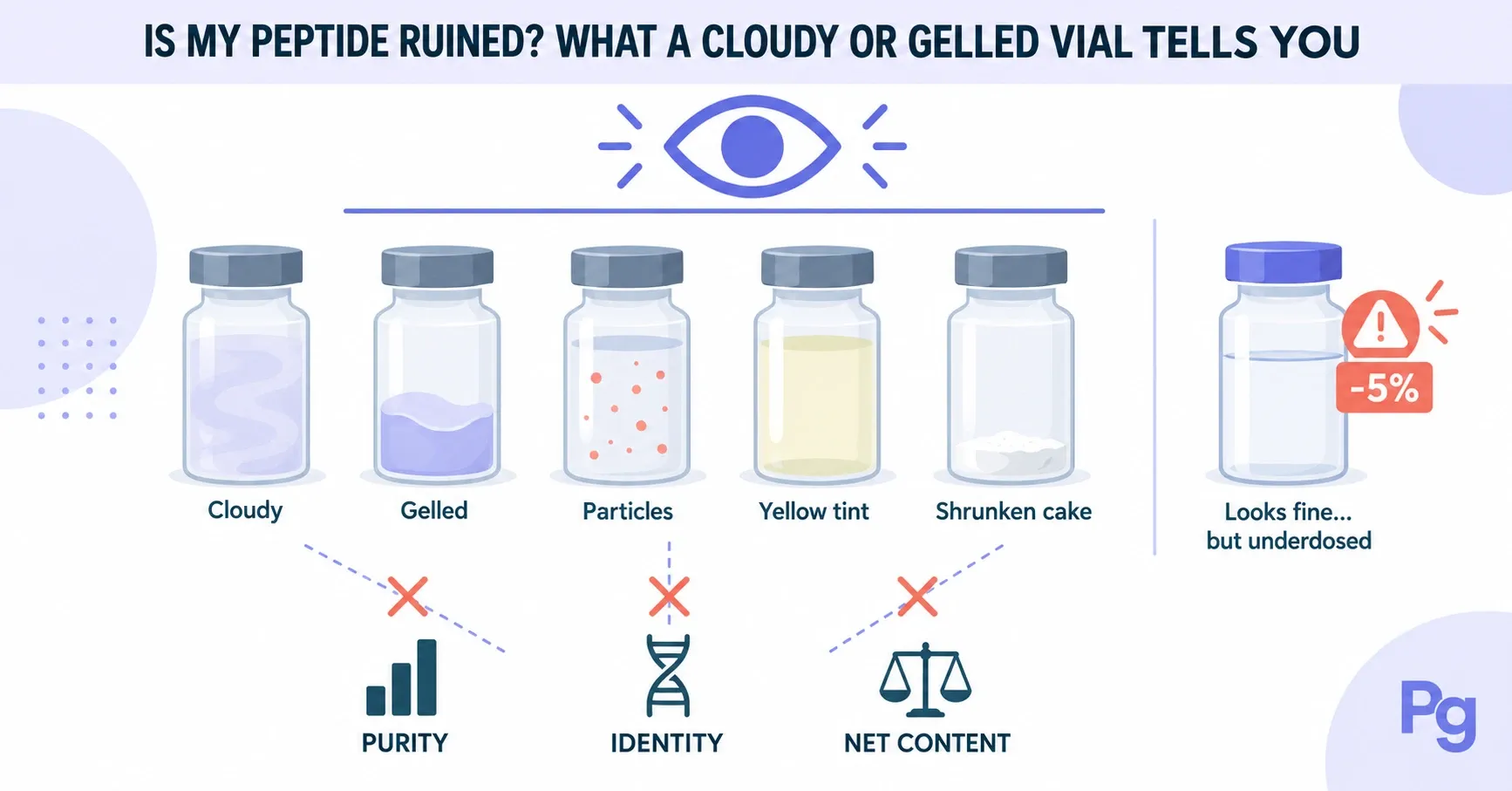
Quantitative content testing, before anything else. Ask what the vial actually contains, not what proportion of it is the intended peak. This is the check our own dataset says to run first: vials labelled 10 to 65 mg have tested between 10.71 and 68.1 mg. See why 10 mg isn't 10 mg.
Mass spectrometry at 4,813.0 Da, with the C20 diacid attached. The mass has to include the acylation. Material with incomplete acylation elutes convincingly and reports a respectable purity figure while sitting at the wrong mass, so an MS result is the only thing that settles it.
The salt form, written on the certificate. FDA has stated that salt forms of these peptides "are different active ingredients than are used in the approved drugs," and the same logic applies to any tirzepatide salt. A certificate that omits the form has omitted what you are weighing — see TFA vs acetate vs amidate peptide salt forms.
Third-party HPLC purity, read against the platform average rather than against 100%. Tirzepatide averages 99.75% across 930 tests, so the useful question is not "is it above 98%" but "is this shop's result normal for a compound the market makes well". A materially lower result is an outlier in a well-characterised field.
A certificate from a laboratory that has actually tested this compound. The 930 results on this platform come from Freedom Diagnostics, Kovera, ILS, Accumark and MZ Biolabs. A CoA from a laboratory with no track record on tirzepatide is a document you cannot calibrate — see third-party peptide testing labs.
Endotoxin testing on the batch you are buying. LAL results are the routinely skipped line on GLP-1 certificates, and a field blank or an absent result tells you the batch was never tested rather than that it passed. Peptide endotoxin testing and LAL interpretation covers how to read one.
Per-milligram price checked against the market median, not against other listings from the same shop. The median is $5.67/mg and the lowest on record is $1.17/mg on a 60 mg vial. Price below the floor of a 48-offer comparison is a claim about something other than the drug.
Check | What it confirms | How to verify | Red flag |
|---|---|---|---|
Fill accuracy | Vial matches label | Quantitative content testing on your batch | +26.7% is on record — the main risk here |
Mass spectrometry | 4,813.0 Da with the C20 diacid attached | Batch-matched CoA with the MS result | HPLC purity alone — incomplete acylation changes the mass |
Salt form | Free base versus a salt FDA says is a different active ingredient | Stated form on the CoA | Not stated |
Net peptide content | Peptide versus salts and water | Net content or amino acid analysis | Purity quoted as quantity |
HPLC purity | Proportion of intended peptide | Third-party CoA from a lab with a tirzepatide track record | Result far off the 99.75% platform average |
Endotoxin (LAL) | No pyrogens | LAL result on the batch | Field blank |
Where does tirzepatide rank on Peptigrity's lab test database?
The Purity Index records tirzepatide at 99.75% average across 930 independent tests (verified August 2026), one of the deepest datasets on this platform, from Freedom Diagnostics, Kovera, ILS, Accumark and MZ Biolabs, across 227 shops selling. Identity is not the failure mode. Quantity is: variance runs +2.6% to +26.7%, with vials labelled 10 to 65 mg testing between 10.71 and 68.1 mg. On a drug titrated in 2.5 mg steps that is a dosing error, not a rounding difference.
The direction of the error is what makes it consequential. An overfilled vial delivers more drug per unit than the label implies, and more drug in this class means more nausea and vomiting — the effects people discontinue for. In SURMOUNT-1, discontinuation due to adverse events ran 4.3%, 7.1% and 6.2% across the 5, 10 and 15 mg arms against 2.6% on placebo, which is low for the class and was measured on vials whose contents were known. See tirzepatide side effects and the SURMOUNT data.
Peptigrity's platform currently tracks 530 shops and 11,852 independent lab tests across 118 peptides, with 1,283 community reviews (verified August 2026), and trust scores weight community reviews and independently verified HPLC purity equally at 50% each, with no financial relationship influencing the ranking. Individual results with the testing laboratory named are searchable in the lab test database, and shop-by-shop detail sits on the tirzepatide compound page.
What does tirzepatide cost per milligram, and does the cheapest vial win?
Tirzepatide price data shows 14 shops in stock, a median of $5.67/mg and a lowest of $1.17/mg on a 60 mg vial (verified 9 August 2026), across 48 compared offers with vial prices from $19.99 to $465.00. Per milligram, price falls steeply as vial size rises: 5–10 mg runs a median $9.60/mg, 15–35 mg $5.69/mg, and 40–120 mg $3.85/mg. Those figures exclude shipping, taxes and customs, coupon codes, bulk tiers, multi-vial kits and account-gated pricing.
Vial size | Median price per mg (verified August 2026) |
|---|---|
5–10 mg | $9.60/mg |
15–35 mg | $5.69/mg |
40–120 mg | $3.85/mg |
All sizes | Median $5.67/mg · lowest $1.17/mg on a 60 mg vial |
Two things follow, and neither is "buy the biggest vial". The first is that comparing headline vial prices across shops compares vial sizes, not value — a $19.99 listing and a $465.00 listing may sit at similar per-milligram rates. Convert to cost per dose before you compare anything, using the cost-per-dose calculator.
The second is that per-milligram price on this compound is partly fictional in a way it is not for most peptides. If fill variance runs to +26.7%, then the milligrams you paid for and the milligrams in the vial are different numbers, in your favour on price and against you on dose. A cheap vial that holds a quarter more drug than it claims is not a bargain; it is an unlabelled dose change. Shop-level track records sit alongside the community-verified reviews for each vendor.
Can compounding pharmacies still sell tirzepatide?
Compounding pharmacies can no longer sell tirzepatide as a copy of the approved product. Sections 503A and 503B of the Food, Drug and Cosmetic Act permit compounding a drug that is essentially a copy of an approved product only while that product is in shortage, and FDA's shortage database now lists Tirzepatide Injection as "Resolved." Tirzepatide appears on neither of FDA's bulk substances tables, and that absence is not permission.
Belcourt, Sapowadia & White, writing in Annals of Pharmacotherapy in September 2026, state the consequence directly: "With the shortage of innovator semaglutide or tirzepatide products resolved, compounding pharmacies can only legally sell unique products." A "unique product" is not a cheaper copy of Zepbound with a different label on it. We could not verify the specific resolution dates or the wind-down deadlines from a primary FDA page, so we are not printing them — the current status is verifiable and it is what matters. For the structural comparison between the two supply routes, see compounding pharmacy versus research peptide.
FDA's warnings about what replaced compounded supply are specific. On dosing, the agency received "multiple reports of adverse events... that may be related to dosing errors associated with compounded injectable semaglutide products," resulting from patients measuring and self-administering incorrect doses — the same arithmetic applies to a tirzepatide vial of uncertain fill. As of 30 November 2024, FDA had received more than 215 adverse event reports for compounded tirzepatide. Those are spontaneous reports rather than trial data, and the figures have not been updated since.
The trial that would settle this has not been run, and it is a smaller and cheaper study than most of the ones that have.
Element | Detail |
|---|---|
Question | What proportion of vials sold as tirzepatide fall outside ±5% of the labelled quantity? |
Design | Blinded purchase across shops, quantitative content testing on every vial, identity confirmed by mass spectrometry |
Primary endpoint | Proportion of vials outside ±5% of label, and the direction of the deviation |
Why it has not run | No commercial sponsor has an interest in the answer |
Closest existing evidence | 930 independent tests on this platform, variance +2.6% to +26.7% |
What it still would not answer | Whether the material is sterile, or what dose the buyer actually drew |
Frequently Asked Questions
What purity standard should tirzepatide meet?
Tirzepatide averages 99.75% across 930 independent tests on this platform, which makes it one of the best-characterised compounds we track, so a result well below that average is an outlier rather than a borderline pass. Ask for a batch-matched third-party HPLC result from a laboratory with a tirzepatide track record. Then stop treating purity as the answer, because on this compound it is the question that has already been answered well.
How much does tirzepatide cost?
Median $5.67 per milligram, lowest $1.17 per milligram on a 60 mg vial, across 48 compared offers from 14 shops in stock (verified 9 August 2026), with vial prices running from $19.99 to $465.00. Per-milligram cost falls with vial size, from a $9.60 median in the 5–10 mg tier to $3.85 in the 40–120 mg tier. Those figures exclude shipping, taxes and customs, coupon codes, bulk tiers, multi-vial kits and account-gated pricing.
Can you still buy compounded tirzepatide legally?
Not as a copy of the approved product. The 503A and 503B route applied only while tirzepatide was in shortage, and FDA's shortage database now lists Tirzepatide Injection as resolved. As the peer-reviewed summary puts it, compounding pharmacies "can only legally sell unique products," which is a narrower category than most marketing suggests.
How do you verify a tirzepatide vial is genuine?
Mass spectrometry at 4,813.0 Da with the C20 fatty diacid attached, because incomplete acylation shifts the mass while leaving the HPLC trace looking clean. Then quantitative content testing, because identity is the part this market generally gets right. A certificate carrying a purity figure and no identity or content result has answered neither of the questions that matter here.
Does the 2.5 mg titration ladder change how you reconstitute?
It raises the cost of an arithmetic error, because each step is small relative to the fill variance on record. Work out your reconstitution volume and per-injection units before you draw anything, using the tirzepatide calculator and tirzepatide dosing and reconstitution. Dosing decisions themselves belong to a prescriber.
Is a 26.7% overage actually dangerous?
It is a dose you did not choose, in the direction that produces this class's dose-limiting effects. Nausea and vomiting are why people discontinue, and discontinuation for adverse events ran 4.3% to 7.1% across the SURMOUNT-1 arms against 2.6% on placebo — measured on vials whose contents were known. An overfilled vial moves you up the ladder without telling you.
Browse the weight loss and metabolic peptides category, or our complete peptide guide with 118 compounds (verified August 2026). For per-injection volume, use the tirzepatide calculator and the cost-per-dose calculator, alongside the reconstitution calculator. Compare shops through independent lab tests and community-verified shop reviews.
This article is for educational and informational purposes only and does not constitute medical advice. Peptides discussed may be investigational compounds not approved by the FDA (or equivalent regulators in your jurisdiction) for human use. Always consult a qualified healthcare provider before using any peptide or research compound. Peptigrity is an independent review platform and does not sell, endorse, or recommend specific products or vendors.