Epitalon is four amino acids with a defined mass of 390.35, which makes it verifiable. Most of the bioregulator category is not: the product next to it on the shelf is a gland extract with no single mass to confirm.
That advantage is real and conditional, because it only holds if somebody runs the mass spectrum. Epitalon sits in the bioregulator peptides category, identity and pricing sit on the Epithalon compound page, and the evidence picture is in Epithalon: the telomere lengthening is real, in cultured cells. Epitalon and epithalon are the same molecule under two spellings, which is itself worth knowing before you compare listings.
What is Epitalon, and why does source quality matter?
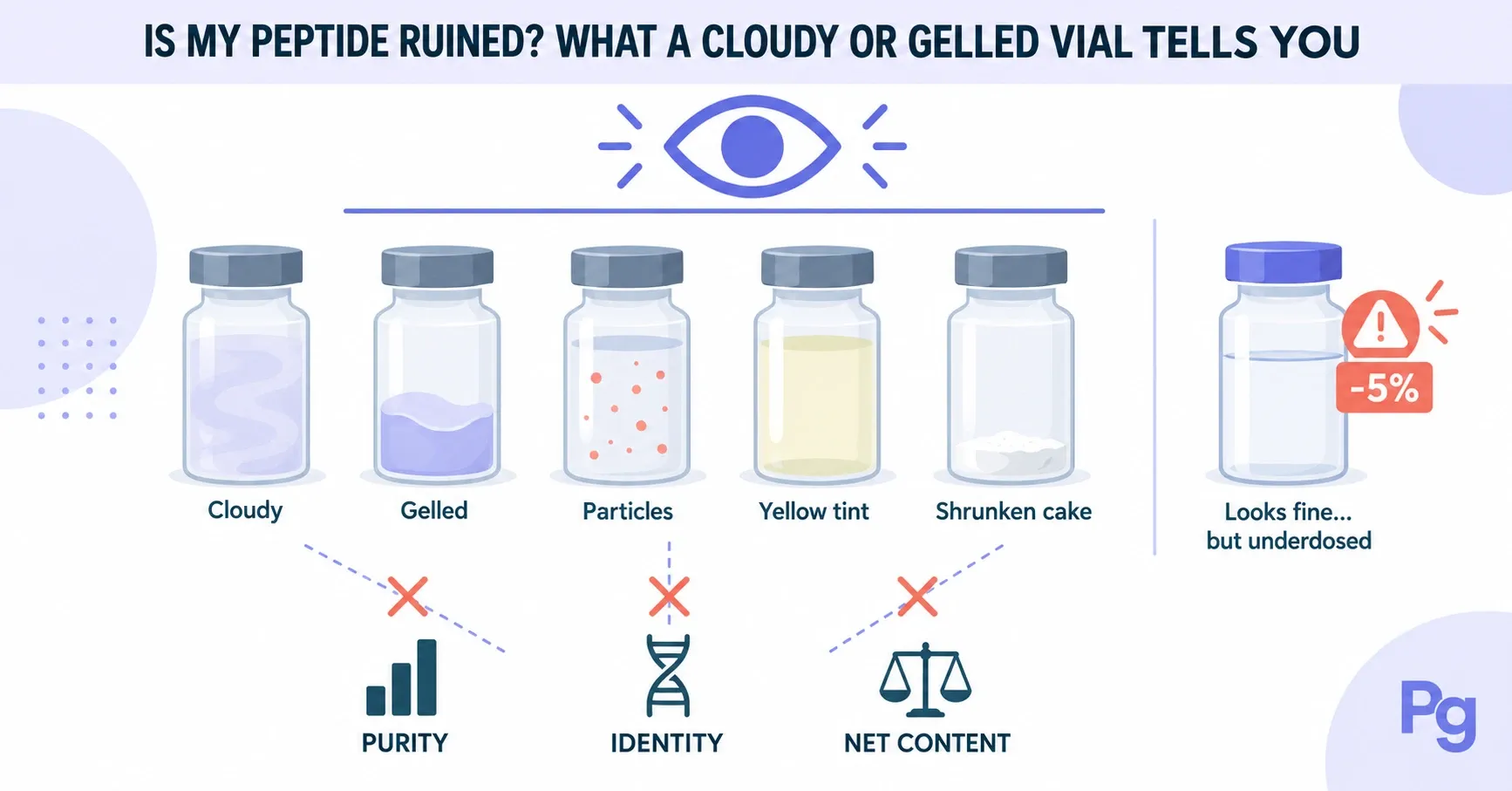
Epitalon is a synthetic tetrapeptide, Ala-Glu-Asp-Gly, CAS 307297-39-8, molecular weight 390.35 g/mol, sold as a telomerase activator. Source quality matters because four amino acids of common residues are cheap and easy to synthesise, and short peptides are difficult to tell apart by purity testing alone. A vial can report high HPLC purity while containing something else entirely, which makes a mass spectrum the only document that establishes what you bought.
Property | Value |
|---|---|
Sequence | Ala-Glu-Asp-Gly (AEDG) |
Length | 4 amino acids (tetrapeptide) |
CAS | 307297-39-8 (PubChem CID 219042) |
Formula / MW | C₁₄H₂₂N₄O₉ / 390.35 g/mol |
Also written | Epitalon, Epithalone; AEDG peptide |
Origin | Synthetic analogue of epithalamin, a pineal gland extract |
Two things in that table cause more buyer confusion than the rest of the compound put together. The first is the spelling: Epitalon, epithalon and epithalone all name the same four residues, so a price comparison run on one spelling misses listings filed under the others, and a vendor using several spellings across one catalogue is not necessarily selling several products.
The second is the origin line. Epitalon is a synthetic analogue of epithalamin, which is a pineal gland extract, not a thymic one. That correction matters early because it is widely garbled: the thymic member of the same family is thymalin, a different compound with a different research line, and any product page describing epithalamin as thymus-derived has crossed the two. A seller that cannot keep those straight is not a reliable source for anything else on the label.
What is the regulatory status of Epitalon?
Epitalon is not approved for human use by the FDA, EMA or TGA, and as of August 2026 no compounding route exists. At the Pharmacy Compounding Advisory Committee meeting of 23 to 24 July 2026 it was nominated for insomnia; FDA's own reviewers found no publications discussing its efficacy in insomnia patients and recommended against listing, and the committee voted 7 in favour to 4 against with 1 abstention to recommend it anyway.
Because that vote is advisory and non-binding, and FDA must complete rulemaking before anything is added to the 503A list, this page has no compounded-Epitalon section. Rulemaking is projected for 2027 or later and nothing has been added. The gap between "an advisory committee recommended" and "the FDA approved" is where most of the misreporting on this compound sits, and our FDA peptide regulation timeline tracks what actually happened. DSIP went before the same meeting and was rejected.
The most consequential line in the regulatory file is not about insomnia at all. On the telomerase mechanism, the mechanism the compound is sold on, FDA wrote:
"epitalon has been shown to activate telomerase and lengthen telomeres, and longer telomeres are generally associated with increased risk for cancer"
That sentence inverts the pitch. The property presented in marketing as the benefit is the property the agency flagged as a risk, and the tension is intrinsic to the target rather than a manufacturing problem a better vendor could solve. No study shows that Epitalon increases cancer risk, and the Khavinson group's long-term studies report no increase in cancer incidence — meaningful evidence rather than nothing, and single-institution data on a risk that would need large, long, independent follow-up to exclude.
On sport, Epitalon is not named on the WADA Prohibited List, though as an unapproved substance it can fall under the S0 catch-all, which applies at all times. Absence from the list is not clearance.
Claim you will meet while shopping | What the record says | Verdict |
|---|---|---|
"Lengthens telomeres" | Real — in cultured cells; never measured in a living person | In vitro |
"Activates telomerase" | Real — in cultured human fibroblasts | In vitro |
"Reverses biological age by X years" | No study supports any such figure | No source |
"Extends lifespan" | Rodent studies, single institute | Animal, unreplicated |
"Reduces mortality in elderly humans" | Long-term cohorts, mostly epithalamin, single institute | Unreplicated human data |
"Restores melatonin rhythm" | Monkeys and elderly humans, single institute | Best-supported claim |
"Improves sleep" | Inferred from the melatonin finding; not measured directly | Indirect |
"Improves skin elasticity and wrinkles" | No verifiable controlled study | Unsupported |
"FDA backed it in July 2026" | Advisory recommendation 7–4–1; no rulemaking completed | Overstated |
"Telomerase activation carries no cancer risk" | Reported in the group's own studies; FDA flagged the opposite | Single-institution; concern remains |
Note where the strongest claim sits. Melatonin rhythm restoration is the best-supported finding and it is not what the compound is sold for, while the telomere claim that drives the market has never been measured in vivo in a human being.
Why is a synthetic tetrapeptide easier to verify than the extracts sold beside it?
A synthetic tetrapeptide has a defined mass and a gland extract does not. Epitalon is a four-residue molecule at 390.35 g/mol that mass spectrometry either confirms or does not, whereas epithalamin, the pineal extract it was modelled on, has no single mass to confirm. That is a genuine buyer advantage over most of the bioregulator category, and it is conditional: it only holds if somebody actually runs the mass spectrum.
This is the unusual position Epitalon occupies. In most of this cluster the buyer's problem is that the compound is hard to pin down. Here the compound is entirely pinnable — one sequence, one formula, one mass — and the problem is that the market it sits in has no habit of pinning anything down, because for its neighbouring products there is nothing to pin. An extract is defined by its source tissue and its preparation method, not by a molecular weight, so a certificate of analysis for one cannot mean what a certificate for Epitalon can mean.
Compound | Proposed mechanism | Best evidence | Human data |
|---|---|---|---|
Epithalon | Telomerase activation, pineal regulation | In vitro telomere elongation | Single-institution; melatonin rhythm |
Thymalin | Thymic immune restoration | Same research programme | Single-institution |
Senolytic — clears senescent cells | Striking aged-mouse data | None | |
Metformin | AMPK activation | Large human diabetes evidence base | Extensive, ageing trials ongoing |
The advantage has a second edge, and it should be stated rather than sold. Because several of the most-cited human findings in this literature were collected on epithalamin, the natural preparation, rather than on the four-residue peptide that ships to buyers, a verified vial of Epitalon is not a vial of the substance behind the mortality-cohort data. Confirming identity confirms identity. It does not transfer the evidence.
And the verifiability is conditional in a way worth repeating, because the entire advantage collapses without it. A four-residue peptide of common amino acids is among the cheapest things in this market to synthesise and among the hardest to distinguish by purity testing, so an HPLC-only certificate is close to uninformative about identity here. The general method is in how to verify peptide quality before you buy, and the wider programme this compound belongs to is in peptide bioregulators: the Khavinson framework.
7 things to check before ordering Epitalon
Seven checks cover Epitalon, and the first is load-bearing in a way it is not for larger peptides: a batch-matched mass spectrum reading near 390.35 daltons. After that come the CAS number 307297-39-8 on the label, third-party HPLC purity from a named laboratory, net peptide content, an LAL endotoxin result, the synthetic-versus-extract distinction on the product page, and a shop and price check against live data.
A batch-matched mass spectrum near 390.35 Da. On a four-residue peptide this is not one check among several, it is the check. Short peptides are difficult to distinguish from one another by purity testing alone, so mass is the only property on a certificate that identifies the molecule. Insist on a result tied to your lot rather than a specimen certificate from an earlier batch, and read it with mass spectrometry for peptides and how to read peptide lab test results.
CAS 307297-39-8 on the label, and the spelling variants treated as one product. A CAS matching nothing, or no CAS at all, tells you the listing was assembled from other listings. Epitalon, epithalon and epithalone are the same molecule, so do not treat a spelling difference as a product difference, and do not accept a page that presents them as distinct items with distinct claims.
Third-party HPLC purity from a named laboratory, read live — and read for what it cannot say. Purity establishes the proportion of a single species and moves as new certificates are indexed, so read the current figure on the Purity Index rather than a number quoted in prose. Require the laboratory to be named, since an unattributed document is a claim rather than a measurement, as third-party peptide testing labs sets out. Then hold the limit in mind: a high figure on a 4-mer is compatible with the wrong molecule.
Net peptide content, as a separate line from purity. Purity is a proportion and net content is a quantity, and a 99% pure vial can be substantially underfilled, which is what net peptide content measures. On a cheap-to-synthesise short peptide the economic pressure sits on fill quantity rather than on substitution, which makes this axis more relevant here than the price would suggest.
An LAL endotoxin result on the same batch. Community practice with this compound is subcutaneous injection over a course of days, so pyrogen load is a live question rather than a formality. An absent LAL result means the batch was not tested rather than that it passed, as peptide endotoxin testing explains.
The product page, read for extract confusion and evidence provenance. A page calling epithalamin a thymus extract has crossed Epitalon with thymalin. A page citing telomere elongation without saying cultured human fetal fibroblasts, or citing mortality-cohort results without saying those were collected largely on epithalamin, is transferring evidence between preparations. Both are visible before you buy anything, and both are covered by red flags in peptide certificates of analysis.
Shop record and price, plus what no certificate can establish. Trust scores weight community reviews and independently verified HPLC purity equally at 50% each, so read community-verified shop reviews alongside the documents. Then note the ceiling on all of it: a perfect certificate confirms a vendor shipped 390.35-dalton material at the stated quantity, and no published human trial has measured in-vivo telomere length after Epitalon.
Check | What it confirms | How to verify | Red flag |
|---|---|---|---|
Mass spectrometry | It is Epitalon — mass near 390.35 Da | Batch-matched CoA carrying the MS result | Purity given with no identity test — decisive on a 4-mer |
CAS and spelling on the label | The vendor knows what it is selling | 307297-39-8; Epitalon = epithalon = epithalone | A CAS matching nothing, or spellings sold as separate products |
Synthetic versus extract, on the page | You are buying the peptide, not the preparation | Epithalamin described as a pineal extract, not thymic | Epithalamin called thymus-derived — that is thymalin |
Evidence provenance in the copy | The seller distinguishes preparations and models | Telomere data attributed to cultured fibroblasts; cohort data to epithalamin | In-vitro results quoted as human outcomes |
HPLC purity | Proportion of a single species | Named third-party lab, read live | Vendor's own document only; house standard unsupported |
Net peptide content | Peptide versus salts and water | Net content or amino acid analysis figure | Purity quoted as though it were quantity |
Endotoxin (LAL) | No pyrogens in injectable material | LAL result on the batch | Not tested, not mentioned |
Rows three and four have no laboratory component at all. They are read off the product page before any money changes hands, and on this compound they catch a failure mode the certificate cannot: a vendor that is selling the right molecule on the wrong preparation's evidence.
Where does Epitalon rank on Peptigrity's lab test database?
Epitalon's per-compound purity index score, contributing test count and laboratory count are read live from the Purity Index rather than fixed on this page, because both the figures and the certificate pool move as new results are indexed. The price page publishes shops in stock with median and lowest price per milligram on the same live basis. Peptigrity tracks 530 shops and 11,852 independent lab tests across 118 peptides, with 1,283 community reviews (verified August 2026).
That is a deliberate choice rather than a gap. A purity number quoted in prose ages the moment the next certificate lands, and on a compound where the purity figure is the least informative document in the file, quoting one in fixed text would give it more weight than it earns. Individual certificates are searchable in the lab test database, and trust scores weight community reviews and independently verified HPLC purity equally, at 50% each, with no financial relationship influencing the ranking.
On cost, Epithalon price data publishes shops in stock and the median and lowest price per milligram, with the vial size behind the lowest figure. Read it within a single vial-size band, since fixed per-vial costs push the per-milligram figure down as fill size rises, which makes a large vial look like a better product rather than simply a bigger one. Those figures exclude shipping, taxes and customs, coupon codes, bulk tiers, multi-vial kits and account-gated pricing.
The dataset carries a standing caveat, and on this compound it has extra force. Published certificates are the ones vendors chose to publish, which makes the sample selection-biased rather than a random market survey — and for a four-residue peptide, a certificate reporting only HPLC purity does not establish that the vial contains Epitalon at all. The sleep-adjacent context that drove the insomnia nomination is covered in peptides for sleep: DSIP, Epithalon and Pinealon.
The trial that would settle this has a first row that no laboratory result can substitute for.
Element | Requirement | Why |
|---|---|---|
Replication site | An institution outside St. Petersburg | The single most valuable missing piece; every core finding awaits independent confirmation |
Design | Randomised, double-blind, placebo-controlled | The human cohort work is largely open-label |
Primary endpoint | Leukocyte telomere length by a validated method, with pre-specified handling of assay variability | The central claim, measured properly for the first time in vivo |
Secondary endpoints | Melatonin rhythm — the best-supported effect | Tests the claim most likely to be real |
Duration | Multi-year, with cancer-incidence surveillance | The theoretical risk requires long follow-up to address |
Product | Characterised, mass-verified material | Gray-market Epitalon is not confirmed to be Epitalon |
Read the last row against the rest of this page. The requirement a trial would place on its own investigational material — mass-verified, characterised, known — is exactly the requirement a buyer is being asked to meet with a single document and no equipment.
Frequently Asked Questions
What purity standard should Epitalon meet?
Read the current figure live on the Purity Index rather than against a fixed threshold or a vendor's "above 98%" promise, because per-compound purity moves as new certificates are indexed. On a four-residue peptide, though, purity is the second question and identity is the first: HPLC reports what proportion of a sample is a single species, not which species it is, and on a 4-mer of common residues that distinction is close to the whole question.
How much does Epitalon cost?
The price page publishes shops in stock with the median and lowest price per milligram and the vial size behind the lowest figure. Compare within one vial-size band, because fixed per-vial costs fall away as fill size rises and make larger vials look cheaper per milligram than the product warrants. Four common amino acids are cheap to make, so a low price is not by itself a warning sign here. Those figures exclude shipping, taxes, coupon codes and bulk tiers.
Is Epitalon legal to buy?
It is not approved for human use by the FDA, EMA or TGA, and as of August 2026 there is no compounding route. An advisory committee recommended it for the 503A bulks list in July 2026 by 7 votes to 4 with 1 abstention, against FDA staff's recommendation, but that vote is non-binding, rulemaking is projected for 2027 or later, and nothing has been added. It is not named on the WADA Prohibited List, though the S0 catch-all can capture unapproved substances at all times.
How do I know my vial is really Epitalon?
Mass spectrometry showing a mass near 390.35 Da, on a certificate matched to your batch. At four amino acids of common residues, HPLC purity alone cannot establish identity, because short peptides are difficult to distinguish from one another by purity testing. Check the CAS as well, 307297-39-8, and treat the Epitalon, epithalon and epithalone spellings as one product rather than three.
What dose of Epitalon is supported by evidence?
None is validated. The widely used pattern of 5 to 10 mg per day subcutaneously for a 10-day course, once or twice a year, descends from the Khavinson group's course-based approach and from community practice rather than from a dose-ranging trial, because none has been published. No published source establishes that the community course matches what was used in any reported study. The calculators convert a chosen dose into a syringe volume; no published source tells you which dose to choose.
Does the telomerase mechanism raise cancer risk?
No study shows that it does, and the theoretical concern is real rather than rhetorical. Telomerase reactivation is part of how malignant cells escape replicative limits, so a compound proposed to activate telomerase in somatic cells is proposing something tumour biology also does, and FDA said so explicitly when it reviewed the file. The Khavinson group's long-term studies report no increase in cancer incidence, which is single-institution data on a risk that would need large, long, independent follow-up to exclude. Anyone with a personal or family history of cancer is in the group for whom this is not academic.
Browse the bioregulator peptides category, or our complete peptide guide with 118 compounds (verified August 2026). For per-injection volume, use the peptide dosing calculator alongside the reconstitution calculator. Compare shops through independent lab tests and community-verified shop reviews.
This article is for educational and informational purposes only and does not constitute medical advice. Peptides discussed may be investigational compounds not approved by the FDA (or equivalent regulators in your jurisdiction) for human use. Always consult a qualified healthcare provider before using any peptide or research compound. Peptigrity is an independent review platform and does not sell, endorse, or recommend specific products or vendors.