Semaglutide's compounding route closed in 2025, and what replaced it is a grey market where a vial can be 99% pure and still hold a different active ingredient. Seven checks separate real semaglutide from semaglutide sodium.
Semaglutide sits in the weight loss and metabolic peptides category as the best-evidenced compound on this platform and the one whose supply route changed most abruptly. The trial evidence is set out in semaglutide: the nausea rate is 44.2%, not 73%; this page is about the vial. For per-injection volume there is a semaglutide calculator alongside the reconstitution calculator.
What is semaglutide, and why does source quality matter?
Semaglutide is a 31-amino-acid analogue of human GLP-1(7-37) with a molecular weight of 4,113.6 g/mol, CAS 910463-68-2, developed by Novo Nordisk and approved as Wegovy and Ozempic. Source quality matters because FDA has stated that semaglutide sodium and semaglutide acetate "are different active ingredients than are used in the approved drugs" — so a vial can test 99% pure and still contain a substance no trial has studied.
Property | Value |
|---|---|
Structure | Human GLP-1(7-37) analogue — 31 amino acids |
Modifications | Aib at position 8, Arg34, C18 fatty-diacid on Lys26 via γGlu/OEG linker |
CAS | 910463-68-2 (PubChem CID 56843331) |
Formula / MW | C₁₈₇H₂₉₁N₄₅O₅₉ / 4,113.6 g/mol |
Half-life | ~7 days |
Developer | Novo Nordisk (codes NN9535 / NNC 0113-0217) |
Brands | Wegovy®, Ozempic® |
Two modifications do the work. The Aib8 substitution blocks DPP-4, the enzyme that clears native GLP-1 within minutes, and the C18 fatty-diacid chain on Lys26 drives albumin binding, stretching the half-life to roughly seven days. Semaglutide is not built on an exendin-4 backbone — that is the Gila monster-derived scaffold of exenatide, a different drug — and a vendor page repeating the exendin-4 lineage is telling you where it copied its chemistry from.
One naming point before you read a catalogue: "GLP-1SG" is a catalog code for semaglutide, not a separate or cheaper compound, as covered in GLP-1SG explained. Buyers who think they are comparing two molecules are comparing two labels.
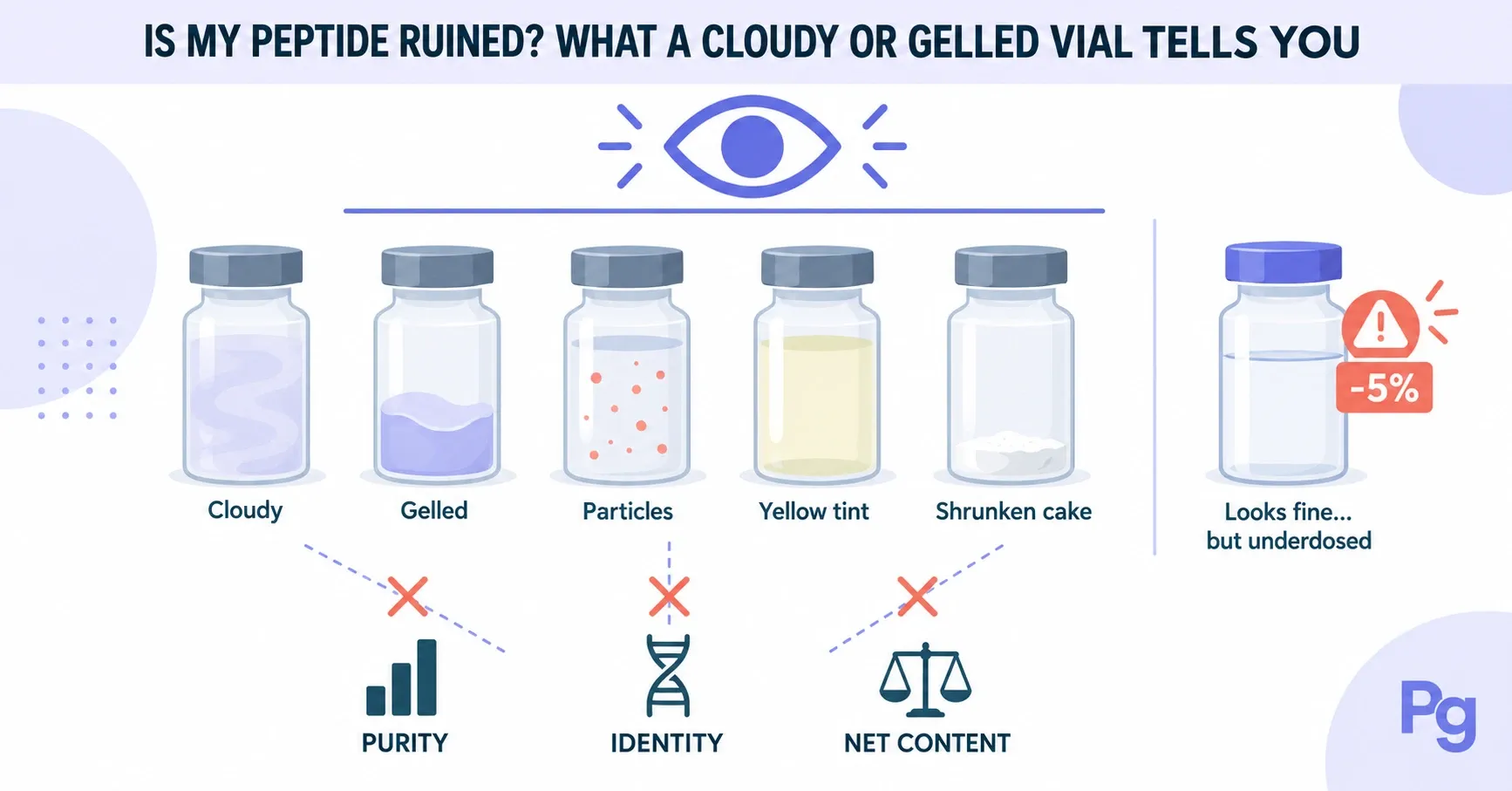
Semaglutide's sourcing risk is therefore specific, and it is not the one most guides describe. The molecule is easy to identify by mass and hard to counterfeit convincingly, so the two failures that actually occur are substitution of a salt form and quantity that does not match the label. A vial can be 99% pure and still contain substantially less peptide than the label claims, because purity and quantity are separate measurements answering separate questions — see mass spectrometry for peptides for what an identity test actually establishes.
The third risk is arithmetic rather than chemistry. FDA received "multiple reports of adverse events... that may be related to dosing errors associated with compounded injectable semaglutide products," resulting from patients measuring and self-administering incorrect doses. A drug titrated from 0.25 mg to 2.4 mg weekly leaves very little room for a units mistake.
Semaglutide | Tirzepatide | |
|---|---|---|
Mechanism | GLP-1 receptor agonist | Dual GIP and GLP-1 receptor agonist |
Molecular weight | 4,113.6 g/mol | 4,813.0 g/mol |
CAS | 910463-68-2 | 2023788-19-2 |
Head-to-head at 72 weeks (SURMOUNT-5, n=751) | −13.7% | −20.2% |
Access | Prescription | Prescription |
The distance between 4,113.6 and 4,813.0 is the reason a mass spectrometer is not optional. HPLC tells you what proportion of the sample is the main peak; it does not tell you which molecule that peak is.
What is the regulatory status of semaglutide?
Semaglutide is a prescription medicine, and as of August 2026 its compounding route is closed. FDA declared the semaglutide injection shortage resolved on 21 February 2025, enforcement discretion ended 22 April 2025 for 503A pharmacies and 22 May 2025 for 503B outsourcing facilities, and FDA has proposed permanently excluding semaglutide from the 503B bulks list. Semaglutide is not on WADA's Prohibited List; it has been on the Monitoring Program since 2024.
Semaglutide appears on neither of FDA's bulk drug substances tables. We enumerated both on the page current 22 April 2026: no GLP-1, GIP, glucagon or amylin agonist is on either. That absence is not permission. The mechanism that legitimised compounded semaglutide was always the shortage list, and the shortage list now reads Resolved.
On sport, monitoring is not prohibition, but it is not nothing either. From 1 January 2026 markers of semaglutide and tirzepatide are monitored both in and out of competition, which means use is being tracked at population level even though no anti-doping rule violation attaches to it.
On labelling, FDA "has warned companies that have illegally sold unapproved drugs... falsely labeled 'for research purposes' or 'not for human consumption.' These products have been sold directly to consumers for human use." A research-use label is a legal posture adopted by the seller, not a grade, a specification or a defence. For the dated regulatory record see the FDA peptide regulation timeline, and for the prescription question specifically, can you get semaglutide without a prescription.
Claim you will meet while shopping | What the record says | Verdict |
|---|---|---|
"Compounded semaglutide is a legal option" | Shortage resolved 21 Feb 2025; discretion ended April and May 2025 | Out of date |
"Semaglutide sodium is the same active ingredient" | FDA: salt forms "are different active ingredients" | Wrong |
"It is 99% pure, so the vial holds what the label says" | Purity and quantity are separate measurements | Category error |
"It is labelled for research, so the rules do not apply" | FDA has warned sellers using exactly that labelling | No exemption |
"GLP-1SG is a different, cheaper compound" | GLP-1SG is a catalog code for semaglutide | Same molecule |
"Semaglutide is banned in sport" | Monitoring Program, not the Prohibited List | Wrong |
"It is built on an exendin-4 backbone" | Human GLP-1(7-37) analogue | Wrong molecule |
Why is semaglutide sodium not semaglutide?
Semaglutide sodium and semaglutide acetate are not semaglutide. FDA's position is explicit: these salt forms "are different active ingredients than are used in the approved drugs," and the agency "does not have information on whether these salts have the same chemical and pharmacologic properties." A vial of semaglutide sodium can return a 99% HPLC purity figure and genuinely be 99% pure — of something no randomised trial has tested. Purity answers a question about proportion, not about identity.
The practical consequence runs through the whole transaction. A salt form changes what you are weighing, so a labelled 10 mg can be 10 mg of a salt of which the peptide itself is some smaller fraction, and it changes what a regulator considers the product to be. Neither effect is visible on a purity percentage. Both are visible on a certificate of analysis that states the form, and both are resolvable by mass spectrometry plus a net-content measurement.
So the check is not "is it pure" but "pure what, and how much of it". Ask for the salt form in writing before you buy, treat "pharmaceutical grade" as marketing rather than an answer, and read TFA vs acetate vs amidate peptide salt forms alongside how to read peptide lab test results if the CoA in front of you is ambiguous. A vendor who cannot say which form they are selling has told you they do not know.
7 things to check before ordering semaglutide
Seven checks cover semaglutide's real failure modes, and three of them carry most of the weight: mass spectrometry at 4,113.6 Da, the salt form stated in writing, and net peptide content measured separately from purity. The remaining four — batch-matched third-party HPLC, a readable certificate of analysis, Peptigrity's independent test history, and the label and price read together — catch the vendors who never intended to answer the first three.
Mass spectrometry at 4,113.6 Da. This is the identity test, and it is the one most often missing. It confirms the 31-residue GLP-1(7-37) analogue with its C18 diacid attached, and it separates semaglutide from tirzepatide at 4,813.0 Da, from fragments, and from a peptide that merely elutes in the right place.
The salt form, in writing, before you pay. Free base, sodium or acetate. FDA treats the salts as different active ingredients, so this single line on a certificate decides what you are actually buying.
Third-party HPLC purity, matched to your batch. A named independent laboratory, a batch number that matches the vial you receive, and a date. A stock certificate reused across batches is a document about a different vial.
Net peptide content, measured separately from purity. Net content or amino acid analysis answers "how much peptide is in here"; HPLC answers "what proportion of it is the intended peak". Underdosing is the failure that costs money quietly — see why 10 mg isn't 10 mg.
A certificate of analysis you can actually read. Named lab, batch number, test date, method, and results for each test claimed. Red flags in peptide certificates of analysis covers what a fabricated one looks like, and what is HPLC testing covers what the purity number means.
Independent test history and community reviews for the shop, not just the vial. Search Peptigrity's lab test database for results the vendor did not commission, and read the community-verified reviews for the shop itself. One clean CoA is a sample; a testing history is a pattern.
The label and the price, read together. "Research purposes only" is a legal posture, not a quality tier. And because 7.2 mg was approved in March 2026, the range of plausible label strengths widened — check the strength against the semaglutide dosing chart so you are not converting units on the fly with a syringe in your hand.
Check | What it confirms | How to verify | Red flag |
|---|---|---|---|
Mass spectrometry | It is semaglutide — mass near 4,113.6 Da | Batch-matched CoA carrying the MS result | Purity given with no identity test |
Salt form | Free base versus a salt FDA calls a different active ingredient | The form written on the CoA | Form not stated |
Net peptide content | Actual peptide mass in the vial | Net content or amino acid analysis | Purity quoted as if it were quantity |
HPLC purity | Proportion of intended peptide | Third-party CoA, named lab, your batch | Vendor's own document only |
Cold-chain documentation | Material was handled correctly | Shipping records | None available |
Where does semaglutide rank on Peptigrity's lab test database?
Peptigrity tracks 530 shops and 11,852 independent lab tests across 118 peptides, with 1,283 community reviews (verified August 2026), and trust scores weight community reviews and independently verified HPLC purity equally at 50% each. Semaglutide's own purity average, test count and per-milligram spread are read live from the Purity Index and the semaglutide price page rather than printed here, because a figure we cannot date is worth less than a page you can refresh.
Semaglutide price data shows 8 shops in stock, a median of $9.00/mg and a lowest tracked price of $3.00/mg on a 10 mg vial, across 20 comparable offers with per-vial prices from $29.99 to $300.00 (verified 10 August 2026). Vial size drives most of that spread: 2–5 mg vials run a median $14.00/mg against $8.00/mg for 10–20 mg, because packaging and testing costs are fixed regardless of fill. Those figures exclude shipping, taxes and customs, coupon codes, bulk tiers, multi-vial kits and account-gated pricing. Per-compound purity averages and test counts sit in the Purity Index, and individual results with the testing laboratory named sit in the lab test database.
No financial relationship influences the ranking, and we do not take vendor payment for placement. That is worth stating on a page like this precisely because most pages carrying the phrase "where to buy" are compensated for the answer. Vendor-level detail, including which shops have been tested and how often, sits on the semaglutide compound page.
Read the price spread as a risk signal rather than a bargain hunt. Semaglutide has an approved version that exists on prescription, manufactured under pharmaceutical controls with a cold chain attached, and any per-milligram figure far below the rest of the market is pricing the absence of those things rather than discounting their presence.
What about compounded semaglutide?
Compounded semaglutide is largely no longer a legal option. FDA declared the shortage resolved on 21 February 2025, enforcement discretion ended 22 April 2025 for 503A pharmacies and 22 May 2025 for 503B outsourcing facilities, and what survives is narrow: 503A compounding under documented clinical-difference exceptions, such as a verified excipient allergy or a strength not commercially available. Compounded semaglutide marketed broadly to consumers is operating outside that framework.
The statutory logic is worth understanding rather than memorising. Sections 503A and 503B of the Food, Drug and Cosmetic Act permit compounding a drug that is essentially a copy of an approved product only while that product is in shortage. The shortage was the permission. Belcourt, Sapowadia & White, writing in Annals of Pharmacotherapy in September 2026, put the consequence plainly: "With the shortage of innovator semaglutide or tirzepatide products resolved, compounding pharmacies can only legally sell unique products." FDA has gone further for this molecule specifically, proposing permanent exclusion from the 503B bulks list, which would remove the route regardless of any future shortage.
Cost was the whole appeal of the compounded route, and its closure is a price event as much as a legal one. What it left behind is a two-way choice: the approved product at pharmacy prices on a prescription, or research-market vials at per-milligram prices with no prescriber, no cold chain and no regulatory recourse. There is no third option in which the compounded price survives the compounded pathway. For the structural comparison see compounding pharmacy versus research peptide and how much do peptides cost.
The safety record of the closed route is the part most often skipped. As of 30 November 2024, FDA had received more than 392 adverse event reports for compounded semaglutide. Those are spontaneous reports rather than trial data, they carry all the limitations of spontaneous reporting, and they still describe a route that operated under pharmacy oversight — which is more oversight than a research vial has.
The trial that would settle this has not been run, and naming it is more useful than pretending the question is closed.
Element | Detail |
|---|---|
Question | What proportion of vials sold as semaglutide contain semaglutide free base at the labelled quantity? |
Design | Blinded purchase across shops, assayed for identity by mass spectrometry, salt form, and net peptide content |
Primary endpoint | Proportion failing on identity, salt form or quantity |
Why it has not run | No commercial sponsor has an interest in the answer |
Closest existing evidence | The independent lab test database and Purity Index described above |
Published equivalent | None we could find — which is not the same as none existing |
Frequently Asked Questions
What purity standard should semaglutide meet?
A batch-matched third-party HPLC result from a named laboratory is the baseline, and on this platform independently verified HPLC purity carries half the weight of a shop's trust score. But treat the percentage as necessary rather than sufficient: a salt form can score just as high as the free base, so the purity figure needs an identity test and a net-content figure beside it before it means anything.
How much should semaglutide cost?
Per-milligram medians, lowest offers and shops-in-stock are read live on the semaglutide price data page linked above, broken out by vial size. Those figures exclude shipping, taxes and customs, coupon codes, bulk tiers, multi-vial kits and account-gated pricing. The comparison that matters is not vial against vial but per-dose cost against the approved product on prescription, since semaglutide is one of the few compounds on this site with a pharmacy version to compare against.
Is it legal to buy semaglutide without a prescription?
No. Semaglutide is a prescription medicine, and labelling a vial "for research purposes" does not change its classification — FDA has warned companies selling unapproved drugs under exactly that wording. The compounded route that briefly widened access closed in 2025, and what remains is patient-specific 503A compounding under documented clinical-difference exceptions.
How do you verify semaglutide is genuine?
Mass spectrometry at a mass near 4,113.6 Da for identity, the salt form stated on the certificate, and net peptide content or amino acid analysis for quantity. HPLC purity belongs in the set but cannot substitute for any of the three, because it measures proportion rather than identity or mass. A certificate that gives you a purity number and nothing else has answered the easiest question only.
What dose should you start at?
The approved schedule starts at 0.25 mg weekly and escalates over months to a standard weight-management dose of 2.4 mg weekly, with 7.2 mg approved in March 2026. This is prescription medicine and dosing belongs to your prescriber. For the volume arithmetic once a vial is reconstituted, use the semaglutide calculator — self-measurement error is a documented source of adverse events on this drug.
Is semaglutide sodium the same as semaglutide?
No. FDA has stated that these salt forms "are different active ingredients than are used in the approved drugs" and that the agency lacks information on whether they share the same chemical and pharmacologic properties. A vendor selling semaglutide sodium is selling something the STEP trials did not test, however clean its purity figure looks.
Browse the weight loss and metabolic peptides category, or our complete peptide guide with 118 compounds (verified August 2026). For per-injection volume, use the semaglutide calculator alongside the reconstitution calculator. Compare shops through independent lab tests and community-verified shop reviews.
This article is for educational and informational purposes only and does not constitute medical advice. Peptides discussed may be investigational compounds not approved by the FDA (or equivalent regulators in your jurisdiction) for human use. Always consult a qualified healthcare provider before using any peptide or research compound. Peptigrity is an independent review platform and does not sell, endorse, or recommend specific products or vendors.