Buying peptides from China is possible but risky: U.S. Customs and Border Protection reports seizing about 5,000 China-origin peptide shipments in a single Cincinnati operation between December 2025 and March 2026. If you have ordered research peptides from a Western shop, you may already have bought Chinese-made powder, so the real variables are whether anyone tested the product and whether your package gets through, not the country of origin.
Most research peptides sold anywhere trace back to Chinese manufacturing, so "from China" is the supply-chain default rather than a red flag by itself. What varies enormously, and what this guide helps you control, is whether the vendor is honest, whether the vial contains the right compound at the right dose, and whether the certificate that's supposed to prove it is genuine. To compare independent purity data before you commit, Peptigrity's Peptide Lab Tests database tracks third-party HPLC results across vendors — and because that data is origin-agnostic, it answers the "is it real?" question better than any country-of-origin debate.
The short version
Much of the research-peptide powder sold worldwide is made in Chinese factories, so "from China" describes the supply chain rather than the quality of one vial.
The real risks are a wrong or underdosed compound, a faked certificate, a seller who never delivers, a seized parcel and contamination; on Peptigrity, 7.23% of 12,710 lab tests that measured how much peptide a vial held found less than 95% of the labeled amount (verified October 2026).
Only a third-party lab test on the batch you received shows what is in the vial: how pure it is, whether it is the right molecule and how many milligrams it holds.
In the US, a "research use only" label creates no import exemption, and FDA import alerts let the agency hold flagged drug shipments at the border without opening them.
As of October 2026, none of the six peptides an FDA advisory committee backed in July 2026 has been cleared for pharmacy compounding, and those changes concern pharmacies, not personal imports.
What are Chinese peptides?
"Chinese peptides" is the market's shorthand for research peptides synthesized by contract manufacturers in China and sold either direct by Chinese vendors or relabeled by shops elsewhere. The factories work at industrial scale: one of them, WuXi AppTec, synthesized more than 15 metric tons of peptide active pharmaceutical ingredients (APIs) and intermediates in 2023, according to industry reporting. The term describes where the powder was made, not its quality, so only a third-party test on your batch shows what a vial holds.
The scale is the part most buyers underestimate. The ChinaTalk special report Chinese Peptides (Ottinger et al., February 2026), the source of the WuXi figure, also reports that WuXi tripled its solid-phase peptide synthesis (SPPS) reactor volume to 32,000 liters in 2024 and that another major manufacturer, GenScript, can synthesize custom peptides in as little as five days. SPPS is the chemistry that builds a peptide one amino acid at a time. This is industry reporting, not a safety verdict — the same factories supply legitimate pharmaceutical pipelines and the grey market alike.
In practice the term covers two different purchases. A China-direct order ships from a Chinese vendor or factory to the buyer's own address; a repackaged vial comes from a reseller elsewhere that bought Chinese powder or finished vials in bulk and sells them under its own name. Both usually start in the same factories, but only the first crosses a border with the buyer as the importer of record. A separate research field studies bioactive peptides extracted from traditional Chinese natural products, reviewed in The Research Progress of Bioactive Peptides Derived from Traditional Natural Products in China (Zhang et al., 2023); that work concerns foods and natural extracts, not research vials. Neither meaning covers collagen supplements or the peptides in skincare serums, which are a separate product class entirely.
Are all peptides made in China?
No: approved peptide drugs such as Wegovy and Zepbound are made by their licensed manufacturers, Novo Nordisk and Eli Lilly, but most research-peptide powder sold online starts in Chinese contract factories, including much of what Western shops repackage. China produces an estimated 40% of all active pharmaceutical ingredients, according to ChinaTalk's February 2026 report. A shop's address therefore tells you little about where its powder was made; whether it publishes a third-party test for each batch tells you more.
The distinction matters most for the GLP-1 drugs, the weight-loss and diabetes medicines that mimic the gut hormone GLP-1. A Wegovy or Zepbound pen reaches a patient from its manufacturer through a licensed pharmacy; a vial sold online as a research version of the same molecule comes from the contract-factory supply chain instead, whatever the shop's address. U.S. Customs' 2026 Cincinnati seizure of China-origin peptide parcels included both molecules.
Can you actually buy peptides from China?
Yes — you can buy research peptides from China, and if you've ever ordered from a Western vendor, you likely already have. The practical limits are payment and recourse, the shipping route and the law where your package lands, not availability. Buyers choose among 4 sourcing channels — China-direct, a Western reseller, a vetted domestic shop and a US compounding pharmacy — and buying direct strips away the vetting, batch testing, accountability and customs buffer a domestic vendor provides.
The supply chain has distinct layers, and understanding them dismantles a popular myth. Upstream API manufacturers make bulk powder and rarely sell to the public. Fill/finish laboratories turn that powder into vials — dissolving, sterile-filtering, filling, freeze-drying (lyophilizing), and sealing — using cleanrooms and equipment that run as production campaigns, not retail counters. Resellers buy finished vials in bulk and split them into kits and single units, and group-buy organizers and domestic depots sit on top of that. The verification standards applied to retail shops (independent testing, traceable batch numbers, accessible certificates) usually aren't available at the factory level.
That structure is why "buy direct from the factory to save money" often backfires. Fill/finish labs price around batch economics: line setup, sterilization, quality control, and long lyophilization cycles are mostly fixed per batch, so a small order carries a steep "small-order penalty," and many factories impose high minimums or refuse retail quantities outright. A reseller who buys thousands of vials at wholesale and splits them can genuinely undercut a "direct" order — which is why going direct mainly strips away the reseller's batch testing and recourse, not the cost.
Sourcing channel | Where the API usually comes from | Relative price | Purity & identity assurance | Legal / customs risk (US buyer) | Recourse if it goes wrong |
|---|---|---|---|---|---|
China-direct vendor / factory | Chinese SPPS factory | Often not the lowest (small-order penalty, MOQs) | None unless you test it yourself | Highest (international shipment, detention risk) | Effectively none |
Western reseller (repackaged) | Usually Chinese | Variable; sometimes lower than direct | Varies; depends on whether they test batches | Lower (domestic shipment) | Some, if the shop is reputable |
Vetted domestic shop w/ batch testing | Usually Chinese | Mid-to-higher | Best in the grey market — publishes a third-party test for each imported batch | Lower (domestic shipment) | Best in the grey market |
US compounding pharmacy (503A/503B) | Regulated supply chain | Highest | Pharmacy-grade, prescription-gated | Legal only for eligible substances, with a prescription — retatrutide and BPC-157 do not qualify (October 2026) | Full (licensed, accountable) |
Four widely sold peptides serve as running examples. The investigational triple agonist retatrutide has no approval anywhere. The GLP-1 receptor agonist semaglutide is the active ingredient in Ozempic and Wegovy. The dual GIP/GLP-1 agonist tirzepatide is the active ingredient in Mounjaro and Zepbound. The 15-amino-acid pentadecapeptide BPC-157 has no regulatory approval for any use. For the chemistry behind why origin barely predicts quality, How Are Peptides Made walks through solid-phase synthesis step by step.
How ordering peptides from China actually works
Ordering peptides from China usually means buying lyophilized "research use only" powder from a standalone vendor website, a B2B marketplace listing, or a Telegram or WeChat seller, then paying by cryptocurrency, bank transfer, or card. Orders range from single vials to bulk minimums, frequently ship repackaged, and often come with "reship if seized" guarantees. The mechanics are worth understanding before you commit money — not as a procurement playbook, but so you know exactly what you're walking into and where the protections you're used to disappear.
Payment is the part that quietly determines your risk. The three common methods carry very different recourse: cryptocurrency is irreversible — once sent, there is no chargeback and no intermediary to dispute with; bank wires are similarly final; a card at least preserves a chargeback path, but you've now handed card and identity details to an unverified overseas site. Many China-direct vendors push crypto specifically because it removes the buyer's leverage. For a fuller breakdown of how payment choice changes your exposure, see Peptigrity's guide to peptide shop payment methods.
The vendor landscape is fragmented and opaque, and the same operation often wears several faces. Buyers search for specific abbreviated brand names they've seen in forum threads, but grey-market investigations regularly find one supplier running under multiple "vendor" identities — shared catalogues, shared stock photos, even shared lab reports. An independent review platform can't responsibly endorse any individual China-direct seller, because the verification data simply isn't there. The more useful move is to evaluate any vendor against objective signals rather than its reputation in a chat group; Peptigrity's directory of peptide suppliers exists to compare those signals side by side. As for "bulk" or "wholesale" listings: those minimum-order quantities exist because resellers buy upstream to repackage, which is supply-chain context, not an invitation for an end-buyer to import kilogram quantities.
What can go wrong when you buy peptides from China
The risks of buying peptides from China fall into six buckets: getting the wrong compound or dose, getting a faked certificate, getting scammed, having the package seized at the border, contamination, and your own legal and payment exposure. Most are real but avoidable. The most important point is that a peptide can look perfect on paper — high purity, clean certificate — and still be the wrong molecule, underdosed, or accompanied by a recycled report, which is why independent testing of the exact batch you receive is the only reliable defense.
Risk | Why it happens | How likely | How to reduce it |
|---|---|---|---|
Wrong compound or wrong dose | No oversight; cheaper peptides substituted; underfilling | Documented in lab testing | Mass-spec identity test, not just purity; test the batch |
Faked or recycled certificate of analysis | Reports are photoshopped, shared, batch numbers reused | Documented across vendors | Verify the CoA directly with the issuing lab |
Scam / nondelivery / vanishing vendor | No accountability; irreversible payment | ~50% in one market study | Small first order; reviewed vendor; card over crypto |
Customs seizure at the border | Unapproved-drug imports; FDA import alerts | Active: about 5,000 China-origin shipments seized at one US port, Dec 2025–Mar 2026 | Understand the route risk; accept it is real |
Contamination (endotoxin, sterility) | RUO powder carries no sterility guarantee | Found in tested samples | Endotoxin/sterility testing; never assume injectable-grade |
Legal & irreversible-payment exposure | "Research use only" is not an import exemption | Jurisdiction-dependent | Know your local law; use a payment method with recourse |
You get the wrong compound or the wrong dose
The most unsettling failure isn't a weak product — it's the wrong drug in a convincing vial. Retatrutide and tirzepatide are both 39-amino-acid GLP-1-class peptides, and their molecular weights sit only 82 daltons apart — about 4,731 Da for retatrutide against 4,813 Da for tirzepatide, as the Retatrutide lab tests page sets out. A swapped vial can carry a clean HPLC purity figure, because purity measures how much of the sample is one molecule, not which molecule it is; an identity test by mass spectrometry (LC-MS, which weighs the molecule) tells the two apart, and a mix-up needs no fraud to happen.
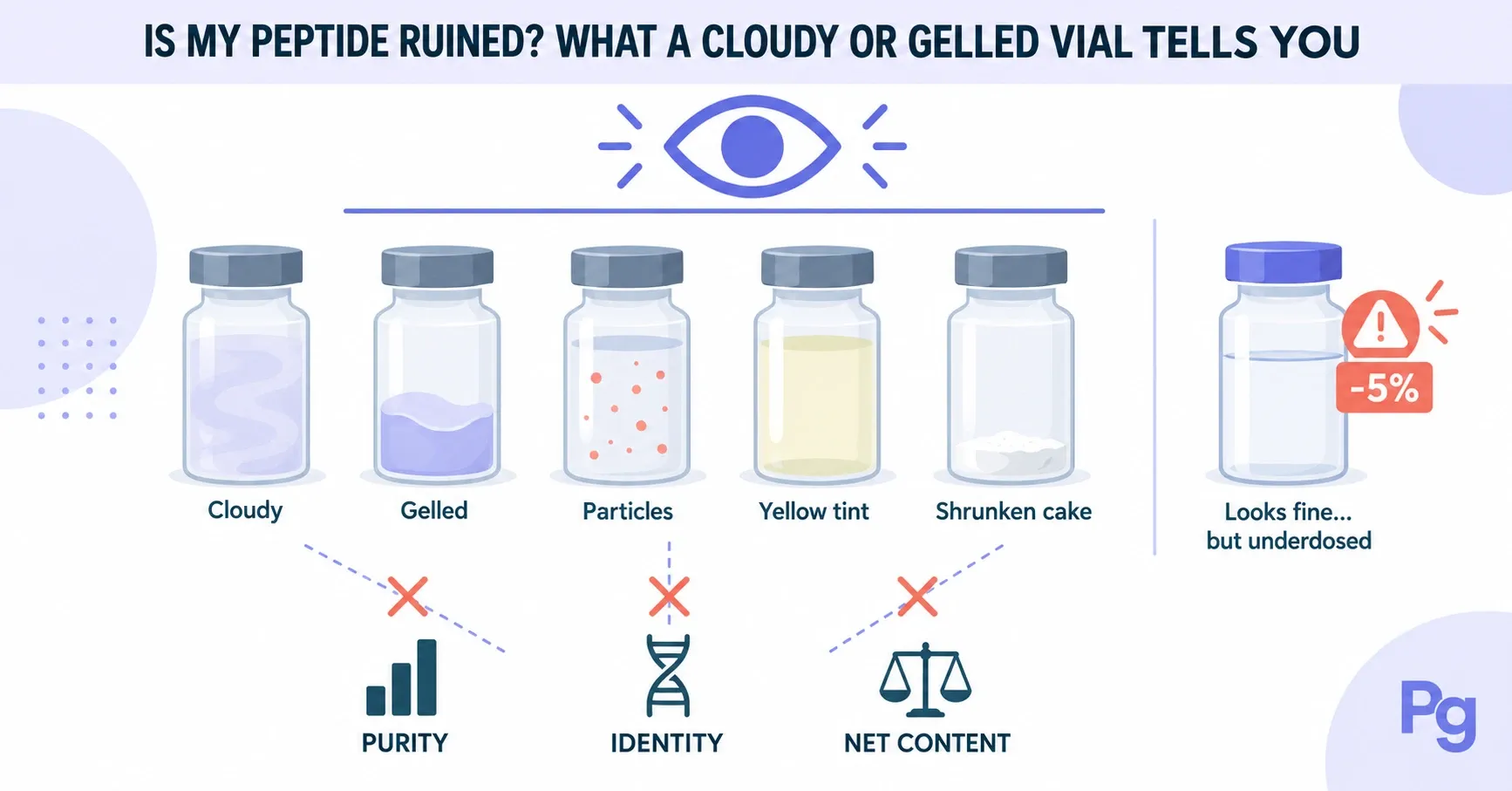
Underdosing is the quieter version of the same problem: on the Peptigrity Purity Index, 919 of the 12,710 lab tests that measured net content — the milligrams actually in the vial — found less than 95% of the labeled amount (7.23%), against 0.28% of 13,364 purity results below 95% purity (verified October 2026). Purity can fail badly too: in the study Multifactor Quality and Safety Analysis of Semaglutide Products Sold by Online Sellers Without a Prescription: Market Surveillance, Content Analysis, and Product Purchase Evaluation Study (Ashraf et al., 2024), test-purchased semaglutide measured 7.7% to 14.4% purity against a 99% label — analytical evidence from a University of Pécs and UC San Diego team. Impurities turn up even in commercially synthesized research peptides, as the paper Peptide Impurities in Commercial Synthetic Peptides and Their Implications for Vaccine Trial Assessment (Currier et al., 2008) documented in peptide libraries used for HIV vaccine research. Purity and identity are different questions, and only mass-spec identity testing answers the second one.
The certificate of analysis itself can be faked or recycled
The document that's supposed to protect you can be the most polished lie in the transaction. Grey-market investigations have repeatedly found the same third-party lab report circulating across nominally different vendors with only a digit changed in the batch and task numbers, and the same batch number reused across entirely different products — a tell, because a genuine batch number identifies one specific production lot and shouldn't repeat. (Community-reported.) Buyers post worked examples of edited certificates on the grey market peptide forum, where every thread sits next to the lab data. A photoshopped or recycled certificate is worse than none, because it manufactures false confidence. This is why a certificate only counts if you can verify it directly with the issuing laboratory and confirm it describes your exact batch — the verification section below explains how.
You get scammed — or the vendor vanishes
Nondelivery scams are a documented feature of the unregulated peptide market, not a rare accident. In the JMIR market study, half of the test-purchase vendors failed to deliver any product, with several instead demanding additional payments after the initial order. A China-direct vendor has no domestic legal accountability, and if you paid by crypto or wire, there is no chargeback to fall back on. Vendors also rebrand and disappear regularly. The protective move is to treat the first order as a test, use a payment method with recourse, and check whether a vendor has a track record before sending money — Peptigrity's guide on how to spot a scam peptide shop covers the warning signs.
Customs seizes your package at the border
Customs seizure is the biggest financial risk of ordering from China. U.S. Customs and Border Protection's release Cincinnati CBP foils scheme to smuggle over 5,000 unapproved peptides into the U.S. (March 31, 2026) reports about 5,000 individual peptide shipments from a shipper in China seized at the Port of Cincinnati between December 2025 and March 25, 2026, packed about 15 at a time into more than 300 mis-manifested "master cartons"; the seized peptides included retatrutide, semaglutide and tirzepatide. A seized package means lost money with no refund, and the Research Peptide Customs Seizure Guide covers the notices you may receive and how to respond.
Contamination and sterility risk
"Research use only" powder carries no sterility, endotoxin, or heavy-metal guarantee, because it was never intended for injection. In the JMIR semaglutide test purchases, endotoxin was detected in every sample, at levels up to 8.95 EU/mg — a contamination signal that matters for anything injected. This is analytical evidence from a small sample, but it illustrates the category risk: a vial can contain the right compound at the right dose and still be unsafe to inject. Endotoxin and sterility are separate tests from purity and identity, and grey-market sellers rarely provide any of the three.
Legal exposure and irreversible payment
Two risks sit with you regardless of the product's quality. Importing unapproved-drug peptides is not legalized by an "RUO" label, because U.S. Customs evaluates a shipment's apparent intended use, not the wording on the vial — so labeling a weight-loss peptide "for research" creates no import exemption, and being the importer of record on a non-compliant shipment can carry consequences beyond a lost package. Layered on top, the payment methods these vendors prefer — cryptocurrency and bank wires — are irreversible, so a bad order is also an unrecoverable one. Favor a payment method that preserves a chargeback, and never send identity documents a legitimate research-chemical sale would not require.
Are peptides from China safe and legit?
Peptides from China are not automatically unsafe — many are made in facilities inspected to international GMP standards — but the unregulated "research use only" channel most buyers use offers no guarantee of what's in the vial. Country of origin doesn't predict quality, and a single batch from a "good" vendor can differ from the last. The only reliable answer to "is it legit?" is a third-party HPLC and mass-spectrometry test on the batch you actually received.
This is exactly where a vetted Western source earns its markup. The strongest domestic shops publish a third-party test for every batch they import from China (purity, and ideally identity and net content), which catches mislabeled, underdosed, or wrong-compound lots before they ever reach a customer — the single most practical advantage of a reputable reseller over buying direct, where nobody tests the batch on your behalf. It also reframes the price comparison: you are not paying a domestic shop only for faster shipping, you are paying for the testing layer that a factory-direct order skips.
Vendor reviews are useful signal but they are not proof. Reddit threads and forum testimonials — which Google now surfaces in a discussions block for queries like "peptides from china" — reflect real buyer experiences, but reviews can be seeded, and a positive experience with one batch says nothing about the next. If you have ordered from a China-direct seller, the Peptide source & vendor talk board on Peptigrity's forum is where buyers compare how an order went and how long shipping took; posts name the shop and the compound, so each claim can be checked against that shop's lab record, and each one is still a single buyer's experience.
Objective lab data outranks anecdote. Peptigrity lists 767 shops and publishes 13,413 third-party lab tests, nearly all supplied by the shops that sold the vials (verified October 2026), and its Trust Score, as How Peptigrity actually works sets out, weighs community reviews and lab purity at 50% each, each scaled by how much data stands behind it. The compounds this guide uses as examples are among the most-tested on the platform: retatrutide leads with 1,348 lab tests, followed by tirzepatide (1,028) and BPC-157 (889), with semaglutide at 444 (verified October 2026) — giving you a real baseline to check any vendor's claims against. The underlying point holds regardless of origin: an unapproved peptide's quality is verifiable by testing even when its clinical evidence is thin.
How to buy peptides from China more safely
If you decide to buy peptides from China, you reduce the risk by shifting trust from the seller's word and paperwork to evidence you can independently confirm. That means five steps: vet the vendor on verifiable signals (a track record of third-party lab tests, real reviews, and a payment method with recourse); demand a recent certificate of analysis and verify it directly with the issuing lab; require mass-spec identity confirmation, not just an HPLC purity number; place a small first order; and ideally test the vial yourself before use.
The checklist below maps each check to the red flag it's designed to catch.
Check | What it confirms | How to verify | Red flag |
|---|---|---|---|
HPLC purity (≥98%) | What share of the peptide content is the main compound | Recent third-party HPLC report on the batch | No CoA, or a CoA with no date or batch number |
Net content | That the vial holds the milligrams on its label | A quantity (net-content) result on the batch's certificate | No quantity result, or one well below the label |
Mass-spec identity | That it's the right molecule (correct MW) | LC-MS / MS report matching the compound's mass | Purity-only report with no identity confirmation |
CoA verified with the lab | The report is genuine, not photoshopped | Confirm it on the issuing lab's verification portal | Report can't be confirmed; same report seen under other vendors |
Batch / lot integrity | The CoA describes your vial | Lot number matches the vial and isn't reused | Batch number repeated across different products |
Vendor track record | Pattern of quality over time | Lab-test history + reviews on an independent platform | No history; only chat-group hype; multiple aliases |
Independent database check | Cross-vendor reality check | Look the compound up on a public lab-test index | Vendor's numbers far exceed the platform norm |
Your own test | Ground truth on what you received | Submit a sample to a third-party lab | Vendor discourages independent testing |
Two habits matter most. First, verify the certificate at the source — a real third-party lab can confirm whether a report and its batch number are authentic, which neutralizes the recycled-CoA problem entirely. Second, insist on identity, not just purity — a vial sold as retatrutide that holds tirzepatide would pass a purity glance and fail a mass-spec identity test. You can compare results across vendors and learn the full workflow, including how to read an HPLC and mass-spec report, in the how to test your peptides hub. A certificate is only as trustworthy as the lab behind it and your ability to confirm it describes the exact batch in your hands.
Is it legal to buy peptides from China?
Buying peptides from China is rarely about Chinese law — it's about the law where the package arrives. Peptides are not controlled substances, but the FDA treats research peptides intended for human use as unapproved drugs, and a "research use only" label creates no import exemption because U.S. Customs judges intended use, not packaging. FDA Import Alerts authorize detaining unapproved peptide shipments without physical examination, and as the Cincinnati seizure showed, enforcement against China-origin parcels is active. This is regulatory status as of October 2026 — verify before relying on it.
The enforcement mechanism is worth naming. FDA's Import Alert 66-41, Detention Without Physical Examination of Unapproved New Drugs Promoted In The U.S., lets the agency hold flagged drug shipments at the border without opening them. Import Alert 66-80, Detention Without Physical Examination of Glucagon-Like Peptide-1 (GLP-1) Receptor Agonist Bulk Drug Substances, does the same for GLP-1 active ingredients and was revised in 2026. Personal-importation discretion exists but is narrow and case-by-case; it is not a right you can count on.
Jurisdiction is the deciding variable, and it changes fast. The table below is a starting point, not legal advice — confirm the current rules for your country before ordering.
Jurisdiction | How peptides are classified | Customs enforcement posture | Personal-import nuance |
|---|---|---|---|
USA | Unapproved drugs (FDA) | Active; Import Alerts allow detention without exam | Narrow, discretionary |
UK | Unlicensed medicines (MHRA) | Border seizures occur | Limited personal allowance, not guaranteed |
EU | Unauthorised medicinal products | Varies by member state | Generally restricted |
Australia | Largely Schedule 4 (TGA) | Strict; one of the toughest regimes | Personal Importation Scheme has firm limits |
Canada | Prescription/unapproved drugs | Border holds occur | Limited personal exemptions |
For the full country-by-country picture, Peptigrity's guide Are Peptides Legal? covers the US, Europe, Australia and Canada. If you're buying for use in the US specifically, Peptigrity's list of peptide suppliers that ship to the US shows each shop's lab record; a seller that ships from inside the US removes the international leg and its customs risk.
There is also a moving regulatory story worth watching. In April 2026 FDA removed 12 peptides from Category 2, its list of substances that may present significant safety risks in compounding — a removal that does not make any of them compoundable — and at the July 23-24, 2026: Meeting of the Pharmacy Compounding Advisory Committee the committee voted to recommend six of them for the 503A bulks list, the list a substance must be on before pharmacies may compound it. FDA's advisory committees make non-binding recommendations, and as of October 2026 none of the six has been added. The Washington Post reported in Trump administration paving way for temporary sale of some unapproved peptides (October 7, 2026) that the administration is drafting a temporary policy letting some compounding pharmacies sell certain restricted peptides while rules are written, a plan that has not been announced. Every one of these changes governs compounding-pharmacy access, not the grey market, and none makes importing research-grade peptides from China any more legal.
Should you buy peptides from China?
Whether you should buy peptides from China comes down to who tests the product and how much risk you can absorb — not the country on the label. China-direct sourcing reaches compounds with no domestic prescription path, but you accept purity and identity uncertainty, faked-certificate risk, scams with no recourse, border seizures, contamination, and zero medical oversight. For most buyers, the safer routes are an approved drug on prescription where one exists, or a vendor whose batches carry verifiable third-party tests.
The decision is less about geography and more about whether the product reaching you has been independently verified.
The case for it. Some compounds — investigational ones like retatrutide — have no legal prescription route in many countries, which is what drives buyers upstream in the first place. The cost argument is weaker than it sounds: factory-direct orders carry minimum quantities and a small-order penalty, so a bulk-buying reseller is often cheaper anyway.
The case against it. Every risk in this guide compounds when you remove both the reseller's testing and the regulator: unverified purity and identity, recycled certificates, documented scams, customs seizures at the border, contamination with no sterility guarantee, and irreversible payments. If you won't independently test the product, the case against is decisive.
The safer routes. A vetted domestic shop that publishes third-party tests on its imported batches reduces customs and recourse risk while doing much of the verification work for you; Compounding Pharmacy vs Research Peptide lays out the trade-off against the pharmacy route. For semaglutide and tirzepatide, the lawful US route is the approved product on prescription (Ozempic or Wegovy; Mounjaro or Zepbound): FDA's update FDA clarifies policies for compounders as national GLP-1 supply begins to stabilize records that both shortages have been resolved; once FDA's grace periods ended in 2025, compounders could no longer make copies of either drug except in narrow cases. A licensed compounding pharmacy can supply only substances eligible for compounding, and as of October 2026 neither retatrutide nor BPC-157 is eligible. If you're moving toward a specific compound next, the buyer guides for where to buy retatrutide and where to buy BPC-157 translate these principles into compound-specific checks.
Frequently Asked Questions
Is it cheaper to buy peptides direct from a Chinese factory?
Often not. Fill/finish factories price around production batches, impose minimum-order quantities, and frequently refuse retail-scale orders, so a small "direct" purchase carries a steep per-vial penalty. A reseller buying thousands of vials at wholesale and splitting them can undercut a direct order while also testing batches and handling shipping. Going direct mainly removes the testing and recourse, not the cost.
Are "US-based" peptide companies actually selling Chinese peptides?
Very often, yes. A large share of domestic peptide vendors repackage Chinese-synthesized API, so a "US brand" label tells you nothing about manufacturing quality on its own. What distinguishes vendors is not where they're headquartered but whether they publish recent third-party lab tests — ideally on every batch — that you can verify against an independent database.
How do I know a peptide's certificate of analysis isn't fake?
Verify it at the source. A genuine third-party lab can confirm whether a report and its batch number are authentic, so check the certificate on the issuing lab's portal, confirm the batch number matches your vial and isn't reused across other products, and require mass-spec identity confirmation rather than an HPLC purity number alone. Photoshopped and recycled certificates — sometimes the same report shared across several "different" vendors — are common in the grey market.
Can I buy retatrutide, tirzepatide, or semaglutide from China?
Chinese sellers list all three, but none of them is a lawful purchase that way in the US: retatrutide is approved nowhere, and semaglutide and tirzepatide are prescription drugs (Ozempic and Wegovy; Mounjaro and Zepbound) whose lawful route is a prescription and a licensed pharmacy. All three were named in the 2026 Cincinnati seizure, and retatrutide and tirzepatide are the two most-tested compounds on Peptigrity (1,348 and 1,028 lab tests; semaglutide 444, verified October 2026). Be especially careful with identity: retatrutide and tirzepatide differ by only 82 daltons, a gap that mass spectrometry resolves and an HPLC purity figure does not.
What happens if customs seizes my peptides from China?
Typically you receive a detention or seizure notice, lose the product with no refund, and — depending on the shipment and jurisdiction — may face further questions as the importer of record. There is no consumer-protection recourse against an overseas vendor.
Is it safe to buy peptides from China?
It can be, but only if you verify the specific batch by independent third-party testing — both purity and identity. The country isn't the risk; the unverified grey-market channel is. Published analyses of no-prescription online peptides have found purity far below label claims and contamination in tested samples — outcomes that testing catches and blind trust does not.
What's the difference between research peptides and collagen peptides from China?
They are completely different products. This guide covers research and therapeutic peptides — injectable compounds like BPC-157 and the GLP-1 agonists. "Collagen peptides," "marine collagen," and copper or cosmetic peptides are dietary supplements or skincare ingredients with their own supply chains and regulations, and none of the sourcing risks here apply to them in the same way.
This article is for educational and informational purposes only and does not constitute medical advice. Peptides discussed may be investigational compounds not approved by the FDA (or equivalent regulators in your jurisdiction) for human use. Peptigrity does not recommend doses; any dose figure above is an approved-label value, a published-trial value or a community report, and is labelled as such. Always consult a qualified healthcare provider before using any peptide or research compound. Peptigrity is an independent review platform and does not sell, endorse, or recommend specific products or vendors.